 |
| Perfect for arts and crafts projects in the Sunday School or classroom. Use them in personal craft too. |

Thursday, November 29, 2018
Free Paper Cuts of Sheep
Vintage Paper Cuts for Fall
 |
| Here are a few old-fashioned paper cuts for Fall. A turkey, haystack and pumpkins for personal craft projects or the classroom. |
Saturday, September 29, 2018
Paper Cuts for Halloween of Black Cats

These little black cats may be used in the classroom and in personal crafts.
Paper Cuts of Thanksgiving Turkeys

Thanksgiving silhouettes/paper cuts of turkeys for the classroom and personal crafts.
Tuesday, September 4, 2018
Our Nature Table and Center

"Live in the sunshine. Swim in the sea. Drink the wild air." ~Ralph Waldo Emerson
The two things I love most about this area of our room is that it's
mostly been built by the students. It houses their treasures (as they
deem them) which they constantly show off to one another. And second,
behind each of their nature finds is usually a story or memory of some
special outing they had with a friend or their family---which they're
always eager to share! Many of them even chose to write their personal
narratives about their nature related adventures at the beginning of the
year.

Many of our treasures don't stay for long though as the children are
constantly bringing in new finds and there's only so much space! Here
have been some of the favorites though so far this year...

One student brought in a birds nest, so I found some quail eggs online
to order to go along with it. We've had sea shells from various summer
vacations, parts of bee and wasp hives, butterfly wings... and the list
truly could go on.


Probably by far the most favored part of our nature center is our class
pet toad, Frodo (because The Lord of the Rings was a tad to long of a
name). Frodo also has a book (class community journal) about all of his
many adventures authored by the students.

We also keep a small--yet most used--part of our class library dedicated
to nature related books. Here have been some recent favored books from
it:

The center also houses the students' phenology journals and nature study sketchbooks:

Provocation: Abraham Lincoln and Cabin Building

In addition to our social studies curriculum, where we learned about
George Washington, we took some of our morning work time to also explore
more about Abraham Lincoln's life to celebrate President's day. I set
up a provocation for the students where they were asked how they would
design and build a log cabin. To aid them, I set out the following
materials: books on Abraham Lincoln and a Eric Sloan's book American Yesterday--which
has tons of illustrations on early American houses, a few drawings of
log cabin plans and blueprints, the My Plan paper, Lincoln Logs, and a Presidents Field Guide.
Here were a few of their creations they built based off of the plans they drew...

The students then brought their plans to our morning to meeting to share
with one another and discussed what worked and what didn't work when
they were building their cabins, as well as what sorts of items they
would house their cabins with and why.
Later on, we extended our learning by taking the book Abe Lincoln: The Boy Who Loved Books to further practice our ability to infer the meaning of unknown words when reading:

Snapshots: Going on a Noun Hunt!

Here's a couple of quick snapshots from one of our recent language arts
lessons where we learned about nouns. Students were introduced to the
definition of a noun and its many examples through a read-aloud of the
book If You Were a Noun by Michael Dahl. We then drew our own examples of nouns and created an anchor chart for them. Snakes and aliens were popular choices today =)

Students then picked a book from their book box to use along with Beth Gordon's noun scavenger hunt printable (download here for free). They tried to locate as many different nouns as they could while going through their chosen book.

S.T.E.A.M. Basic Insect Hotels

One of our recent STEAM projects came out of our entomology unit: insect
hotels. After seeing dozens of elaborate insect hotels in my own Pinterest feed,
I decided to try and find a way to let me students build a mini one
during one of our afternoon science blocks. We had been reading about
insects and their habitats, so we collected our research on what we had
learned attracted really beneficial insects. Pine cones, dry leaves,
branches, bark, and--yes--even straws--these were the (primarily)
natural materials we gathered to arrange into snug nooks and crannies in
tin cans to create these mini homes for our insect friends.

and here's a finished one...

We tied our up with Baker's Twine to be hung, and the students got to take them home to find a garden for them.
Snapshots: Exploring Herbs with Descriptive Writing

Today students had the opportunity to explore three different
herbs--mint, sage, and rosemary--after having read selected poems from Anna's Garden Songs
for our current study on botany and gardening. Before I gave each
student their specimen we conversed on how these different herbs have
and can be used. Students then had to use their five senses to then
write descriptive words about each herb. Here's how a couple of students
described sage:
"It feels soft and fuzzy--kind of like how the leaves on pumpkins feel soft sometimes."
"It smells a little like mint, but it smells more like the stew my mom makes for dinner."
"It's furry-like and reminds me of fall."

30 Loose Parts to Use in Story Workshop
If you're interested in incorporating story workshop into your writing
lessons, you'll be needing a stock of open-ended materials, or loose
parts, that students can manipulate as well as use to represent
different aspects of their stories in as many different ways as
possible. Here are 30 ideas of materials to get you started:

- Glass marbles, round and flat
- Playdoh
- Pine cones
- Small sticks
- Bark chips
- Various fabric squares
- Fake flowers (detached from wire stems)
- Small plastic animals or play figures
- Various types of blocks
- Toilet paper rolls
- Small stones
- Seashells
- Buckeyes and acorns
- Buttons
- Beads
- Various types of paints
- Small containers
- Lincoln Logs
- Straws
- Sand
- Plastic and wooden spools
- Corks
- Fabric place mats (great for representing landscapes as a story's setting)
- Round clothespins
- Popsicle sticks
- Pom-poms
- Pipe cleaners
- Foam shape cutouts
- Leaves
- Wikki Stix
Block Play into Learning

I'm an architect's daughter, and one of the very first toys we had lying
around our house were blocks. Different brands and types littered our
home's floors through the years--from Lincoln Logs to Lego's to
cardboard boxes. Even now I still firmly believe that giving children
blocks to play and create and manipulate serves as one of the best
toys.
The benefits of block play have been researched in depth on the great
many skills they build in children. Here are five of those skills that
as an educator I greatly appreciate:
- Development of visual discrimination, the recognition of detail in visuals--particularly with descriptive and comparative language, as a pre-reading skill
- Development of small and gross motor skills, along with hand-eye cordination development
- Basic mapping skills are often learned through blocks
- Offers introductory math and science concepts to children such as problem solving via trial and error, pattern creating, categorizing and classifying, and identifying sets, size, shapes, and weight
- Ability to visualize spatially--to mentally manipulate 2D, 3D, and 4D objects--often a skill that is stronger in boys than in girls simply due to their time spent with constructive based toys (blocks)
Even more, I've always loved how blocks are one of the most open-ended
toys. Regardless of the age and interest of the child, they can utilize
blocks in countless ways. While I was planning curriculum with first
graders in mind this past school year I wanted to find ways to
incorporate blocks into some of our various learning activities. My
favorite was when the student had to build a zoo using blocks and small
plastic animals, followed by drawing their creation as a map, which you can check out here. What ways have you integrated blocks into your students and children's learning?
What are you able to build with your blocks?Castles and palaces, temples and docks.Rain may keep raining, and others go roam,But I can be happy and building at home.
~Block City, Robert Louis Stevenson~
*To learn more on the importance and history of block play check out The Yale-New Haven Teacher Institute
Study on Mammals and Camouflage

We recently wrapped up our integrated
study on mammals, camouflage, and map-making (geography) in room 14.
From day one of this unit the students have shown genuine enthusiasm and
interest in learning about their favorite mammals and discovering new
mammals from all over the world.
Our unit began with the reading of Mammals by Adele Richardson.
From the read-alouds we learned what makes a mammal a mammal (as opposed
to reptiles, amphibians, etc.) and mapped out our acquired information
with a bubble map. I also took this opportunity to introduce features of
non-fiction texts. Throughout the rest of the week we continued to
participate in shared readings that introduced new vocabulary words,
which we illustrated on post-it notes as we were reading.


The historical figure that was integrated into the unit was Jane
Goodall. We had two read-alouds that the students had to narrate back at
the end of their reading on her life working with the chimps: Me... Jane by Patrick McDonnell and The Watcher by Jeanette Winter.

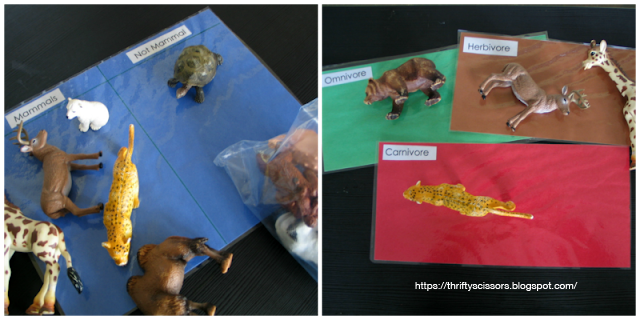
The students were really excited when at the end of the week they were
partnered off and given a big zip-lock bag of plastics animals, which
they then had to sort out the mammals from the rest of the differing
creatures found within our huge animal kingdom. They then had the choice
to play some of the various mammal and camouflage file folder games I
had on hand, or they could participate in a challenge sort: sorting
their group of mammals into groups of carnivores, herbivores, and
omnivores.
Students were then divided into small groups to collaborate in designing
and building a 3-D zoo with exhibits for four mammals of their
choosing. The groups had to then look at all the materials provided to
them (which consisted mostly of construction paper, markers, and various
types of blocks that were pulled from our classroom tinker station),
their mammals, and then consider what their exhibits would have to have
in order to reflect the mammals given habitats. As the children were
building, I interviewed each group--asking them questions to explain and
support their decisions.


The final component of our unit integrated information writing. Each
student picked a mammal of their choice to research and write on. During
this latter half of the unit, students learned that researchers read
informational texts to gain knowledge on their topic, the difference
between writing information and narratives, and the structure of
paragraph writing. Student's were given a plan to help support them in
their writing.


Author Study Unit on James Herriot
 Using the beloved children's books penned
by award-winning author, James Herriot, students will widen their
knowledge in the following: animal life science, England's geography,
watercolor as an art medium, music styles from the 1940's, measurment
practice, and more. The unit seeks to integrate social science, math,
language arts, science, art, and music together--over the course of
eight school days.
Using the beloved children's books penned
by award-winning author, James Herriot, students will widen their
knowledge in the following: animal life science, England's geography,
watercolor as an art medium, music styles from the 1940's, measurment
practice, and more. The unit seeks to integrate social science, math,
language arts, science, art, and music together--over the course of
eight school days.
Unit at a Glance
Grade Level: Second
Dictionary: Amphibian, Author, Life Cycle, Mammal, Reptiles, Setting, Veterinarian
Objectives:
- Practice respectful listening skills
- Describe the author and his professions
- Connect their own experiences to the reading materials
- Retell and narrate a story orally
- Create a storybook including proper story structure: beginning, middle, and end
- Describe the setting (including its geography) of the stories
- Explain how a country's geography related to how its people live
- Measure objects in inches and rounding off to the nearest inch
- Distinguish the difference between mammals, reptiles, and amphibians and their differing life cycles
Below is a brief outline of the learning activities of the unit.
- Day 1: Students are introduced to the author James Herriot through a short video clip and the teacher's SMARTBoard presentation. Student's listen to a read-aloud of Moses the Kitten, followed by constructing a 7 Flip-Flap Booklet of key terms and vocabulary words they'll come across throughout the unit.
- Day 2: Students listen to a read aloud of Bonny's Big Day and take a virtual field trip of where author James Herriot lived and worked.
- Day 3: Students design postcards writing and illustrating about James Herriot's home.
- Day 4: Student's listen to a read aloud of Blossom Comes Home and participate in the SMARTBoard activity: Animal Classification
- Day 5: Working with partner's students will practice measuring
- Day 6: Students listen to a read aloud of Only One Woof and begin their storybook projects
- Day 7: Students listen to a read aloud of Market Square Dog and continue to work on their storybook
- Day 8: Students share their storybooks with the class and assess themselves.
Standards: CCSS.ELA-Literacy.RL.2.7, CCSS.ELA-Literacy.W.2.8, CCSS.ELA-Literacy.SL.2.2,
CCSS.ELA-Literacy.L.2.4a, CCSS.ELA-Literacy.L.2.4e, CCSS.Math.Content.2.MD.A.1, CCSS.Math.Content.2.MD.A.4
Author Profile of James Herriot.
The First Grade Journal Pages
 |
| Welcome to My Teaching and Reflecting: One Year In 1rst Grade. You can also read my current posts at www.nataliegrimm.com |
"For as long as I can remember I wanted to be a teacher. Some childhoods are spent playing house or with Tonka trucks; mine was spent subjecting my little sister to playing school (naturally I made her the student). My passion and love for teaching children has grown ever since then.
It is my firm belief that the role of a teacher is one of a cultivator.
Looking back on my own education, the teachers that made the
most impact in my life were not the ones who tried to fit me into
some kind of mold, but rather spotted my strengths and passions
that were already present in me and sought out to grow them in me. I desire to continue that approach in my own
teaching and learning. Likewise,
the role of the student is to glean, personalize, & take
ownership in the learning environment they find themselves." Natalie Grimm
1rst Grade Journal Pages: Tour My First Grade Classroom
Recommended Reading:
1rst Grade Journal Pages: Tour My First Grade Classroom
- Integrating Block Play into Learning
- 30 Loose Parts to Use in Story Workshop
- Story Workshop in First Grade
- Tide Pool Inquiry
- Garden Maps
- Snapshots: Exploring Herbs with Descriptive Writing
- Nature Study (The How and Why)
- Botany on Our Plates!
- Entomology and Ladybug Study
- S.T.E.A.M. Basic Insect Hotels
- Exploring Architecture
- Snapshots: Going on a Noun Hunt!
- 5 Insect Inspired Morning Work Activities
- Steam Leprechaun Traps
- Microbe Study
- Provocation: Abraham Lincoln and Cabin Building
- Our Class Valentine's Day
- Our Nature Table and Center
- Tree Inquiry
- Study on Mammals and Camouflage
- Author Study Unit: James Herriot
- PD Reads on Nature Based and Eco-Learning
- 7 Books on Tide Pools for Children
- 7 Gardening Books for Kids
- 10 Must Have Insect Books for Your Classroom
- 6 Books to Celebrate Valentines Day
- Rotating Library for Winter Book Themes
- Favored Children's Books of 2015
- 25 Days of Christmas Books for Children (and Adults Too!)
- Rotating Library Selections for Thanksgiving in 2015
- 2014 Favorite Books for The Classroom
- Halloween Book Bin for 2018
Recommended Reading:
Sunday, August 19, 2018
Lessons: The Lorax
 |
| Unless someone like you care a whole lot, nothing is ever going to get better. It's not. ~The Lorax |
Hands down The Lorax was my favorite Dr. Suess book as a child. I
always loved it's message of taking care and stewarding the environment
wisely--a message I still appreciate as an adult.
Grade(s): Kindergarten, First, Second
Big Picture(s): Preservation, Sustainability, Earth-Friendly
Dictionary: Caretaker/Steward, Environment, Green, Habitat, Nature, Wildlife, Tree, Pollution, Park
In Class: This
lesson began with a shared reading of the Dr. Seuss classic, The Lorax,
followed up with How to Help the Earth by Tish Rabe. As a whole group,
the students fill out a graphic organizer on the SMARTBoard addressing
either of the two: What practical (big or little) things they could do
to take care of their environment (if the group of students already had a
basic understanding of sustainability), or list the different causes
and effects that were present in the story as a way to scaffold into
further discussions and learning on sustainability. Throughout this time
various vocabulary words would be introduced and discussed as well.
During the next portion of the lesson, students were released to individually write reflectively on what they thought about the reading, class discussion, and how the two connect to them each. As students finished they're writing, they gathered an assortment of art materials provided to them to make their own visual depiction of a Truffula forest around their writing which was mounted on construction paper.
During the next portion of the lesson, students were released to individually write reflectively on what they thought about the reading, class discussion, and how the two connect to them each. As students finished they're writing, they gathered an assortment of art materials provided to them to make their own visual depiction of a Truffula forest around their writing which was mounted on construction paper.
Further Resources:
- How to Help the Earth by Tish Rabe
- View the Original 1972 short film The Lorax
- Lorax Quest Game on Suessville
Lessons by Natalie Grimm © 2014
Lessons: Pumpkin Soup
 |
| "Deep in the woods in an old white cabin, three friends make their pumpkin soup..." ~Helen Cooper |
This sweet tradebook, Pumpkin Soup,
tells the tale of how three friends, Duck, Cat, and Squirrel, learn to
work together to make their favorite fall dinner. In the elementary
grades, the book lends itself well to teaching process writing and
verbs. Likewise, preschoolers can be introduced to the same topics of
teamwork and friendship that are explored through the text through
various play activities. Young children and adults will both love the
illustrations and this simple story to celebrate the coming of autumn
together.
Ages and Grades: Preschool--First Grade
The Big Picture: Autumn, Teamwork, Friendship
Dictionary: Process, Sequence, Step(s), Pumpkin, Scoff, Trudge, Mutter, Wail
In The Classroom...
- Read aloud Helen Cooper's storybook Pumpkin Soup
- Brainstorm a list using a graphic organizer of all the different foods we eat with pumpkins
- Have students sort out the sequence of steps to making pumpkin soup based on what they heard in the read aloud
- Process Writing Activity (1st Grade): Have students pick one of the pumpkin foods brainstormed, write the sequence (series of steps) of how that food is made, then add illustrations
- Have students identify the verbs the author used throughout the book (e.g. scoff, mutter, trudge) through various vocabulary strategies and activities
- For preschoolers discuss each character's job and how they needed to work as a team to make their pumpkin soup using this free job card printable from Learning Parade
In The Home...
- For little ones set up this sensory table inspired by the book from Frogs, Snails, and Puppy Dog Tails.
- Read the further tales of Squirrel, Cat, Duck, and their favorite soup in the companion books Delicious! and A Pipkin of Pepper.
- Make a pipping hot pot of pumpkin soup together as a team at home with this recipe: Roasted Pumpkin Soup
Further Resources...
- Related Lesson: It's Pumpkin Time!
- YouTube Video Read Aloud
- Teacher's Notes for The Pumpkin Soup Trilogy (along with discussion questions)
*CCSS: ELA-Literacy.W.1.5
Lessons by Natalie Grimm © 2014
Monday, July 30, 2018
PD Reads on Nature Based and Eco-Learning

"Normally I share on the children's books that line the shelves in my
classroom, however, I wanted to share a few of the books that have lined
my own shelf these past couple of months. This past winter and spring I
wanted the focus of my professional development (pd) reading to be on
eco-learning (naturalist learning or nature based learning). Here's a
little snapshot of each book that I'd recommend to other educators who
have the same passion and interest" N. Grimm
The Last Child in the Woods: Saving Our Children from Nature Deficit Disorder by Richard Louv. Children
spend less time outdoors in nature more than ever before: Richard Louv
explores the causes that have lead to this nature deficit culture
children live in currently through a great deal of research that he
shares in this award winning book--a must-have for any educator's
bookshelf who wants to cultivate and implement eco-learning in their
classroom and school.
The Nature Connection by Clare Walker Leslie.
If a teacher were ever in need of a resource packed with nature based
lessons and activities, then this ought to be the book to pick up. From
garden planning, to building a nature table, to exploring dirt, The Nature Connection is sure to lay out a wide variety of ideas for the whole year--every season--to choose from to take into your classroom.
Botany on Your Plate: Investigating the Plants We Eat by Katharine D. Barrett. This
book is a great curriculum resource for bringing gardening into your
classroom. We did a lesson out of it this spring that the kids loved on
taste-testing various garden vegetables and collecting data on them.
The Sense of Wonder by Rachel Carson.
Carson weaves together a beautiful narrative, parried with lovely
photographs, of her days exploring outdoors with her young nephew and on
the importance of helping children keep their "inborn sense of wonder"
through nature.
Cabinet of Curiosities: Collecting and Understanding the Wonders of the Natural World by Gordon Grice.
This book shares on the art of collecting the nature treasures that
peek our curiosity or serve as a memento of a memory made--the art of
bringing natural history into your life. I still have nature finds from
my own childhood in a small wooden cabinet on display that remind me of
days spent walking sandy shores or hiking through the Colorado
mountains. The book has a small section on building one's own cabinet of
curiosities and caring for your specimens, with the majority of the
book focused on classifying specimens with the Linneaus system. This
would be a great reference book to have in a class library for older
elementary students to practice classifying specimens and building their
own collection.
And a couple of articles from across the web that resonated with me
while I've been learning more on integrating eco-learning into the
classroom...
7 Books on Tide Pools for Children
 |
| Seven new titles have rotated into our class library for our last summer inquiry on tide pools. Check them out! |
Ocean Soup by Stephan R. Swinburne. Student learn about different tide pool creatures through rap and rhyme.
Is This a House for Hermit Crab? by Megan Mcdonald. Readers follow a little hermit crab along the sandy shores as he searches for a new home.
A Swim through the Sea by Kristan Joy Pratt. An
alphabet book about creatures from A-to-Z of both tide pools and the
ocean deeps. There's specific facts per each animal given as well for
older students to expand their knowledge further.
In One Tidepool by Anthony D. Fredricks.
Follow a young curly-haired girl to the beach as she explores the
creatures that make their home in tide pools through a clever rhyming
narrative.
Barnacle is Bored by Jonathan Fenske.
Underneath the pier lives a barnacle who's grown bored with the
predictable rise and fall of the tide life he lives. One day a bright,
colorful fish swims by and barnacle learns a lesson that 'excitement'
isn't sometimes all we imagine it to be.
Shell by Alex Arthur. From DK Eyewitness, all the information a young scientist could need about shells with corresponding photographs.
Flotsam by David Wiesner. A
wordless book that tell the story of a young boy who is treasuring
hunting along the beach--and treasure he does indeed find--through vivid
illustrations.
7 Gardening Books for Kids
 |
| Check out these 7 beautiful stories on gardens and all the wonders they can hold for you and your young readers! |
Grandpa Green by Jane Smith. A young boy shares the story of his grandfathers life through the topiary trees he's made in the garden.
The Imaginary Garden by Andrew Larsen.
Most gardens grow with soil, sunlight, and water, but Theo and her
grandpa's garden grows with paint and their imagination. A lovely story
of how a grandpa shows his granddaughter how they too can have a garden
even when they live in an apartment lacking in dirt.
In the Garden with Dr. Carver by Susan Grigsby. A small community of rural children learn first-hand from Dr. George
Washington Carver how to grow their own food having struggled with
planting and farming due to depleated soil from cotton farming.
Up in the Garden and Down in the Dirt by Kate Messner. Young readers discover the many treasures to be found in the garden beds and beneath the dirt from which their roots grow.
Jack's Garden by Henry Cole. Told in familiar verse to This is the House that Jack Built, Children read about the steps to building a garden all the way through seeing blooms pop up from the ground in vibrant color.
Linnea's Windowsill Garden by Cristina Bjork. Explore Linnea's world of gardening through various activities, stories, and how-to's projects. From organizing a pea Olympic game to scrumptious recipes, this book is bound to be a favored narrative resource book for young green thumbs.
Tops and Bottoms by Janet Stevens. A lazy, sleepy bear gets tricked by a clever hare in this retelling of an American slave story. Who will come away with the most food from the harvest?