Monday, April 29, 2013
Draw An Animal Hospital
Doodling an animal hospital will be tricky if you don't know how to draw particular medical equipment. I've included, at the bottom of this post, some basic visual depictions of those things found in a human hospital for this drawing project. The Betty Boop video above portrays animals with human characteristics. This idea is called anthropomorphism.
According to Wikipedia, "Anthropomorphism or personification is any attribution of human characteristics (or characteristics assumed to belong only to humans) to other animals, non-living things, phenomena, material states, objects or abstract concepts, such as organizations, governments, spirits or deities. The term was coined in the mid 1700s. Examples include animals and plants and forces of nature such as winds, rain or the sun depicted as creatures with human motivations, and/or the abilities to reason and converse. The term derives from the combination of the Greek ἄνθρωπος (ánthrōpos), "human" and μορφή (morphē), "shape" or "form"
This doodle exercise should depict animals as patients inside of a hospital of sorts. You can also include humans or animals as the doctors and nurses.
![]() |
| Think about the uniforms your doctors and nurses will need to be wearing. |
![]() |
| Things seen inside of a hospital. |
A Treehouse Collage
Burn was born in Portland, Oregon to explorer, mountaineer and United States Forest Service worker Lage Wernstedt and his wife Adele. The family resided on Guemes Island near Anacortes. After being interviewed by writer June Burn for the Bellingham Herald,
Mr. Wernstedt and his family became friends of the Burns and built a
summer cabin near theirs on Waldron, a small island without ferry
service.
![]() |
| Doris Burn at her home in Guemes Island, WA |
Burn attended the University of Oregon and the University of Hawaii, and graduated from the University of Washington. She married South (Bob) Burn after World War II and the couple made their home on Waldron Island.
She had four children, whom she taught for one year on Guemes Island's
one-room schoolhouse. Burn separated from her husband, but they remained
lifelong friends and neighbors.
Burn worked on her meticulous illustrations in the evenings, in "a
small cabin where she spends the day at work after chopping enough wood
to keep the fire going through the day, hauling two buckets of water
from the pump for washing brushes and pens and brewing 'a perpetual pot
of tea'".
Waldron Island was without electricity, telephone service, running
water or merchants. All of her goods and supplies were brought by boat
from the mainland.
In 1956 Burn took a portfolio of illustrations to publishers in New
York and was encouraged to continue working. Her children remember her
working late nights by lantern-light with the fireplace burning down to
embers.
Doe's oldest son, Mark Nathaniel Burn, was the inspiration for her first book, Andrew Henry's Meadow (1965),
the story of a boy who, ignored by his family, builds a retreat for
himself in a nearby meadow. He is soon joined by other children for whom
he also builds houses, tailored to their interests and hobbies. Andrew Henry's Meadow won the Washington Governor's Art Award and was a Weekly Reader
book club selection. It was reissued in a 40th anniversary edition by
San Juan Publishing in 2005. She went on to write two other works, The Summerfolk and The Tale of Lazy Lizard Canyon, and illustrated eight others.
More Related Content:
- Tree house art projects help foster kids
- HEArt at Chavez - Tree house havens
- Tiny Tree House by Ricza Ricky
- Tree House Project: Tree Houses capture the imagination of the child in all of us!
| A similar watercolor assignment exploring the treehouse theme. |
Crayon Resist Parrots
A crayon resist, parrot project is perfect for teaching first and second graders how to work with their crayons and watercolor paints. Just have them color first with heavy layers of bright crayon and then wash over these with colorful washes of watercolor paints. The effects are stunning!
More Related Content:
Your students can view parrots and exotic birds interacting online even if they can't make a field trip to the zoo.
Friday, April 26, 2013
The School Lunch
The school lunch is the problem. It is a subject over which mothers are waxing warm in the mothers' clubs, over which doctors are theorizing, over which teachers are fretting. It is the question of the hour in hygienic circles; and all the while the innocent little tummy accepts what is offered it, never realizing that the school lunch is disturbing grown-up heads.
What shall young America carry in the school lunch basket?
In the first place, doctors have firmly agreed that it shall not carry the lunch basket at all if it is a possible thing to reach home in time for a warm lunch. The cold lunch is an indigestible affair at best compared with a bowl of hot soup or a plate of steaming stew or rare steak. But what can't be made of a bad thing is worth while.
There seems to be a vast difference between the cold lunch that is and the cold lunch that ought to be.
Pickles and ice cream make a popular combination. You can get 5 cents' worth of pickles, chemically vinegared. You can get 5 cents' worth of ice cream at the little store next door, where they sell candy and prize packages and chewing gum and striped lead pencils. You can buy all of these if your money holds out.
Miss Casey, principal of the Lafayette Primary School, says that she has seen this sort of thing happen many a time, sometimes in her own school and more often she has known of it in other schools when the bakeries and the candy shops were nearer. Children are started off to school without a lunch. It is too far to go home. So paper or mamma hands out a little money and says, "Buy your lunch."
![]() |
| Twelve o'clock has come at Redding Primary, by Stanford |
Maybe there is a beautiful pink cake in the window with little shells of frosting all around the edge and jelly in the cracks. Maybe the loaf costs two bits and maybe the luncher has just that amount. It takes less then two minutes to own the cake and not much longer to shove it down. Here endeth the lunch and likewise here beginneth the dyspepsia.
Or maybe it is a pie that tempts, a lemon pie, brave with billows of meringue. Heaven help young American when this is the sum total of its lunch.
Miss Casey says that she has seen a little tot that possessed just one nickel spend it for candy and make an entire meal on the purchase. It is like the things that little girls and boys wish for in day dreams, but it is not hygienic.
Mrs. Walker, principal of the Marshall Primary School, says: "I wish we could see the school lunch basket containing bread and jelly and good, sensible sandwiches made of lamb, roast beef or corned beef. It ought to have a bottle of milk instead of coffee. Plenty of fruit should be in it. And no cakes--none whatever. This matter of the school lunch is worth thinking about."
All the principals and the doctors seem to say the same thing about coffee and milk. Off with the former, on with the latter. Although Miss Deane of the Redding Primary finds that her flock is inclined to the milk tipple for the most part. "On the whole they seem to bring sensible things," she says. "Sandwiches, milk and fruit are the chief articles."
Mrs. M. M. Murphy of the Irving Scott Primary School says: "It isn't so much what is put up for the children as how it is put up that I want to find fault with. For instance, they have meat sandwiches, which sounds well enough, but some of them are enough to frighten any appetite just to look at them. Great chunks of bread on each side of an ungainly chunk of meat. Ugh! I don't see how the poor little things eat them. I know I couldn't touch a crumb of them."
Dr. Mary Page Campbell was asked to discuss the ideal school lunch from the physician's standpoint and this is what she said:
"It's hard to talk about the ideal basket lunch when there is nothing ideal about such a meal. Every child should go home to lunch. This is the sort of thing, however, that is a waste of breath to talk about and I am practical enough to realize that. Many children live so far from home that they cannot possibly get home, eat and return in the time allowed. Or if they do they will have to bolt the meal so rapidly that it is worse than a cold lunch.
"In Boston the problem has been solved, or partially so, by the little lunch stations near the school buildings where soup is sold to the children for so small a sum that it is possible to all. It is good, wholesome, steaming hot soup that does the little bodies good from top to toe. This furnishes the heat which nature craves in a meal, and cold adjuncts can be carried in a basket.
"Some day I hope to see a kettle of good soup raising a hearty steam within sight of every San Francisco school. But until that comes about we must face the problem as it stands. Hundreds of our children carry a cold lunch to school.
"What shall the basket contain?
"In the first place, there should be something to drink with the meal, and this something should be milk. A bottle of fresh milk can easily be put up in the morning. It is far less trouble than coffee because there is no cooking about it. Let the bottle of cold coffee be tabooed. It is absolutely unwholesome. If the child has acquired a liking for it, then the taste is unwholesome and should be overcome.
"Let the basis of the lunch be bread and butter and sandwiches. Cut the bread thin and spread it thinly. There is a great deal in putting up a lunch daintily. Perhaps it does seem as if children are willing to eat anything, they are so much more the gourmand and less the gourmet than their parents. But nevertheless they are affected by the way their food is prepared. Their appetite will be keener and the benefit from the food greater if it is tempting instead of mussy.
"The sandwiches may be made of good, tender meat; of cheese, or of nuts. Cheese and nuts contain an immense amount of condensed nourishment. If the little folks care for it there is not the least harm in letting them have a pickle, but it must be a good pickle; not one of the ordinary grocery store kind, put up in some kind of chemical vinegar, but one that you know is to be seasoned with pure spices and pure vinegar.
"Now for the lunch basket cup. This cup (or, better yet a jelly glass with a tightly fitted cover) may be made the charm of the basket, for it may reveal a delightful surprise every day to tempt the young appetite. Don't say that it is too much bother to think up new dainties. Set your wits to work. The result will pay.
"Different forms of sage, rice and tapioca can be put into the little glass jar. These may be the simplest and wholesomest puddings, slightly sweetened. They are full of nourishment and palatable as well.
"Macaroni is another idea for your cup. It may be cooked with either tomatoes or cheese.
A little meat pie, with a light, flaky crust, is delicious and wholesome, too. When the youngster carries this he won't need meat sandwiches. Bread and butter is enough. Try to make the parts of the lunch harmonize in this way, just as much as if you were preparing a menu for guests.
"Mayonnaise is an article that I sometimes hear people speaking of as too rich for children. It is nothing of the kind. What could be more valuable than eggs and olive oil? Don't be so afraid of foods of this kind-- the children are not inclined to eat any great amount of them if left to their own devices. Mayonnaise is good on many kinds of sandwiches, but it is better to let the child carry it in a little cup and spread it when noon arrives, as it soaks into the bread if it stands long, becoming unpalatable.
"Children need sweets for fuel. Remember that every morning when you pack the basket. The sweets should be furnished in very moderate quantities, but they should not be forgotten or condemned. A slice of light sponge cake or a few simple cookies are best. With the cake should be plenty of fruit, and so you have a good dessert.
Bear in mind the value of a varied bill of fare. This involves much thought, but it is entirely possible. A cold lunch is at best, less cheerful than a meal at a table. Do your best to brighten the basket by frequent novelties. And wrap each article separately so that flavors won't mix and make an unappetizing mess of the whole." San Francisco Call, April 19, 1903
"Mayonnaise is an article that I sometimes hear people speaking of as too rich for children. It is nothing of the kind. What could be more valuable than eggs and olive oil? Don't be so afraid of foods of this kind-- the children are not inclined to eat any great amount of them if left to their own devices. Mayonnaise is good on many kinds of sandwiches, but it is better to let the child carry it in a little cup and spread it when noon arrives, as it soaks into the bread if it stands long, becoming unpalatable.
"Children need sweets for fuel. Remember that every morning when you pack the basket. The sweets should be furnished in very moderate quantities, but they should not be forgotten or condemned. A slice of light sponge cake or a few simple cookies are best. With the cake should be plenty of fruit, and so you have a good dessert.
Bear in mind the value of a varied bill of fare. This involves much thought, but it is entirely possible. A cold lunch is at best, less cheerful than a meal at a table. Do your best to brighten the basket by frequent novelties. And wrap each article separately so that flavors won't mix and make an unappetizing mess of the whole." San Francisco Call, April 19, 1903
Thursday, April 25, 2013
Historic Paper Buildings at Greenfield Village
| I found these paper scale model buildings at a flee market. |
The Henry Ford (also known as the Henry Ford Museum and Greenfield Village, and more formally as the Edison Institute) is a large indoor and outdoor history museum complex and a National Historic Landmark in the Metro Detroit suburb of Dearborn, Michigan, USA. Named for its founder, the noted automobile industrialist Henry Ford, and based on his desire to preserve items of historical significance and portray the Industrial Revolution, the property houses a vast array of famous homes, machinery, exhibits, and Americana. The collection contains many rare exhibits including John F. Kennedy's presidential limousine, Abraham Lincoln's chair from Ford's Theatre, Thomas Edison's laboratory, the Wright Brothers' bicycle shop, and the Rosa Parks bus.
Henry Ford said of his museum:
"I am collecting the history of our people as written into things their hands made and used.... When we are through, we shall have reproduced American life as lived, and that, I think, is the best way of preserving at least a part of our history and tradition..."
The Henry Ford is the largest indoor-outdoor museum complex in
America. Patrons enter at the gate, passing by the Josephine Ford
Memorial Fountain and Benson Ford Research Center. Nearly one hundred
historical buildings were moved to the property from their original
locations and arranged in a "village" setting. The museum's intent is to
show how Americans
lived and worked since the founding of the country. The Village
includes buildings from the 17th century to the present, many of which
are staffed by costumed interpreters who conduct period tasks like farming, sewing and cooking. A collection of craft
buildings such as pottery, glass-blowing, and tin shops provide
demonstrations while producing materials used in the Village and for
sale. Greenfield Village has 240 acres (970,000 m²) of land of which
only 90 acres (360,000 m²) are used for the attraction, the rest being
forest, river and extra pasture for the sheep and horses.
- Noah Webster's Connecticut home
- the Wright brothers' bicycle shop and home from Dayton, Ohio
- A replica of Thomas Edison's Menlo Park laboratory complex from New Jersey
- Henry Ford's birthplace
- Henry Ford's prototype garage where he built the Ford Quadricycle
- Harvey Firestone family farm from Columbiana, Ohio
- the Logan County, Illinois courthouse where Abraham Lincoln practiced law
- William Holmes McGuffey's birthplace
- Luther Burbank's office
Paint The Wheels on Your Bus
These school buses were painted by my kindergarten students during my student teaching. The project actually included two parts. First the children were taught to draw "balloon people" before cutting them out to paste onto their school bus paintings. I'll include a link to that exercise when I have posted here. For now, enjoy all of the sweet little orange school bus paintings.
"Sam's Snack" by David Pelham
Devid Pelham designs fun pop-up books for children.
This little lunch box by Pelham is a cherished artifact from my eldest child's book collection.
I've also included below another book by David Pelham called, "The Senstional SamBurger"
More Related Content:
More in: http://librospopup.blogspot.com/
Book in the Form of a Hamburger
The Sensational SamBurger
Incredible and unusual POP-UP Book in the Form of a Hamburger
By David Pelham
Dutton Children's books 1995
Printed and hand-assembled in Colombia
Increíble e inusual libro pop-up en forma de hamburguesa
Book in the Form of a Hamburger
The Sensational SamBurger
Incredible and unusual POP-UP Book in the Form of a Hamburger
By David Pelham
Dutton Children's books 1995
Printed and hand-assembled in Colombia
Increíble e inusual libro pop-up en forma de hamburguesa
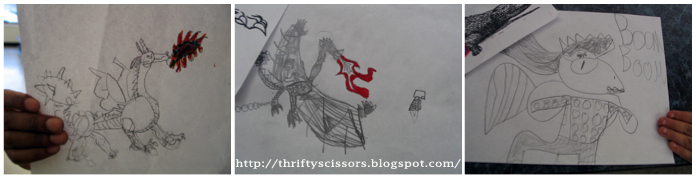
Drawing Dragons
The boys at my work place love to draw mythical creatures. I've included a video here for them to watch at home if they should dare to keep pursuing these animated beasts. Below are some of their recent drawings.
Sandy's Circus
![]() |
| I purchased this book, "Sandy's Circus" as an introductory artifact for future classroom art projects about circus life. It is the story of Alexander Calder's early life. The book is authored by Tanya Lee Stone and is illustrated by Boris Kulikov. |
Alexander Calder (July 22, 1898 – November 11, 1976) was an American sculptor best known as the originator of the mobile, a type of kinetic sculpture
the delicately balanced or suspended components of which move in
response to motor power or air currents; by contrast, Calder’s
stationary sculptures are called stabiles. He also produced numerous
wire figures, notably for a vast miniature circus.
Alexander "Sandy" Calder was born in Lawnton, Pennsylvania on July 22, 1898. His father, Stirling Calder, was a well-known sculptor who created many public installations, a majority of them in nearby Philadelphia.
Sandy Calder's grandfather, sculptor Alexander Milne Calder, was born in Scotland, immigrated to Philadelphia in 1868, and is best known for the colossal statue of William Penn on top of Philadelphia City Hall's tower. Sandy Calder's mother, Nanette (née Lederer), was a professional portrait artist, who had studied at the Académie Julian and the Sorbonne in Paris from around 1888 until 1893. She moved to Philadelphia where she met Stirling Calder while studying at the Pennsylvania Academy of the Fine Arts.
Sandy Calder's parents married on February 22, 1895; his sister, Mrs.
Margaret Calder Hayes, is considered instrumental in the development of
the UC Berkeley Art Museum.
In 1902, Sandy Calder completed his earliest sculpture, a clay elephant. Three years later, Stirling Calder contracted tuberculosis, and Calder's parents moved to a ranch in Oracle, Arizona, leaving the children in the care of family friends for a year.
The children were reunited with their parents in late March 1906 and
stayed at the ranch in Arizona until fall of the same year.
After Arizona, the Calder family moved to Pasadena, California.
The windowed cellar of the family home became Calder's first studio and
he received his first set of tools. He used scraps of copper wire that
he found in the streets to make jewelry and beads for his sister's
dolls. On January 1, 1907, Nanette Calder took her son to the Tournament of Roses Parade
in Pasadena, where he observed a four-horse-chariot race. This style of
event later became the finale of Calder's wire circus shows.
In 1909, when Calder was in the fourth grade, he sculpted a dog and a
duck out of sheet brass as Christmas gifts for his parents. The
sculptures were three dimensional and the duck was kinetic because it
rocked when gently tapped.
In 1910, the Calder family moved back to Philadelphia, where Sandy briefly attended Germantown Academy, then moved to Croton-on-Hudson, New York. In Croton, during his early high school years, Calder was befriended by painter Everett Shinn
with whom he built a gravity powered system of mechanical trains.
Calder described it, "We ran the train on wooden rails held by spikes; a
chunk of iron racing down the incline speeded the cars. We even lit up some cars with candle lights". After Croton, the Calders moved to Spuyten Duyvil to be closer to the Tenth Street Studio Building
in New York City, where Stirling Calder rented a studio. While living
in Spuyten Duyvil, Sandy Calder attended high school in nearby Yonkers. In 1912, Stirling Calder was appointed acting chief of the Department of Sculpture of the Panama–Pacific International Exposition in San Francisco, California.
He began work on sculptures for the exposition that was held in 1915.
During Sandy Calder's high school years (1912–1915), the family moved
back and forth between New York and California. In each new location,
Calder's parents reserved cellar space as a studio for their son. Toward
the end of this period, Calder stayed with friends in California while
his parents moved back to New York, so that he could graduate from Lowell High School in San Francisco. Calder graduated with the class of 1915.
In 1926, at the suggestion of a Serbian toy merchant in Paris, Calder began to make toys. At the urging of fellow sculptor Jose de Creeft, he submitted them to the Salon des Humoristes. Later that fall, Calder began to create his Cirque Calder,
a miniature circus fashioned from wire, string, rubber, cloth, and
other found objects. Designed to fit into suitcases (it eventually grew
to fill five), the circus was portable, and allowed Calder to hold
performances on both sides of the Atlantic. He gave improvised shows,
recreating the performance of a real circus. Soon, his Cirque Calder (usually on view at the Whitney Museum of American Art at present) became popular with the Parisian avant-garde.
In 1927, Calder returned to the United States. He designed several
kinetic wooden push and pull toys for children, which were mass-produced
by the Gould Manufacturing Company, in Oshkosh, Wisconsin. His originals, as well as playable replicas, are on display in the Berkshire Museum in Pittsfield, Massachusetts. Throughout the 1930s, Calder continued to give Cirque Calder performances, but he also worked with choreographer Martha Graham, designing stage sets for her ballets and created a moving stage construction to accompany Eric Satie's Socrate in 1936.
"Kids made this incredible art after hearing author Tanya Lee Stone read
her picture book about Alexander Calder's circus made of found
materials. The artist's Cirque de Calder is on exhibit at the Whitney
Museum. Stone's picture book about Calder and his circus is called
Sandy's Circus: A Story About Alexander Calder. Illustrations in the
book by Boris Kulikov. Published by Viking Children's Books. (c) 2008" by goldendoodlerule
More Related Content:
Wednesday, April 24, 2013
Learning to Draw Birds
In drawing, all objects should be studied under the general heads of:
This order, however, is not intended to be arbitrary. If the object is something that can be leisurely studied, like a leaf, or a flower, then an order similar to this should be followed: (1) The object; (2) the copy; (3) memory and imagination.
The principle of the construction of all birds is, in general, the same ; the difference is in the proportion and minor details. By learning the proportions and general features from pictures and drawings, much time will be saved, and the work made more effective and less discouraging than if the study is attempted from the living bird alone. This does not mean to blindly copy the drawings of others, but to study them intelligently, to study them with a view of learning their form and proportion and the general principle of bird construction. To learn such points the following: The size of the head as compared with the body; the movement of the tail, head and body; how the feet are placed under the body to give perfect balance; how the wings rest on the body, and their movements when flying. All of these can be studied from drawings coupled with observation, and then verified on the real bird, much better than from the real bird alone. It is doubtful if one untrained in drawing can make very much headway learning to draw from such a restless bit of animation as a live bird, with its multiplicity of markings and numberless details. One must have both knowledge of the bird and skill in drawing to do this.
- The Copy, or Imitation.
- The Object, or Observation.
- The Memory and Imagination.
This order, however, is not intended to be arbitrary. If the object is something that can be leisurely studied, like a leaf, or a flower, then an order similar to this should be followed: (1) The object; (2) the copy; (3) memory and imagination.
The principle of the construction of all birds is, in general, the same ; the difference is in the proportion and minor details. By learning the proportions and general features from pictures and drawings, much time will be saved, and the work made more effective and less discouraging than if the study is attempted from the living bird alone. This does not mean to blindly copy the drawings of others, but to study them intelligently, to study them with a view of learning their form and proportion and the general principle of bird construction. To learn such points the following: The size of the head as compared with the body; the movement of the tail, head and body; how the feet are placed under the body to give perfect balance; how the wings rest on the body, and their movements when flying. All of these can be studied from drawings coupled with observation, and then verified on the real bird, much better than from the real bird alone. It is doubtful if one untrained in drawing can make very much headway learning to draw from such a restless bit of animation as a live bird, with its multiplicity of markings and numberless details. One must have both knowledge of the bird and skill in drawing to do this.
- Balance
- Character
- Divisions of Study
- General Directions
- Drill Exercises
![]() |
| Here is a simple sketch of how to draw a bird. Memorize how to draw birds from these instructions and soon little birds will be dancing across your notebook in no time. |
Subscribe to:
Comments (Atom)