Friday, August 23, 2024

Study The Bee: Lesson 1

Africanized bees on hive.
       The  bee  is  a  rather  stoutly  built  insect,  belonging  to  the  Apiarian  family  of the  Aculeate  or  stinging  Hymenoptera.  Owing  to  the  value  man  places  on its  productions,  honey  and  wax,  it  seems  to  have  been  early  domesticated. It  is  a  blackish-brown  insect  covered  generally  with  grayish-brown  hairs,  the abdomen  showing  bands  of  a  somewhat  paler  color

Required for Observation In The Classroom: Picture  of  bees  and  the  bee-hive.  Diagram showing  bees,  much  enlarged.  Specimens  of  bees  and  honey-comb.

Method of Student Observation:

  • Compare  with  other  insects,  and point  out  that  this  division  of  the body  into  three  parts is  characteristic of  insects.
  • Explain  the  nature  of  the  compound  eye  of  an  insect.
  • Compare  with  the  corresponding  part  of  the  body  of  the  butterfly or  other  insect.
  • Explain  the  nature  of  the  sting with  the  aid  of  a  drawing. 

How to Grade Study Notes For Student Journals: Every student will need a journal to write in weekly for this online nature study series. Teacher will assign the weekly content in advance.

  • Make sure the facts are: written in complete sentences, the first word of each sentence capitalized, and a period should be included at the end of each sentence.
  • Spell check your vocabulary and write the words correctly.
  • Dress up your journal entries with student clip art, drawings of your own in color or in black and white.
  • Student may also include photographs of their own taking for extra credit.

Look for the following facts about bee anatomy inside of student journals. Assign a point value to the quality of the content.

  • Body - In  three  parts -  head, thorax,  and  abdomen.  Covered  with hair.
  • Head - Provided  with  two  large, compound  eyes ;  a  sucking-tube;  and a  pair  of  jaws.
  • Thorax - Composed  of  three ring-like  segments.  Each  segment bears  a  pair  of  legs,  and  the  second and  third  a  pair  of  wings  also.
  • Legs - Composed  of  several  parts jointed  together.  Each  foot  terminates  in  a  pair  of  hooked  claws.
  • Wings - Each  composed  of  a very  thin  and  transparent  membrane, supported  by  a  few  rays.  The  wings are  placed  one  beneath  the  other  on  the  back, when  not  in  use.  When spread  for  flying,  the  two  wings  of each  side  are  locked  together  at  their edges.
  • Abdomen - Composed  of  several ring-like  segments.  The  last  segment provided  with  a  sting.  (The drone  bees  have  no  sting.)
  • Sting - A  very  slender  tube terminating  in  a  sharp  point.  The base  of  the  sting  communicates  with a  gland  which  secretes  an  irritant poison.  When  the  sting  is  used, some  of  the  poison  passes  through  it into  the  puncture  made.
 
teacher example of bee life-cycle
       Students can make this "life cycle of a queen bee'' using a black marker, three paper plates, yellow paper, white school glue, a stapler, and a brad.
       Look below to see how to cut the first paper plate into queen bee parts. I used glue to assemble my teacher's sample of this graphic craft, but students will find it is much simpler to use a staple gun to assemble the decorative pieces on the top plate.
       Cut the first plate into equal fourths. Use two of these cuts to shape the queen bee's wings just as seen in the photo. Then cut a heart shaped head from the third section and a daisy crown to staple behind the head before attaching the entire head section to the top plate between the two wings.
       Cut and paste yellow to cover the body and head as seen in the photo. Students could paint these areas alternatively instead.
       Cut away a pie shaped window to reveal the hand drawn ''life cycle of a bee'' on the plate attached beneath the body at it's center with a brad.
       Add a few extra trims by cutting antenna from black paper to insert between the queen bee's head and daisy crown. Give the queen rosy cheeks too if you'd prefer!

How to cut and assemble parts of queen bee from paper plate.
 
More Bee Arts/Crafts for Students:

Free Student Clip Art: Clip art may be printed from a home computer, a classroom computer or from a computer at a library and/or a local printing service provider. This may be done from multiple locations as needed because our education blog is online and available to the general public.

Body. Of  three  parts.  Covered  with  hair.
Head. Compound  eyes,  sucking-tube,  and  a  pair  of  jaws.
Thorax. Bears  the  legs  and  wings.
Legs. Composed  of  several  jointed  parts.
Wings. Formed  of  a  thin  membrane,  with  a  few  rays.
Abdomen. Formed  of  several  ring-like  segments.
Sting. A  fine  tube,  with  a  poison-gland  at  its  base.

Thursday, August 22, 2024

Study The Mole

Common European Mole
       The  Common  Mole  (Talpa  europcea)  belongs  to  the  order  of  the  Insectivora,  an  order  of  animals  small  in  size,  and  m  stly  of  more  or  less  purely nocturnal  habits.  Closely  akin  to  it  are  the  hedgehogs  and  shrews,  which belong  to  th.  same  order.  The  insectivora  are  in  many  ways  closely  related to  the  bats.  In  general  appearance  some  of  the  members  of  the  order  closely resemble  the  gnawing  animals  or  rodents.  Shrews  in  particular  are  very  like mice,  and  are  usually,  indeed,  spoken  of  as  shrew-mice.  It  was  its  close resemblance  to  the  shrew  that  led  people  in  England  in  olden  times  to  call  the bat  a  flitter-mouse,  a  name  by  which  it  is  still  spoken  of  in  some  parts  of  the country.
       The  mole  is  clearly  distinguished  from  other  insectivores  by  the  perfect adaptation  of  its  form  to  a  subterranean  life.  It  inhabits  the  northern  hemisphere  both  in  the  old  and  in  the  new  world,  not  a  single  species  of  mole being  found  south  of  the  equator.  Its  dwelling  or  fortress  is  usually  formed under  a  hillock,  and  in  its  construction  the  mole  displays  considerable ingenuity  and  engineering  skill.
       Moles  are  exceedingly  voracious  animals,  and  though  living  chiefly  on  worms and  grubs, will,  if  they  get  the  opportunity,  kill  and  devour  mice,  small  birds, lizards,  and  frogs.  The  mole,  in  such  cases,  hurls  itself  on  its  victim  as  if frenzied  with  rage,  and  grasps  it  with  the  ferocity  and  tenacity  of  a  bull-dog. The  mole  is  also  a  very  thirsty  creature,  and  usually  makes  a  run  to  the nearest  ditch  or  pond,  or  supplies  itself  with  water  by  sinking  a perpendicular shaft.
       The  mole,  though  he  sometimes  condescends  to  make  use  of  a  common passage,  is  far  from  being  a  sociable  animal,  and  has  always  his  own  nest  or fortress,  where  in  the  spring  he  brings  his  bride.  He  seems,  however,  to  be possessed  of  strong  family  affection.  Most commonly  in  April  the  young appear.  They  number  usually  four  or  five,  and  are  most assiduously attended  to  by  their  parents,  who  see  to  it  that  the  nest  is  softly  lined  with grass  and  fine  roots.

Required for Observation: A picture and/or video of a mole.

Method of Student Observation:
  • Elicit  that  the  form  of  the mole's  body  is  peculiarly  adapted  to a  subterranean  existence  ;  elicit  also the  use  of  the  short,  thick  fur  in keeping  out  particles  of  earth.
  • Compare  the  limbs  of  the  mole with  our  own  ;  also  with  those  of  the bat.  Why  are  the  fore -limbs  so much  stronger  than  the  hind  ones ?
  • Elicit  the  adaptation  of  the pointed  snout ;  the  reason  why  the eyes  and  ears  should  be  so  closely protected  by  fur  ;  and  the  advantage of  the  absence  of  external  appendages to  the  ears.
  • Compare  the  teeth  with  those  of other  well-known  animals.
  • Show  a  diagram  of  the  mole's nest,  with  its  radiating  system  of tunnels.Elicit  the  various  points  in which  the  mole  is  adapted  to  its  habit  of  burrowing,  and  especially the  reason  why  the  palm  of  the  hand is  directed  backwards.
  • Compare  the  habits  of  the  mole with  those  of  the  bat,  especially  with regard  to  their  food  and  their  natural aversion  to  light.
  • Note  that  the  mole  devours  the farmer's  enemies ‚ worms  and  grubs, but  that  it  also  disfigures  the  land by  casting  up  its  ''hills.''
  • Note  that  the  position  of  the mole  in  the  animal  scale  is  very  near that  of  the  bat.  Both  are  mammals exhibiting  a  considerable  degree  of development.

How to Grade Study Notes For Student Journals: Every student will need a journal to write in weekly for this online nature study series. Teacher will assign the weekly content in advance.

  • Make sure the facts are: written in complete sentences, the first word of each sentence capitalized, and a period should be included at the end of each sentence.
  • Spell check your vocabulary and write the words correctly.
  • Dress up your journal entries with student clip art, drawings of your own in color or in black and white.
  • Student may also include photographs of their own taking for extra credit.

Look for the following facts about moles inside of student journals. Assign a point value to the quality of the content.

  • Body. - Long  and  narrow ‚ cylindrical  in  form.  Covered  with  a very  closely-set,  velvety fur.  Terminates  in  a  short  tail.
  • Limbs. - Four in number.  Short, strong,  and  terminating  in  distinct toes  with  strong  claws.  Fore-limbs especially  strong,  with  the  palm  of the  hand  directed  backwards.
  • Head. - Provided  with  a  long, tapering  snout.
  • Eyes  closely  surrounded  by  the thickly-set  fur.
  • Ears  without  external  appendages, and  closely  covered  with  fur.
  • Teeth  pointed.  No  broad  masticating  teeth.
  • Home. - The  home  of  the  mole is  the  soil,  where  it  burrows  its  way in  search  of  food.  It  constructs  a couple  of  circular  galleries  round  a central  chamber,  and  from  these  it makes  a  series  of  burrows  or  runs  in all  directions.
  • Burrowing. - The  work  of  burrowing  is  performed  mainly  by  the strong  forepaws,  the  soil  being shovelled  backwards  as  the  work proceeds.  The  sharp  snout  assists the  creature  in  pushing  its  way through  the  soil.  The  soil  is  thrown to  the  surface  at  intervals,  forming little  heaps  called  mole-hills.
  • Food.  - The  food  consists  of worms  and  grubs.  These  are  caught by  means  of  the  pointed  teeth,  and generally  swallowed  whole.
  • When  the  soil  is  dry,  and  the worms  burrow  deeply,  the  mole  also burrows  deeper ;  but  the  excavations of  the  mole  are  generally  very  near the  surface.
  • Young. - The  young  of  the  mole are  produced  alive,  and  are  nourished by  the  milk  of  the  mother.  Hence, like  the  bat,  the  mole  is  classed among  the  mammals.

Video at Youtube for Students to Watch:

  1. How Hard Do Mole Dig? by The New York Times
  2. The weird and wonderful star-nosed mole by BBC Earth
  3. How to feed and raise a baby mole by The Dodo

The Mole Anchor Chart and Classroom Discussion: Direct discussions, develop vocabulary and demonstrate correct sentence writing. Anchor charts are used in many different grades the following example below may be used in 2nd through 4th grade during a group discussion.

  1. The  mole  has  a  pointed  snout.
  2. Its  body  is  covered  with  soft  fur.
  3. The  soft  fur  hides  its  small  eyes.
  4. The  mole  has  a  pointed  snout  and  its  body  is  covered  with soft  fur  which  hides  its  small  eyes.
  5. The  mole's  legs  are  very  short. The  fore-feet  of  the  mole  are  like  little  hands.
  6. Its  claws  are  like  fingers  with  long  nails.
  7. The  fore-feet  of  the  mole  are  like  little  hands  and  its  claws are  like  fingers  with  long  nails.
  8. The  mole  can  burrow  or  scratch  its  way  under  the  ground.
  9. It  finds  worms  for  food.
  10. The  mole  can  burrow  or  scratch  its  way  under  the  ground, where  it  finds  worms  for  food.
  11. The  long  narrow  body  and  the  pointed  snout,  as  well  as  the strong  claws,  help  the  mole  to  burrow  under  the  ground, where  it  can  catch  worms.
A Paper Mole in The Hole Craft: To make this project you will need: 1 paper plate, a 1/4 cup of rice, green construction paper, parts of a recycled paper egg carton, white school glue, acrylic paints (brown, grey, pink flesh), one cotton ball, one chenille stem and scrap paper.

The finished mole in a hole art collage.
Step-by-Step Directions:
  1. Cut a nose shape from a recycled egg carton and glue this to the center of a paper plate.
  2. Then puddle white school glue around this cardboard ''nose'' and sprinkle rice in the glue. Let this dry overnight.
  3. Shred multiple shades of green and yellow paper to paste around the rice. Let dry.
  4. Paint the rice with brown acrylics and paint the nose piece with grey acrylic.
  5. Shred the cotton ball and glue it to the tip of the mole's nose. After it drys paint it pink.
  6. Cut pink paws from paper and glue these into the dirt (rice).
  7. Cut a chenille stem in half, twist shredded cotton about it with white glue in order to give it a smooth wormy surface. paint is pink and poke a hole under the mole's nose for a mouth to insert the worm inside of.

Left, the beginnings of our mole collage. The nose glued in place, the rice glued down,
 surrounding the mole's nose and the grass clippings added around the brim of
the plate. Right, the rice is painted brown to resemble dirt.
 
Free Student Clip Art: Clip art may be printed from a home computer, a classroom computer or from a computer at a library and/or a local printing service provider. This may be done from multiple locations as needed because our education blog is online and available to the general public.

1,  Mole ;  2,  Set  of  fur  in  Mole ;  3,  Set  of  fur  in  ordinary  animals ;
  4,  Skull  of  Mole ;5,  Teeth  of  Mole ;  6,  Fore-foot  of  Mole, 
outer  surface ;  7,  Fore-foot  of  Mole,  under
surface ;  8,  Section  of  Mole's  dwelling.

Tuesday, August 20, 2024

Study The Caterpillar

The monarch caterpillars.
       The  eggs  of  butterflies  are  interesting  microscopic  objects,  as  they  are usually  covered  with  a  hard  shell,  and  are  of  various  shapes  and  colors. The  majority  of  insects  pass  through  a  regular  series  of  changes.  The ''young''  on  escaping  from  the  egg  is  known  as  the  larva.  The ''larvae''  are  soft  creatures,  with  the  body  in  segments,  not  unlike  earthworms.  When  they  have  no  distinct  head  and  no  limbs  they  are  called maggots;  when  they  have  a  horny  head  and  no  limbs,  or  only  jointed  legs, they  are  known  as  grubs;  and  when  they  are  furnished  with  head,  joined legs,  and  pro-legs,  they  are  called  caterpillars.  After  the  final  moult  the larva  passes  into  the  ''pupa''  state,  and  is  sometimes  known  as  a  chrysalis. Before  taking  this  form  the  larva  usually  selects  some  shelter,  and  very  often also  makes  for  itself  a  protective  case  or   ''cocoon.''  After  a  period  of  quiet it  issues  from  the  shelter  as  the  ''imago‚''  or  adult  insect,  furnished  with wings.

Required for Observation In The Classroom: A  diagram,  illustrating  the  metamorphoses  of a  caterpillar,  will  be  necessary  while  giving  this  lesson;  but  the changes  should  be  studied  from  the  insects  themselves.
       The  eggs  and  the  young  caterpillars  of  the  common  cabbage-butterfly  may  be found  in  any  vegetable  garden,  on  the  leaves  of cabbages,  during  April  and  May,  and  again  about  two  months  later (the  second  brood).  The  caterpillars  may  be  fed  on  cabbage  leaves, and  observed  from  day  to  day. 
       If you cannot locate one of these in your garden at home there are companies that sell chrysalis for students to observe a butterfly transformation all over the web!

Method of Student Observation: 

  • Exhibit  a  cluster  of  the  eggs,  and also  a  picture  of  the  egg  as  seen through  a  microscope.
  • The  structure  of  a  caterpillar should  be  illustrated  by  diagram or video;  but  live  caterpillars  should  also  be  exhibited.
  •  If  the  caterpillar  of  the  cabbage- butterfly  cannot  be  obtained,  any other  will  do,  for  all  are  similar  in their  general  characteristics,  except that  the  number  of  claspers  varies from  two  to  five  pairs.
  • The  process  of  molting  should be  observed  if  possible.  The  approach of  molting-time  may  be  known  by the  temporary  fasting  of  the  insect.
  • A  chrysalis  should  be  exhibited, and,  if  possible,  the  final  molting watched  at  intervals.

How to Grade Study Notes For Student Journals: Every student will need a journal to write in weekly for this online nature study series. Teacher will assign the weekly content in advance.

  • Make sure the facts are: written in complete sentences, the first word of each sentence capitalized, and a period should be included at the end of each sentence.
  • Spell check your vocabulary and write the words correctly.
  • Dress up your journal entries with student clip art, drawings of your own in color or in black and white.
  • Student may also include photographs of their own taking for extra credit.

Look for the following facts about caterpillars inside of student journals. Assign a point value to the quality of the content.

  • Eggs - Laid  by  butterflies  on  the  proper food-plants.  Attached  by  a  gummy substance.
  • Structure - Body  made  up  of several  segments,  the  number  usually given  as thirteen,  counting  the  head as  the  first.
  • Head -  Covered  with  a  hard skin.  A  pair  of  jaws.  Twelve  very small  eyes.
  • Limbs - Six  legs one  pair  on each  of  the  2nd,  3rd,  and  4th  segments.  In  addition to  these  legs, the  caterpillar  has  five  pairs  of  pro- legs,  each  one  provided  with  a circlet of  little  hooks.  The  pro-legs  are often  spoken  of  as  the  claspers.
  • Moulting - A  caterpillar  casts its  skin  several  times  during  its growth.  The  old  skin splits,  and reveals  a  new  one  beneath.
  • Final  Moult - This  occurs  when the  caterpillar  is  full  grown,  and  the insect  then appears  as  a  chrysalis

Video at Youtube for Students to Watch:

  1. Watch a Monarch Caterpillar Change into A Chrysalis by The Jefferson Lab
  2. What's inside a caterpillar ''cocoon? ''

Make Graphic Illustration of Caterpillar Metamorphosis: Draw from real-life observation or from a video or the photograph below.

       ''This caterpillar of the monarch butterfly-hanging head downward-is ready for the metamorphosis. It hatched from a minute egg in late summer and has grown for two weeks. It stopped eating and wandered restlessly about and has now chosen a secure spot on which it has spun a small thick carpet of silk. It walked over this until the hind feet with their many minute hooks were entangled in the silk, then letting go its hold with the other pairs of feet, it hung head downward, motionless. The skin now loosens, and after twenty-four hours splits over the head. At this stage the caterpillar becomes active: by muscular contraction it works the skin off upward into a small shriveled mass; then during the few seconds longer that it still remains attached to the skin, it reaches out its slender end (which also is supplied with hooks) and with great effort and force pushes it up into the silk carpet. the whole process has taken but three or four minutes by the watch. The creature now rests. Slowly the shape changes, the segments above contracting, the form rounding out; and behold an emerald-green chrysalis studded with gold spots! In this form the insect is wholly immovable-although wonderful changes are taking place within, absorption of structures useful to the caterpillar and perfecting of others necessary for the new life of the butterfly. In two weeks the pattern of the butterfly's brown and orange wings begins to show through, finally the chrysalis skin, in its turn, splits over the head, and the butterfly crawls out. Such is one of the simplest and best-known stories of insect metamorphosis.''

Arts/Crafts Projects:

Extended Learning Content: 

Free Student Clip Art: Clip art may be printed from a home computer, a classroom computer or from a computer at a library and/or a local printing service provider. This may be done from multiple locations as needed because our education blog is online and available to the general public.

Illustrations of Caterpillars, their eggs on a leaf, their chrysalis,
and anatomy like: head, legs and claspers.

Study The Butterfly

 butterfly to print
       The  butterfly  is  one  of  the '' Lepidoptera ''  or  scale-winged  insects.  Besides butterflies,  of  which  it  is  reckoned  that  there  are  10,000  different  kinds,  this order  includes  the  moths,  of  which  it  is  estimated  that  there  are  40,000  species. In  the  British  Isles,  of  2000  different  kinds  of  Lepidoptera,  only  65  are  butterflies  and  the  rest  moths.  The  body  is  almost  completely  covered  with  hair  or scales,  and  the  insects  feed  on  the  honey  of  flowers,  honey-dew,  the  sap  of trees,  over-ripe  fruit,  &e.  Their  senses  are  very  keen.  Some  varieties  owe their  safety  to  an  odor  which  they  emit,  and  which  repels  their  enemies. These  are  numerous.  In  many  cases  the  butterfly  imitates  so  completely  the objects  about  it,  leaf  or  twig,  that  it  escapes  the  notice  of  its  foes.
 
Require for Observation: The  chrysalides  exhibited  in  the  last  lesson should  be  preserved  till  the  butterflies  appear.  These  may  then  be employed  for  the illustration  of  the  present  lesson.  If  possible,  the children  should  watch  the  perfect  insect  emerging  from  the  pupacase.

Method of Student Observation of The Butterfly:

  • Point  out  that  this  division  is not  so  apparent  in  the  caterpillar.
  • Compare  with  the  head  of  the caterpillar.  Note  differences.
  • Show  that  this  corresponds  with the  leg-bearing  segments  of  the  caterpillar. 
  • Point  out  that  the  claspers  of the  caterpillar  have  disappeared.
  • Compare  with  the  short  legs  of the  caterpillar.
  • Explain  that  the  wings  are  imperfectly  formed  in  the  chrysalis, but develop  when the  perfect  insect emerges.
  • Contrast  with  the  flight  of  birds.
  • Compare  with  feeding  of  the caterpillar,  which  bites  solid  food.
  • Recapitulate  briefly  the  whole life-history - from  egg  to  perfect  insect.

How to Grade Study Notes For Student Journals: Every student will need a journal to write in weekly for this online nature study series. Teacher will assign the weekly content in advance.

  • Make sure the facts are: written in complete sentences, the first word of each sentence capitalized, and a period should be included at the end of each sentence.
  • Spell check your vocabulary and write the words correctly.
  • Dress up your journal entries with student clip art, drawings of your own in color or in black and white.
  • Student may also include photographs of their own taking for extra credit.

Look for the following facts about butterflies inside of student journals. Assign a point value to the quality of the content.

  • Body - In  three  parts - head, thorax,  and  abdomen.
  • Head - With  two  feelers  (antennae),  usually  thickened  into  a  knot at  the  end,  two large  compound  eyes, and  a  sucking-tube  (proboscis ).
  • Thorax - Bears  three  pairs  of legs  and  two  pairs  of  wings.
  • Abdomen - Covered  with  fine hairs.  No  limbs.
  • Legs - Six  in  number.  Of  several  parts,  jointed  together,  and terminating  in  two hooked  claws.
  • Wings - Four.  Large.  Membrane,  supported  by  rigid  -  veins -or  rays,  and  covered with  minute scales. 
  • Flight - Rapid  but  jerky.
    Feeding - Sucks  the  sweet  juices from  flowers  by  means  of  the  proboscis, which  can  be  extended,  and  when  not in  use  is  coiled  up.
  • Egg-laying - Eggs  laid  by  butterfly  on  the  food-plants  of  the  caterpillar.

Video at Youtube for Students to Watch:

Life cycle of a Butterfly.
The Life Cycle of The Butterfly:
 Students will need writing and drawing tools, two white paper plates, scissors, white school glue and one brass-plated fastener. The teacher should supply the two paper plates and fastener per student.
      Divide the bottom paper plate using a pencil into 4, pie shaped wedges. Draw a picture of each stage of the butterfly's life cycle into these five spaces. Color them in using pencils or crayons.

4 Stages of The Butterfly

  1. The butterfly lays it's eggs on a leaf.
  2. The baby caterpillars hatch from the eggs and start to eat and grow.
  3. The mature caterpillar makes a chrysalis to change in.
  4. The butterfly hatches and unfolds it's wings.

       Next, cut just one pie shaped window from the top plate so that when the two paper plates are joined at the center with a brass-brad fastener, the window will reveal only one life stage at a time. On the top plate write ''Describe the order and stage of a butterfly's life.'' Now students may then share what they have learned by showing off their life cycle project with siblings, friends, parents and teachers. Save this lesson to talk about at a parent-teacher conference or open house for the student.

The Butterfly Arts and Crafts Lessons From Our Blogs:

Extended Learning Content: 

Free Student Clip Art: Clip art may be printed from a home computer, a classroom computer or from a computer at a library and/or a local printing service provider. This may be done from multiple locations as needed because our education blog is online and available to the general public.

The Butterfly clip art illustrates the anatomy of the butterfly: feelers, proboscis, thorax,
wings with veins, abdomen, scales, eyes and legs.

Study The Slug

The spotted leopard slug.

       The  air-breathing  molluscs  (Pulvionates)  in  which  the  shell  is  internal  or entirely  absent  are  popularly  called  slugs  ( Limacidce ).  On  the  front  part  of the  back,  near  the  head,  these  animals  have  a  fleshy  plate,  the  mantle,  near the  right  edge  of  which  is  the  opening  or  pore  by  which  they  breathe.  Slugs closely  resemble  snails  in  structure ;  indeed,  all  the  six  families  into  which slugs  may  be  divided,  seem  to  have  been  derived  separately  from  shell-bearing ancestors.  They  love  dark  and  damp  places,  and  crowd  together  in  cellars and  outhouses  and  under  planks  and  stones.  As  they  hide  themselves  during  the  day  and  only  issue  forth  at  night  the  damage  done  by  them  is  often attributed  to  other  creatures,  though  the  presence  of  slugs  may  be  recognized by  streaks  of  slime  in  the  neighborhood.  All  the  air-breathing  molluscs  can secrete  mucus  from  their  body,  and  in  slugs  this  power  is  highly  developed. When  the  animal  is  irritated  the  secretion  of  mucus  is  greatly  increased,  the secretion  being  partly  defensive.  They  use  the  secretion  in  another  way,  for these  animals  will  lower  themselves  from  a  tree  or  shrub  by  means  of  threads of  mucus.  Like  snails,  slugs  often  lift  their  heads  and  move  their  tentacles in  search  of  objects  around  them.  When  they  are  frightened  they  draw their  heads  under  their  mantles  and  contract  their  foot.  They  lay  their  eggs, which  look  like  small  oval  bags  of  jelly,  in  moist  places.  The  eggs  are  from twenty  to  forty  days  in  hatching,  and  the  young  slug  attains  its  full  size  in  a year. 

Required for Observation: A  live  slug;  a  cabbage  leaf;  and  a  live snail.  A  picture  of  the  slug,  and  a  sketch  of  its  teeth. a rasp

Method of Student Observation:

  • Compare  the  body  of  the  slug with  that  of  the  garden  snail.
  • Show  the  sticky  nature  of  the slime,  and  point  out  that  the  slug will  sometimes  let  itself  down  from  a tree  by  a  thread  formed  of  its  slime.
  • Compare  with  the  head  of  a snail.  Explain  that  the  horns  are pulled  inside  out  as  they  are  retracted  ;  and  imitate  the  movement by  pulling  the  finger  of  a  glove  inside out  by  means  of  a  string  attached  to the  tip.
  • Exhibit  a  diagram  of  the  teeth.
  • The  children  should  watch  the slug  as  it  crawls,  and  observe  the slimy  track  made  by  it.  They  should also  be  allowed  to  see  the  wave-like contraction  of  the  under  surface  as the  slug  crawls  on  a  piece  of  window-glass. 
  • Note  that  the  slug  is  an  air-breathing  animal,  and  that  it  cannot live  in  water.  Point  out  the  pulmonary  aperture  on  the  right  side.
  • Show  a  rasp,  and  compare  the action  of  the  slug's  teeth  with  that of  the  rasp.
  • The  children  should  be  encouraged  to  seek  the  slug  in  its  haunts, and  observe  its  habits  in  the  garden or  during  their  rambles.
  • Slugs'  eggs  should  be  procured  if possible.  They  may  be  found  under stones  and  other  objects.

How To Grade Study Notes For Student Journals: Every student will need a journal to write in weekly for this online nature study series. Teacher will assign the weekly content in advance.

  • Make sure the facts are: written in complete sentences, the first word of each sentence capitalized, and a period should be included at the end of each sentence.
  • Spell check your vocabulary and write the words correctly.
  • Dress up your journal entries with student clip art, drawings of your own in color or in black and white.
  • Student may also include photographs of their own taking for extra credit.

Look for the following facts about slugs inside of student journals. Assign a point value to the quality of the content.

  • General  form - Body  elongated and  tapering  before  and  behind. Convex  above  and  flat  beneath.
  • Skin  -  Soft  and  slimy.  In some  species  much  wrinkled.  Color whitish,  yellowish,  brown,  or  black, according  to  the  species.
  • Head - Provided  with  four  retractile  horns - -two  longer  and  two shorter.  Horns  used  as  feelers,  and the  eyes  are  situated  at  the  tip  of the  longer  pair.
  • Mouth  on  the  under  side  of  the head,  and  provided  with  numerous small  teeth  in  parallel  rows.
  • Crawling -  The  slug  crawls  on its  belly,  moving  itself  along  by  a wave-like  contraction  of  the  muscles of  its  under  surface.  As  it  crawls it  leaves  behind  it  a  streak  of  slime, which  soon  hardens  on  exposure  to air.
  • Breathing - The  slug  breathes by  means  of  a  lung,  the  air  passing through  an  opening  on  the  right  side of  the  body.
  • Feeding -  It  feeds  on  various vegetable  substances,  biting  off  small pieces  with  its  teeth.
  • The  Slug  at  rest. The  slug  does not  like  the  light  and  heat  of  the sun.  It  hides under  cover  during the  day,  and  crawls  about  and  feeds at  night.  It  goes  to sleep  all  winter, taking  no  food.
  • Young - The  young  of  the  slug are  produced  from  eggs.  They  do not  undergo changes,  like  insects, but  are,  from  the  first,  of  the  same form  as  their  parents.

The finished slug craft
photographed outdoors
Video at Youtube for Students to Watch:

  1. Solar-powered slugs by SciShow Kids
  2. Banana Slugs: secret of the slime by Deep Look
  3. Common Leopard Slugs Are Cool! by Discover Downeast

The Life Cycle of The Slug: Students will need writing and drawing tools, two white paper plates, scissors, white school glue and one brass-plated fastener. The teacher should supply the two paper plates and fastener per student. Draw the different stages of a slugs' life on the first paper plate dividing these into separate pie shaped grid. Color the second paper plate with leaves and twigs; the kinds of natural stuff found on a forest floor. Cut away one small pie shaped window so that the life stages may be viewed through the top paper plate after it has been joined to the first using a fastener at the center of both.  

Craft a Slug From An Egg Carton: You will need the following supplies: masking tape, a 2 chenille stems. recycled cardboard egg carton, white school glue, tissue paper, acrylic paints, and Mod Podge

Step-by-Step Instructions:

Left, the cardboard egg carton cut apart and chenille stem threaded through units.
 
        With scissors cut the cardboard egg carton apart into multiple units. Clean up the edges to make these units neater and relatively of the same size and proportion. Poke a whole in each unit at it's center using the sharp end of your scissors. 
       Wrap the tip end of a chenille stem just outside the snail's end unit to hold the wire in place while the units are threaded onto it. You will be threading these while wadding three inch long pieces of masking tape and tucking it between the units. 
       Position the units in a curved shape as you go. Use more masking tape to adjust the shape of the slug and reinforce it as you proceed.
       Bend the chenille wire to hold the units in place and shape the four horns at the end of the slugs' head.
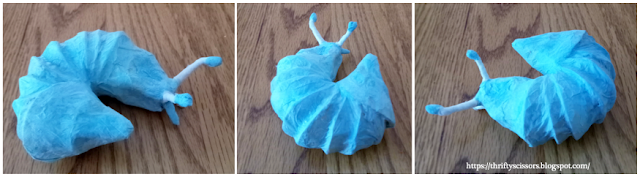
See the paper mache slug prior to painting after it has been covered with a layer of glue and tissue.
 
       Cover the egg carton units with a few layers of tissue paper and white school glue. Let this pretend slug dry over night before painting it.

The slug as seen from the top, side and bottom after painting it.

       I painted my version of a slug using multiple tan and brown colors because it is to represent a spotted leopard slug. However, students may choose to paint a banana slug yellow or some other kind of slug in it's own color variations. Once the painted surfaces are dry, cover the entire slug in stages with Mod Podge to seal it properly.

Free Student Clip Art: Clip art may be printed from a home computer, a classroom computer or from a computer at a library and/or a local printing service provider. This may be done from multiple locations as needed because our education blog is online and available to the general public.

Illustrated in the clip art above are the anatomical features of all slugs.

Monday, August 19, 2024

Study The Rabbit

European Rabbit.
       The  rabbit  is  a  small  rodent  of  the  family  Leporidae - the  same  family  to which  the  hare  belongs.  The  short  fore  legs  have  five  toes  or  digits,  while  on the  long  hind  legs  there  are  only  four.  It  is  smaller  than  the  hare,  and  has shorter  ears  and  hind  legs.  Rabbits  are  so  prolific  that  they  may  become  a pest  as  they  have  in  Australia.  Hares  and  rabbits  differ  from  squirrels, beavers  rats,  mice,  and  other  members  of  the  rodent  family,  in  having  an extra,  though  useless,  pair  of  cutting-teeth  in  the  upper  jaw.   

Required for Compare/Contrast Observation: A live pet rabbit and cat for comparison to each other in the classroom. 

Method of Student Observation:

  • Compare and contrast the fur, tail and legs of a cat to a rabbit.
  • The rabbits legs are adapted for leaping, on the account of the unequal lengths of their legs. Rabbits cannot walk well.
  • Compare the claws of a cat to the rabbit. The claws of a rabbit are not sharp because these are not protected in the way that the claws on a cat are.
  • Compare the ears of the cat to the rabbit.
  • Observe that the eyes on either side of the head allow a rabbit to see behind its self without turning its head.
  • Contrast the teeth of the cat; and note that there are no sharp conical teeth like those of the flesh-eating mammals.
  • Show that the rabbit's teeth are not adapted for tearing, but for biting and mastication. The rabbit does not bolt its food like the cat.

How to Grade Study Notes For Student Journals: Every student will need a journal to write in weekly for this online nature study series. Teacher will assign the weekly content in advance.

  • Make sure the facts are: written in complete sentences, the first word of each sentence capitalized, and a period should be included at the end of each sentence.
  • Spell check your vocabulary and write the words correctly.
  • Dress up your journal entries with student clip art, drawings of your own in color or in black and white.
  • Student may also include photographs of their own taking for extra credit.

Look for the following facts about rabbits inside of student journals. Assign a point value to the quality of the content.

  • Structure of a rabbit. It's fur is soft  and  thick. It's tail is short. It's legs in front are short and it's hind legs are long and powerful.
  • The rabbit's feet have distinct toes, which are provided with claws; but the claws are not retractile.
  • Rabbit's ears are long and can be moved to collect sound from different points of origin.
  • Rabbits eyes are very prominent and located at the sides of it's head.
  • Rabbits front teeth are sharp for cutting and biting. Their back teeth are for grinding.
  • The habits of rabbits include frequent cleaning of it's fur and biting food with front teeth, chewing food with the back.
  • Sometimes people eat rabbit or save it's fur for clothing, particularly in the past. 

Video at Youtube for Students to Watch:

  1. Rabbits versus Cats: Which pet is better? by Sincerely, Cinnabun
  2. Meet the giant Flemish rabbits by Jeff the Nature Guy
  3. Cocoa Puff has the best family by The Dodo 

The Art Lessons associated with rabbits from my Easter blog may be completed for this assignment are linked to below. Remember the important features of a rabbit when working on the projects. The eyes are located on the sides of the head, rabbits have long ears at the top of their heads and their front legs are shorter than their back ones.

Extended Learning Content: 

Free Student Clip Art: Clip art may be printed from a home computer, a classroom computer or from a computer at a library and/or a local printing service provider. This may be done from multiple locations as needed because our education blog is online and available to the general public.

Anatomy of a rabbit: skull, teeth, tail, legs, eyes and ears.