Wednesday, September 4, 2024

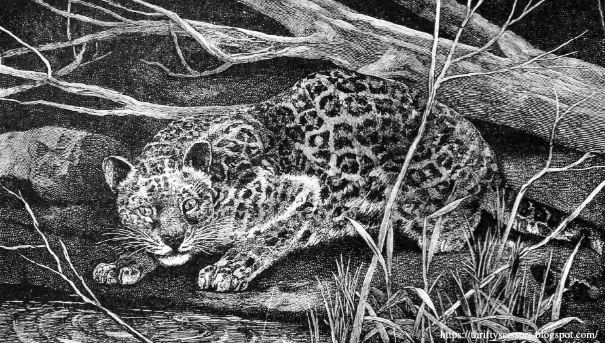
The Cautious Jaguar

Waiting to pounce
       The  Jaguar  takes  the  place  of  the  tiger  in  the  South  American  tropics. In  habits,  however,  it  is  more  like  the  Eastern  leopard.  It  is  not  as  large as  the  tiger,  but  it  is  much  heavier  and  more  powerful  than  the  panther.
       There  are  many  instances  on  record  where  jaguars  have  been  tamed.  A captain  in  the British  navy  had  a  two-year-old  jaguar  that would  eat  from  his hand,  and  was  allowed  to  roam  the  ship  at  large.  In  spite  of  its  size,  it  was as  playful  as  a  kitten,  and  was  never  better  pleased  than  to  find  someone with  whom  to  have  a  game  of  romps  As  time  wore  on,  the  romps  became rather  dangerous,  owing  to  the  jaguar  not  understanding  what  a  frail  playfellow a  man  was.     This  animal  afterward  lived  many  years  in  England.
       The  jaguar  roams  through  the  jungles  from  Paraguay  to  the  Equator,  and nothing  seems  too  large  or  too  powerful  for  it  to  attack.  It  will  kill  anything from  a  horse  down  to  a  lizard.
       Jaguars  swim  well,  and  are  very  fond  of  fish.  They  lie  on  a  branch  over-hanging a  stream,  and  watch  till  a  luckless  fish  swims  within  reach  of  their deadly  paws.  The  favorite  food  of  the  jaguar  is  the  flesh  of  the  monkeys  that swarm  in  the  forests.  The  easiest  time  to  catch  monkeys  is  at  night.  The jaguar  climbs  into  the  trees  and  stealthily  prowls  among  the  branches.  Suddenly, the  stillness  of  the  night  is  broken  by  the  fierce  roar  of  the  jaguar  and the  terrified  yells  of  the  monkeys,  showing  that  it  has  found  a  sleeping  colony. When  the  jaguar  attacks  a  large  animal,  such  as  a  deer,  it  springs  upon  its back  and  grasping  the  head  with  its  powerful  paw,  dislocates  its  neck  with  a single  wrench.
       When  the  jaguar  wishes  to  cross  a  river  it  resorts  to  a  very  clever  trick  to get  the  alligators  out  of  its  way.  It  takes  up  a  position  on  the  bank  and  begins to  howl.  The  alligators  hearing  the  noise  come  swimming  up  to  listen. When  the  jaguar  sees  that  they  have  arrived,  he  sneaks  off  and  swims  the river  lower  down  in  safety.  This  trick  is  played  over  and  over  again  and  yet the  alligators  never  seem  to  understand  it.
       The  jaguar  is  a  very  suspicious  and  cautious  animal,  and  will  never  make an  open  attack  on  man  or  beast.  Should  a  party  of  hunters  travel  through  the forest,  it  will  follow  their  steps  for  days  together,  in  the  hopes  of  picking  up  a straggler.
       In  the  early  days  of  settling  countries  inhabited  by  the  jaguar,  it  was found  almost  impossible  to  keep  anything  alive  in  the  way  of  stock.  Since then  the  jaguar  has been  forced  back into  the  dense,  trackless  forest by man.

The North American Puma

American Puma relaxing in the trees.
        The  Puma  (sometimes  spoken  of  as  the  mountain  lion,  panther,  and  cougar) is  the  largest  cat  of  North  America.  It  is  also  found  far  down  in  South America.  Its  head  is  small  for  its  body,  and  it  does  not  look  as  formidable a  beast  as  it  really  is.  It  does  not  hesitate  to  attack  man,  if  it  can  do  so  suddenly, without  being  seen.
       One  day  some  hunters  in  California  were  creeping  toward  a  small  herd  of deer,  when  they  saw  a  puma  doing  the  same  thing.  So  intent  was  the  animal on  its  prey  that  it  did  not  notice  the  hunters  being  near.  Suddenly  the  deer became  alarmed,  and  at  once  the  puma  sprang  and  brought  down  a  young doe.  One  of  the  hunters  fired,  but  missed,  and  the  puma,  seizing  its  prey  in its  mouth,  made  off  across  the  loose  scree  with  amazing  rapidity.
       The  puma  causes  great  havoc  among  the  small  live-stock,  and  should  a bullock  get  stuck  in  the  mud  the  puma  will  attack  it.  It  is  not  dangerous  if you  can  keep  it  in  sight,  and  you  can  even  prevent  it  springing  by  gazing at  it  steadily.     It  will  turn  its  head  from  side  to  side  trying  to  avoid  the  look.

Young artists can draw a puma step-by-step.

The Cunning Leopard

Mama leopard watching over cubs.
        It  is  about  as  hard  to  catch  a  leopard  asleep  as  to  sprinkle  salt  on  the tail  of  a  bird.   The  beautiful  spotted  creature  is  the  most  cunning  and  daring, of  the  cat  tribe. Although  much inferior  in  strength  and  size  to  the  tiger,  it will  attempt  deeds  that  the  latter  would  shun  as  too  dangerous.
       An  Indian  story  runs  that  a  dead  sheep  was  hung  up  near  a  sentry's  box, and  in  a  short time  it  was  missing.  On  the  ground  directly  beneath  where the  sheep  had  hung  were  footprints  of  a  leopard,  and  yet  the  soldier  on guard  had  not  heard  a  sound.  After  that  he  kept  a  better  watch,  and  another sheep  was  hung  up.  Suddenly,  with  a  roar,  up  sprang  a  leopard,  from nowhere  it  seemed,  and  seizing  the  sheep  it  made  off,  after  viciously  laying about  it  with  its  paws,  wounding  several  natives,  and  leaving  the  soldier half  dead.
       Leopards  do  not  hesitate  to  attack  in  broad  daylight,  and  will  carry small  animals  off  from  under  their  keeper's  very  nose.  On  one  occasion  a leopard  sprang  into  the  middle  of  a  camp  at  midnight,  and  dragged  off  a  pair of  wolf-hounds  that  were  fastened  together.  After  carrying  them  some  hundred yards  or  so,  it  was  forced  to  drop  its  prey.  One  dog  was  dead,  with  its skull  smashed  in,  and  the  other  was  so  badly  injured  that  it  had  to  be  shot.
       Leopards  have  a  fondness  for  eating  the  flesh  of  dogs,  and  resort  to  many clever  tricks  to  gratify  their  taste.
       The  pariah  dogs,  which  swarm  about  every  Indian  village,  on  hearing  the leopard  growling,  will  rush  toward  the  spot  with  loud  barkings.  The  leopard lets  them  approach,  and  then  suddenly  springs  out  on  the  nearest  dog  and bounds  off  with  it.
       Another  clever  device  they  resort  to  is  in  catching  antelopes.  A  great failing  of  all  the  antelope  tribe  is  curiosity.  This  the  leopard  well  knows,  so he  hides  in  a  small  clump  of  grass  near  a  herd  of  the  swift-footed  animals, and  slowly  moves  his  body  back  and  forth  so  as  to  make  the  grass  wave. This  attracts  the  attention  of  the  antelopes,  who  come  forward  to  see  what  it is,  their  curiosity  leading  them  to  swift  death.
       If  a  leopard  is  chased  by  dogs  it  will  take  to  a  tree.  In  fact  a  large part  of  its  life  is  passed  off  the  ground,  preying  upon  the  birds  and  monkeys that  live  in  the  upper  branches.  Leopards  are  seldom  or  never  found  in  forests where  there  is  no  undergrowth.  They  climb  a  tree  and  lie  out  on  the larger  limbs,  and  from  there  leap  upon  anything  that  passes  below.
       One  of  the  most  wonderful  stories  of  a  leopard  comes  from  India.  A native  woman,  who  was  working  among  the  corn,  had  left  her  baby  asleep beneath  a  large  tree.     When  she  had  finished  her  work  she  went  to  get  her child  and  found  that  it  had  vanished.  On  the  ground  round  about  were  the footprints  of  a  large  leopard.  She  followed  these  up  and  found  that  they  led to  a  jungle  near  by.  After  a  long  search  she  came  to  a  sheltered  rock,  under which  she  found  her  baby  sound  asleep  among  three  leopard  cubs,  which  were playing  together.  The  woman  seized  her  child  and  rushed  off,  but  she  had not  gone  far  when  she  heard  something  bounding  after  her.  In  her  terror  she rushed  for  an  open  space  where  there  was  a  small  fire  left  by  some  wood-choppers.  She  threw  some  leaves  on  it  so  that  it  blazed  up ;  at  the  same instant  the  leopard  appeared.  It  stopped,  looked  at  the  fire,  and  lowered  its eyes.  At  last  it  turned  tail  and  went  off.  The  woman  waited  until  help came  from  a  village  hunter,  who  had  seen  the  smoke  of  the  fire  rising  above the  trees.  It  is  impossible  to  say  why  the  leopard  had  not  killed  the  child, but  the  fact  remains  that  it  was  none  the  worse  for  its  adventure.
       Considering  the  fact  that  the  child  had  been  carried  some  distance  by  the leopard  shows  that  it  must  have  been  handled  as  carefully  as  if  it  had  been one  of  her  own  cubs.
       The  leopard  is  regarded  everywhere  as  a  pest,  and  in  India  especially where it  is troublesome.  Many  people  are  of  the  opinion  that  a  large  part  of  the  black deeds  charged  to the  tiger  are  really  the  work  of  the  sly,  cunning  leopard.
 
The wary leopard cautiously drinks from a nearby stream.

The Reckless Tiger

The Bengal tiger running.
       The  Tiger  hunt  is  the  royal  sport  of  India,  because  it  is  attended  with greater  danger  than  any  other  kind  of  hunting  in  the  world.  Books  could  be filled  with  stories  of  the  tigers  ferocity  and  recklessness,  its  wild  charges  upon elephants  and  horses  of  the  hunting-party  and  its  violent  struggles  to  get  away, once  it  has  been  cornered  by  its  foes.  There  is  an  old  saying  which  says: " You  are  never  sure  of  a  tiger  until  he  is  dead,  and  not  always  then."  The striped  skin  of  the  tiger  is  of  great  use  to  him  as  a  protection,  just  as  much  as the  brown  fur  of  the  lion  helps  it  to  hide  among  the  sand-hills  and  rocks. The  tiger  haunts  the  thickest  jungle,  and  its  brilliant  yellow  and  black  striped skin  harmonizes  splendidly  with  the  reeds  and  grasses  in  the  fierce  lights  and shadows  of  the  Indian  day.
       Much  is  written  of  the  man-eating  tiger  by  people  who  do  not  realize  that it  is  only  the  lame  or  aged  beast,  unable  any  longer  to  pull  down  a  buck, that  attacks  man.     When  the  tiger  has  once  tasted  human  blood  it  becomes a  confirmed  man-hunter,  and  holds  the  country  round  in  terror.  The  women no  longer  dare  go  into  the  fields  along,  and  even  the  men  travel  from  place  to place  in  well-armed  parties  of  three  and  four.
       Nothing  is  more  wonderful  about  the  tiger  than  its  ability,  in  spite  of  its enormous  size,  to  move  quietly  over  twigs  and  leaves.  A  good  illustration of  this,  and  its  sneaking  habits,  is  the  following  story:
       A  hunter  decided  to  watch  the  ford  of  a  stream  where  a  tiger  had  been  in the  habit  of  coming  down  to  drink.  He  posted  an  armed  native  on  the  opposite side,  and  then  hid  himself.  After  several  hours  of  watching,  during  which time  he  saw  nothing  of  the  tiger,  he  called  to  his  companion.  The  man  did not  answer  and  the  hunter  became  alarmed.  There  was  an  uncanny  stillness in  the  air.  He  hastened  across,  and  there  he  saw  the  footprints  of  a  huge tiger  just  behind  where  the  man  had  been  standing.  He  followed  up  the tiger's  trail,  and  about  one  hundred  and  fifty  yards  away  he  fell  over  the native's  body.  He  was  quite  dead,  with  a  clawed  and  broken  neck.  Although the  hunter  was  only  a  short  distance  off,  he  had  heard  nothing  of the  tiger's  approach.
       Two  ladies  left  their  bungalow  one  evening,  and  walked  to  the  top  of  a hill  to  view  the  sunset.  While  they  were  returning,  a  full-grown  tiger stepped  out  into  the  road.  One  lady,  in  her  terror,  suddenly  opened  her  red sun-shade.  The  unusual  sight  startled  the  tiger,  who  bounded  into  the  jungle once  more.
       This  story  only  goes  to  show  that  the  fiercest  animals  in  the  world  can  be frightened  by  simple  objects  which  they  do  not  understand.  All  the  cat  tribe are  cautious,  and  will  never  approach  anything  that  looks  to  them  suspicious.
       Another  story  is  told  of  an  Indian  officer,  who  had  to  pass  through  a lonely  piece  of  road  near  a  jungle,  while  going  to  visit  some  friends.  He  was riding  a  bicycle.  Suddenly  a  large  tiger  sprang  out  behind  him,  and  followed him  with  much  the  same  gait  that  a  cat  uses  when  crossing  the  street.  Strain. as  hard  as  he  could,  the  rider  was  unable  to  increase  his  lead  on  the  tiger, who  seemed  not  to  be  making  the  least  effort.  Near  the  end  of  the  road  a number  of  officers  were  waiting  for  the  expected  guest,  and  were  astonished at  the  speed  he  was  making.  When  they  saw  the  tiger  behind  him  they rushed  for  their  guns.  At  the  same  time  the  tiger  seemed  to  think  that  he had  come  far  enough,  and,  uttering  a  loud  roar,  gave  three  huge springs, which  brought  him  up  with  his  victim,  and  down  went  tiger,  bicycle,  and  rider, in  a  heap.  A  lucky  shot  finished  the  tiger,  and  the  officer  escaped  with  a torn  scalp  and  a  broken  arm.
 
Tigers hunted by men riding elephants.
 
Paper tiger toy with joints can move if parts are reconnected with brads.

Lion, King of The Beasts

Lioness and her cubs nursing.
      First  comes  the  Lion,  the  king  of  the  beasts.  The  only  remaining stronghold  of  this  largest  animal  of  the  cat  species  is  in  Central  Africa.  The time  was  when  it  wandered  through  Persia,  Syria,  and  India,  but  owing  to strong  persecution  it  has  almost  vanished  out  of  Asia.
       The  lion  is  an  open-country  hunter.  It  is  to  be  found,  as  a  rule,  in  the long  grass  and  bush-lands,  or  on  the  outskirts  of  the  deserts.  Its  color  is  a beautiful  yellowish-brown,  which  matches  its  surroundings  so  perfectly  that  it is  enabled  to  steal  upon  its  prey  unseen.  A  favorite  trick  of  the  lion  is  to  lie in  wait  upon  some  rock  near  a  path  where  deer  and  antelope  pass  on  their way  to  drink.  Its  color  here  again  serves  to  keep  it  concealed,  for  it  lies  so still  that  even  the  timid  deer  are  deceived,  and  do  not  see  their  enemy  crouching in  ambush.  As  the  deer  pass  by,  the  lion  springs  among  them  and  drags a  victim  down.
       The  lion  has  earned  his  regal  title  from  his  strength.  It  is  said  that  a full-grown  male  will  attack  and  pull  down  a  buffalo.  It  easily  drags  the body  of  the  largest  horse  over  the  roughest  ground.  When  a  lion  makes  an attack  it  springs  upon  its  victim's  neck,  and  at  the  same  time  deals  a  fearful blow  with  its  paw.
       Many  are  the  stories  told  showing  this  trait,  and  one  of  the  most  interesting comes  from  the  late  Dr.  Livingstone:
       ''A  number  of  natives  had  found  a  lion  concealed  in  a  long  grass  swamp. Forming  a  circle,  they  closed  slowly  in,  beating  tom-toms  all  the  while.  As the  circle  became  very  narrow,  the  lion  suddenly  broke  cover  with  a  roar,  and made  off  for  the  nearest  shelter.  The  natives  scattered  right  and  left,  but one  man,  unable  to  get  away  quickly  enough,  was  knocked  down  by  the lion.  When  the  hunt  was  over  .the  doctor  returned  expecting  to  find  the man  only  stunned,  when,  to  his  surprise,  he  found  his  shoulder  broken  and his  skull  crushed  like  an  egg-shell  from  the  blow  he  had  received.''
       The  lion  is  not  a  sneak  like  the  tiger,  for  instead  of  seeking  cover  it comes  boldly  out  into  the  open,  and  it  is  killed  that  much  easier.  An  instance of  the  nature  of  the  lion  is  here  shown  in  the  following  story:
       A  hunter  camping  in  Abyssinia  was  one  evening  surprised  when  a  native told  him  that  a  few  minutes  before  he  had  passed  quite  close  to  a  full-grown lion.  "You  were  not  afraid?" asked  the  hunter.  "No,"  replied  the  native. "Why  should  I  be?  The  lion  never  attacks  us  unless  he  is  very  hungry  or annoyed."
Barbary Lion roaring at dawn.
       This  last  story  shows  an  odd  trait  in  the  lion's  character. The  lion  has no  desire  to  interfere  with  man;  in  fact,  one  never  hears  of  a  man-eating  lion. Why  this  should  be  nobody  has  ever  yet  been  able  to  say  for  certain.  Many hunters  claim  that  should  a  man  fall  into  a  lion's  clutches  and  be  killed,  the body  will  not  be  eaten,  although  the  lion  may  have  fearfully  mangled  it  in  its rage.     The  natives  say  that  the  white  man's  flesh' is  distasteful  to  the  lion.
       With  regard  to  the  lion  not  being  a  sneak,  there  are  always  exceptions  to prove  the  rule,  for  while  it  does  not  hesitate  to  boldly  raid  a  cattle  corral  in broad  daylight,  there  are  times  when  it  prefers  to  sneak  upon  its  prey.  A story  showing  this  comes  from  a  young  man  who  had  recently  taken  service in  South  Africa :
       He  left  his  camp,  one  fine  evening  about  dusk,  for  a  stroll,  and,  passing near  a  small  pond,  he  sat  down  on  the  edge.  Suddenly  looking  across,  he saw  three  pairs  of  green  eyes  on  the  other  side  watching  him.  Being  new  to the  country,  he  did  not  at  once  realize  his  danger.  The  eyes  belonged  to lions  who  had  come  there  to  drink,  who,  on  seeing  him,  divided,  coming round  the  pond  slowly,  and  creeping  toward  him.  The  young  fellow,  who was  smoking,  placed  his  pipe  beside  him  on  the  rock,  and  as  he  turned  to watch  the  eyes  he  upset  it  into  some  dry  grass,  which  took  fire  at  once.  The lions,  thus  exposed  to  view,  glared  at  him,  and  then  turned  tail  and  made  off, like  great  skulking  cats.  Needless  to  say  that  was  the  last  evening  stroll  the young  man  took  while  in  those  parts.
       The  lions  set  a  bad  example  to  the  rest  of  the  animal  kingdom,  for  they are  very  quarrelsome.  Two  or  three  lions  will  combine  to  attack  a  rhinoceros or  buffalo,  but  afterward  they  will  always  fight  over  the  division  of  the spoil,  and  not  infrequently  one  of  the  lions  that  has  helped  to  gain  the  victory will  be  driven  off  without  getting  a  share.  A  hunter  once  wounded  a  giraffe, but  before  he  could  fire  a  second  shot  the  giraffe  rushed  off  over  a  hill-side. The  hunter  followed  as  fast  as  he  could,  and  to  his  astonishment  he  found  the giraffe  in  a  deadly  combat  with  some  lions.  After  making  frantic  efforts  to  get away,  the  bullet  took  effect  and  the  giraffe  fell  dead.  The  lions,  thinking that  they  had  gained  an  easy  victory,  had  a  grand  battle  between  themselves for  the  possession  of  the  carcass.
       Great  authorities  on  Africa  are  of  the  opinion  that  the  lion  will  become extinct  within  the  next  hundred  years,  unless  it  is  strictly  protected.  In  spite of  the  fact  that  the  lioness  gives  birth  to  six  or  seven  cubs  at  a  time,  these animals  are  steadily  vanishing  before  the  advance  of  man.  For  the  hunters of  big  game  it  will  be  a  pity  when  this  mighty  beast  no  longer  roams  the desert,  or  breaks  the  stillness  of  the  tropic  night  with  its  deafening  roar.
 
Lions signal their authority and ownership of a place by roaring.

Saturday, August 31, 2024

Study Nuts

A red squirrel eating a hazelnut.
       A  nut  is  a  hard,  one-celled  and  single-seeded  indehiscent  fruit.  It  is usually  produced  from  an  ovary  of  two  or  more  cells,  with  one  or  more  ovules, in  each  of  which  all  but  the  single ovule  and  single  cell  have  disappeared. The  nut  is  often  enclosed  in  a  kind  of  cup,  which  still  further  protects  the  seed. This  cup  is  called  a  cupule.  Such  is  the  husk  of  the  hazel  nut,  the  cup  of  the acorn,  and  the  prickly  husk  or  covering  of  the  Spanish  chestnut.
       The  kernel  contains,  besides  the  embryo,  a  considerable  amount  of  nourishment,  on  which  the  young  plant  lives  till  it  can  support  itself.  It  is  this  store which  men  turn  to  account,  using  it  as  food  for  animals  and  for  themselves.

Required for Observation In The Classroom: Some  hazel  nuts.  Branch  of  the  hazel  bush with  nuts.  Picture  of  hazel  flowers.

Method of Student Observation:

  • Each  child  should  have  a  nut for  examination  and  description. 
  • Compare  the  nut  with  the  other fruits  examined,  and  the  kernel  with the  seeds  previously  described. 
  • Show  that  the  kernel  splits,  like peas  and  beans.
  • Explain  how  the  nut  is  developed from  the  flower,  and  compare  its growth  with  that  of  other  fruits  previously  examined. 

How To Grade Study Notes For Student Journals: Every student will need a journal to write in weekly for this online nature study series. Teacher will assign the weekly content in advance.

  • Make sure the facts are: written in complete sentences, the first word of each sentence capitalized, and a period should be included at the end of each sentence.
  • Spell check your vocabulary and write the words correctly.
  • Dress up your journal entries with student clip art, drawings of your own in color or in black and white.
  • Student may also include photographs of their own taking for extra credit.

Look for the following facts about nuts inside of student journals. Assign a point value to the quality of the content. 

  • The  Nut - On  a  woody  stalk. Surrounded  by  an  irregular  green cup.  The  nut  a  fruit.
  • Shell  brown,  with  a  soft  lining within.
  • Kernel  covered  with  a  brown  skin. A  seed.  Readily  splits  into  two equal  parts.
  • How  the  nut  is  formed - Produced  from  the  flower.
  • Flowers  formed  in  the  spring.
  • The  nut  is  the  ripened  seed-case-of  the  middle  of  the  flower.

Video at Youtube for Students to Watch:

  1. Why you need native hazelnuts on your property! by Backyard Ecology
  2. Identifying American Hazelnut by Tree Husker
  3. Picking and Processing Wild Hazelnut with Never A Goose Chase
Nut themed crafts: nut + seed dolls, pistachio shell wreath, nut-head owls and Miss Hickory.
 
Crafts Made With Nuts:

Extended Learning Content: 

Free Student Clip Art: Clip art may be printed from a home computer, a classroom computer or from a computer at a library and/or a local printing service provider. This may be done from multiple locations as needed because our education blog is online and available to the general public.

1.  The  Nut - On  a  woody  stalk.  A  fruit.  Green  cup  outside. 
Kernel within.  Kernel  a  seed.  Has  a  brown  skin.
2.  How  the  nut  grows - Formed  from  the  center  of 
the  flower  of  the hazel  bush.

Study Wood

Age of the tree determine by the
cross cut showing annual rings
in the tree trunk.
       In  dicotyledons,  or  exogenous  plants,  the  stem  consists  of  the  bark,  the cambium  layer,  the  wood,  and  the  pith.  The  cambium  layer  gives  rise  to  a layer  of  wood,  which  is  deposited  next  the  old  wood,  a  layer  of  bark  deposited next  to  the  bark,  and  a  new  cambium  layer.  The  layer  of  wood  deposited grows  hard  during  the  winter,  and  so  forms  quite  a  distinct  ring  from  the  next layer  of  wood,  which  is  deposited  on  the  outside  of  it. 

Required for Observation in The Classroom: A few blocks cut from the branch of a tree - varying in diameter. One end of each may be smoothed and varnished, if necessary , to show the rings better. Also some young twigs containing much pitch.

Method of Student Observation:

  • Point out the bark, wood, and pith, in the sections of a branch.
  • Show that wood is tough and fibrous, and that pith is soft and devoid of fibers.
  • Show the pith rays running from the center of the wood.
  • Show the rings of wood in sections of different  sizes. 
  • Count the rings in each. 
  • Show that a young twig has only one or two rings of wood.

How to Grade Study Notes For Student Journals: Every student will need a journal to write in weekly for this online nature study series. Teacher will assign the weekly content in advance.

  • Make sure the facts are: written in complete sentences, the first word of each sentence capitalized, and a period should be included at the end of each sentence.
  • Spell check your vocabulary and write the words correctly.
  • Dress up your journal entries with student clip art, drawings of your own in color or in black and white.
  • Student may also include photographs of their own taking for extra credit.

Look for the following facts about wood inside of student journals. Assign a point value to the quality of the content.

  • The parts of a log - bark outside. protective, sometimes very rough, sometimes smooth.
  • Wood - forms greater part of the log. fiberous
  • Pith - In the center, soft, no fibers. Rays from pith run in all directions.
  • How tree grows - The wood is formed in rings. A very young twig has only one ring of wood. Each summer a new ring of wood is formed outside the older wood, and underneath the bark. The bark is then pushed outward year by year, and the age of the tree may be calculated by counting the rings.

Video at Youtube for Students to Watch:

  1. Materials of a Tree Structure by Kayla Bergeson
  2. How Tree Works, tree physiology by Family Plot Garden
Left, wooden rounds. Right, sculpted honeycomb.

Photo of table and chairs set up in
the garden ready for the fairy feast.
Craft a Fairy Feast for The Garden: For this wooden craft you will need the following supplies: wood glue, sliced wooden rounds, acorn shells and caps, Sculpey, acrylic paint (puff paint optional) and pretend or real garden flower clippings.
        Details above show wooden slices stacked and glued together to make the simple fairy dining furnishings and also the Sculpey shaped honeycomb prior to painting.
       The table is set for a Fall meal of dew drop wine and crusty honeycomb. Leaves make the table covering and a large acorn ''bowl'' displays a toadstool, small berries and a delicate orange flower. The acorn cup goblets are filled with dew drop (hot glue) and the honey comb is made from Sculpey hardened in an oven and painted with puff paints. There is also a small faux apple the size of a crab apple in this case for fairies on the table. Each fairy has a stool made from smaller wooden slices glued together in a short stack.
 
Left, the table and stools were made by gluing and stacking wooden rounds.
The far right, details of honey comb and dew drop wine, some of our fairy's
favorite foods for fall.

More About Fairies in The Woods:

Free Student Clip Art: Clip art may be printed from a home computer, a classroom computer or from a computer at a library and/or a local printing service provider. This may be done from multiple locations as needed because our education blog is online and available to the general public.

A Log includes: bark outside, wood that is tough
and pith in the center that is softer.


Integrated Nature Study Lessons

       The integrated nature studies here for 4th-6th graders include journal writing prompts, art and craft assignments, educational youtube video (reviewed by teachers in advance), and reading materials collected together for independent, student research. 
       There are also materials included in many of the lessons for adapting the material for younger students in grades kindergarten through 3rd via our reader's requests. Homeschooled children with mixed ages may be included in the studies along with their brothers and sisters.

The Animals & Plants Journal Lessons:
  1. Study The Rabbit - The rabbit is a small rodent of the family Leporidæ - the same family to which the hare belongs.
  2. Study The CaterpillarThe  eggs  of  butterflies  are  interesting  microscopic  objects,  as  they  are usually  covered  with  a  hard  shell,  and  are  of  various  shapes  and  colors. The  majority  of  insects  pass  through  a  regular  series  of  changes.
  3. Study The ButterflyThe  butterfly  is  one  of  the '' Lepidoptera ''  or  scale-winged  insects.  Besides butterflies,  of  which  it  is  reckoned  that  there  are  10,000  different  kinds,  this order  includes  the  moths,  of  which  it  is  estimated  that  there  are  40,000  species.
  4. Study The Spider' WebSpiders  are  distinguished  from  all  other  animals  by  their  habit  of  spinning webs.
  5. Study Wood - 
  6. Study The CabbageThe  cabbage  is  another  of  the  plants  cultivated  by people  for  eating and display.
  7. Study The Bee: Lesson 1The  bee  is  a  rather  stoutly  built  insect,  belonging  to  the  Apiarian  family  of the  Aculeate  or  stinging  Hymenoptera.
  8. Study The Bee: Lesson 2During  the  winter  and  the  spring  the  hive  consists  exclusively  of  the  perfect female,  the Queen  Bee,  and  of  a  number  of  imperfect  females  or  worker  bees.
  9. Study The MoleThe  Common  Mole belongs  to  the  order  of  the  Insectivora,  an  order  of  animals  small  in  size,  and  m  stly  of  more  or  less  purely nocturnal  habits.
  10. Study The Crab -
  11. Study The SlugThe  air-breathing  molluscs  in  which  the  shell  is  internal  or entirely  absent  are  popularly  called  slugs.
  12. Study The Pea-PodThe  fruit  of  the  pea  is  a  simple  fruit,  that  is,  it  is  the  result  of  the  ripening of  a  single  pistil.
  13. Study Leaves: Lesson 1Leaves  show  an  almost  infinite  variety  both  of  structure  and  of  shape. They  are  the  breathing  organs  of  the  plant,  and  by  their  aid  the  plant  makes organic  material  from  its inorganic  food. 
  14. Study Leaves: Lesson 2With  regard  to  the  distribution  of  the  strands  which  traverse  the  green blades  we  distinguish  between  blades  with  a  single  main  strand  and  blades with  several.
  15. Study Insects and FlowersThe  vast  majority  of  flowering  plants  are  arranged  by  botanists  into  two classes,  wind-fertilized, and insect-fertilized, that  is,  plants  whose pollen  is  brought  to  their  stigmas  by  the  wind,  and  plants  for which  insects  perform  this  duty.
  16. Study How Seeds GrowThe  seed,  which  must  be  carefully  distinguished  from  the  fruit,  of  which  it forms  a  part,  is  the  fertilized  seed-bud  or  ovule.
  17. Study WoodIn  dicotyledons,  or  exogenous  plants,  the  stem  consists  of  the  bark,  the cambium  layer,  the  wood,  and  the  pith.
  18. Study Nuts A  nut  is  a  hard,  one-celled  and  single-seeded  indehiscent  fruit.  It  is usually  produced  from  an  ovary  of  two  or  more  cells,  with  one  or  more  ovules, in  each  of  which  all  but  the  single ovule  and  single  cell  have  disappeared.
Independent Study: Independent study lessons may be accomplished when the student is away from the classroom. These studies could involve a student's beloved pet or a likely nature study students may participate in when on vacation or during a school closure. Students also may need a lesson or two if they are sick in bed at home. For these lessons I have chosen a few animals that students are likely to be familiar with and therefore comfortable in observing them outside of the classroom.
  1. Study The Cat - The Cat belongs to the order Felidæ, the group to which the lion, tiger, leopard, puma or panther, and lynx belong

Study The Cat

The domesticated Orange Tabby.
7 facts about orange cats.
       The  cat  belongs  to  the  order  Felidae,  the  group  to  which  the  lion,  tiger, leopard,  puma  or  panther,  and  lynx  belong.  The  animals  belonging  to this  family  are,  in  proportion  to  their  size,  the  strongest,  fiercest,  and  most terrible  of  beasts.  Their  teeth  and  claws  are  powerful  weapons  of  attack. They  assail  their  prey  by  striking  it  with  their  powerful  fore-paws,  and  do  not, like  dogs,  first  grip  it  with  their  teeth.  Each  fore-paw  has  five  toes,  and  each toe  is  furnished  with a  strong  claw,  which  is  protected,  when  not  in  use,  by being  withdrawn  behind  folds  of  skin.  There  are  only  four  toes,  also  with claws,  on  each  of  the  hind  feet.  Their  strong  muscular  limbs,  small head,  and  slim  body,  and  the  soft  pads  with  which  the  toes  are  furnished enable  these  animals  to  move  very  swiftly,  gracefully,  and  silently.  Cats have  thirty  teeth,  and  these,  especially  the  four  canine  teeth,  are  very powerful  weapons.  Man  has  been  able  only  partially  to  tame  one  very  small member  of  this  family,  namely,  the  domestic  cat.

Requirements for Independent Study: Independent study lessons may be accomplished when the student is away from the classroom. These studies could involve a student's beloved pet or a likely nature study students may participate in when on vacation or during a school closure. Students also may need a lesson or two if they are sick in bed at home. For these lessons I have chosen a few animals that students are likely to be familiar with and therefore comfortable in observing them outside of the classroom.

How to Grade Study Notes For Student Journals: Every student will need a journal to write in weekly for this online nature study series. Teacher will assign the weekly content in advance from the writing list below.

  • Make sure the facts are: written in complete sentences, the first word of each sentence capitalized, and a period should be included at the end of each sentence.
  • Spell check your vocabulary and write the words correctly.
  • Dress up your journal entries with student clip art, drawings of your own in color or in black and white. Students may also include photographs of their own taking.
What to write about in the student journal?
A.) Observe a domestic cat in person or from one of the videos below and answer the following questions.
  1. Explain the purpose of rough play between kittens.
  2. Explain the purpose of cat whiskers.
  3. Why are the claws of a cat retractile and why to they have soft pads underneath these?
  4. How does a cat use it's rough tongue?
B.) Write in your journal a brief paragraph describing one of the following comparisons between a cat and other animals or things.
  1. Compare the coat of a cat to that of a dog. Explain why the cat's coat is warmer.
  2. Compare the pupil of a cat to a window, and explain the advantages of these.

Video Options at Youtube for Students to Watch:

  1. The Wonderful World of Cats - HD Nature Wildlife Documentary 
  2. Cat Tales by NOVA
  3. All about kitten milestones by Jackson Galaxy

What kinds of art/craft projects about cats may a student accomplish on their own and share with their classmates once the return to the classroom?

Option 1. The Life Cycle Wheel Graph: Students will need writing and drawing tools, two white paper plates, scissors, white school glue and one brass-plated fastener. The teacher should supply the two paper plates and fastener per student.

Directions:

  1. On one plate cut away a pie shaped ''window'' to reveal a stage of the cat's life cycle and a second one opening directly across from it to reveal a brief description.
  2. On the second paper plate, draw a pie shaped grid with 10 slices. In the first five of these pie shaped windows include clip art of the different stages of a cat's life: the newborn kitten stage, the neonatal stage, the juvenile stage, the adult cat and the geriatric cat.
  3. Within the remaining five grid spaces, write brief descriptions of each stage. Correct answers should be revealed by the turning of the upper plate windows to reveal the correctly positioned content.  (See a similar illustration of this craft here.)
  4. Stack the two paper plates together, cut-away on top, and poke a tiny hole with the tip of your scissors through the centers of both plates. 
  5. Insert a fastener through both plates at once in order to join the two paper plates together at their center points only. 
  6. Be prepared to discuss these stages of a cat's life with a fellow student or teacher when presenting your hand-crafted wheel graph in class.

Option 2. The Environment of The Cat: Students will need a small recycled cereal box or shoe box, craft paper, scissors, extra cardboard, white school glue and drawing pencils to fashion a diorama environment for a small toy cat. The toy figure may be of a domesticated cat or of a wild cat. Three things that must be included in the cat diorama are listed below.

  1. Depictions of the food a cat ordinarily eats.
  2. The shelter sculpted or arranged to hide a cat from both danger and bad weather.
  3. The inclusion of animals or humans the cat may peacefully tolerate within their own environment.

Option 3. A banner made up of photographs, pictures and collage. These items may be attached to a string with clothes pins, clamps, tape, or paperclips. 
       Hang the banner up across the classroom while sharing the information a student learned while absent from the classroom.

Extended Learning Content: 

Free Student Clip Art: Clip art may be printed from a home computer, a classroom computer or from a computer at a library and/or a local printing service provider. This may be done from multiple locations as needed because our education blog is online and available to the general public.

Clip art includes: a cat skull, head with whiskers, eyes in dark,
 eyes in daylight, foot with claws, underside with pads.