Monday, March 18, 2013

Silhouettes by a Swedish Artist

Gus Walle. Maker of
Silhouettes. (self portrait)
With His Little Shears Mr. Walle is Making Portraits of Well Known Men and Women.
      Any one who wants to call Gus Walle a psaligraphist can do so with impunity. When you can apply a name like that to a man and not have anything happen to you there must be some good reason for it. In this case the reason is that a psaligraphist is what Mr. Walle really and truly is and he is proud of it.
      The art of cutting silhouettes, or psaligraphy, is much more practised abroad than in this country. In Stockholm, where Mr. Walle lived before he came to America, there have been several masters of it. His own mother was an accomplished manipulator of the little shears, and he himself, watching her from the time he was a child and imitating her for his own amusement, has become so expert that his swiftness and cleverness are astonishing.
       Although Mr. Walle might stand for being called a psaligraphist, he does not describe himself by any such high sounding name. But he will tell you more or less about the origin of the art. He says it was carried to a high degree of perfection by the Greeks. The monochrome figures on Etruscan vases are really silhouettes. Later the art fell into disuse until the middle of the eighteenth century. From that time it was very much in vogue until the invention of photography drove it out again.
      Many of the old time silhouette makers couldn't have cut a profile freehand any more than they could have walked on air. They placed a person so that his shadow would be cast on the wall, then they traced this and reduced it to a smaller size. Some would have the shadow cast on ground glass and trace it on that. All kinds of apparatus were devised for copying the profile mechanically, but they were not eminently successful.  
Mlle Gaby Deslys
     This young man from Stockholm doesn't bother with paraphernalia. He has a pair of scissors about four inches long, three inches of that length being handle. They look as if they might have been intended for surgical use they are so slender. Mr. Walle has been using them for sixteen years and he thinks he would almost have to give up his profession if anything happened to them.

Mr. Walle's Way of Work.
      When he makes a silhouette he does not post the person against the light or against a black cloth or anything of that sort. He simply tells his subject to sit on a rather high office stool. He himself sits on a chair only a few feet away.
      There is only one point about which he is at all particular; he prefers to have the person's right side toward him. A great many persons are inclined to protest about this. they have been informed by photographers that their left is their best side and they want to turn that one to the silhouette artist.
      There really is a great difference between the sides of almost every face; but the variation is in the modelling, the shape of the eyes, the way the hair grows, the corners of the mouth, the lift of the eyebrows and so on. When one comes to think of it, prompted thereto by the silhouette men, one realizes that the outline of the head is the same whichever way you take it.
      The reason the artist in this case wants his subject's right side is because it is easier for him to cut that way. He invariably begins at the bottom of the paper at what will be the front of the picture when finished. He cuts every detail as he goes, the buttons on the coat, the lace jabot: everything is reproduced and with astonishing rapidity. He scarcely looks at the paper his cutting. His hands move as surely as those of a musician who is absolutely familiar with the keys.
small boy
      Yet all the time he is turning and twisting the paper, making little fluttering motions with it as he outlines the lace, slicing boldly in for the curve of the throat and sweeping around the top of the head as freely and easily as if he were merely writing his name. How it happens to come out all right in the end is a mystery to the bystander.
      You might think he would need to block out in some general proportions what he is going to make. Otherwise the head might be out of proportion or the outline might wander dangerously before it had climbed the peak of the topmost feather on the hat and started on the backward descent. But he takes absolutely no precautions to insure proportion. He seems to have instinctive sense of it and the little scissors shear their way unhesitatingly and unerringly.
      If the features to be reproduced are bold as many as six thicknesses of paper can be cut at once, thus making six copies of the same silhouette. The number of thicknesses that can be cut simultaneously diminishes, according to the delicacy of the features and the size of the silhouette to be made, until only a single one can be cut at a time.

Big Silhouettes Hardest. 
      The very large silhouettes are the hardest to make, partly because there are more details of outline to be reproduced and partly because it is not quite as easy to visualize the large picture and "feel" it as a whole. Mr. Walle has made silhouettes with heads that were more than twelve inches in diameter.
      On the other hand he makes many full length silhouettes in which the head is only half an inch long. When he makes one of these full length figures he begins with the toe of the shoe and cuts his way up the front of the figure and down the back without a pause except perhaps for an umbrella or cane or chair.
Mrs. John Jacob Astor
      All these details are cut just as they come instead of being cut by themselves and are pasted on separately. Another hard thing to do is to cut a row of persons to be mounted on the same card. They are posed one after another and all cut from the same sheet of paper so that they fit together with only a narrow line of white between.
      At a recent dinner party where Mr. Walle was engaged he made a row of heads of all the guests, with the dinner table suggested below them. In addition he made three copies fo separate silhouettes of each individual present, including some of the Metropolitan Opera House artists who sang after the dinner.
      Silhouettes of women are as a rule more interesting to Mr. Walle to make because there is so much more variety in their hair and dress. Men's features seem more striking at first thought, but they are not always so by any means.
      While the nose is of course the most prominent feature in a profile, it isn't necessarily the one which gives the most characteristic line. The curve under the nose and of the upper lip is one of the most important sections of a profile. The chin and the line underneath it are also important. In fact not only every detail of outline but also the angle at which the silhouette is finally mounted on the card is significant.
      After the cutting of the outline is competed the artist begins to make what seem like the most careless slashes into it. As likely as not he cuts the head off entirely. In this way he secures the white lines which break up the black and add detail and character.
      Some of the paper he uses is already gummed on one side. He has a pad which he wets and on which he then lays the pieces of the silhouette gum side down. When this gum is softened he takes the paper up with a penknife blade and lays it on the card. This must be done right at the first try or the whole thing is spoiled. It cannot be moved even a fraction of an inch or the card will look soiled.
      If the head has been cut off the silhouette is placed first on the card. Then the rest is added, leaving just a tine line of white to indicate the collar. The paper is smoothed down carefully and the work is done. For rapidity, accuracy and delicacy it is an astonishing performance. The Sun, May 5, 1912.

More Silhouettes by Gus Walle coming soon.

Josephus Hyde And His Sinful Pride

Josephus loved to strut, and cry:
"No boy in town is rich as I!"

And vainly both his aunties tried
To break him of such foolish pride.

His little playmates, in delight,
Made fun of him with all their might,

While he pretended not to see
Or sneered at them unpleasantly.

At length misfortunes came, -- and left
Josephus of his wealth bereft!

He made his way, -- but first of all
He learned: -- Pride goes before a fall!

by Elizabeth Kirkman Fitzhugh.

Saturday, March 2, 2013

Authors And Artists Starring In Latest Silhouette Movies

Scene from Gilbert-Bray movie, "Inbad the Sailor."
 Left to right: J. Bryant, Francis Ramsey,
May Wilson Preston, Connie Neell.
      New York, Feb. 16. 1916 --There's something new under the sun, or rather behind the spotlight--the silhouette movie.
      It has darkened the lives not only of some movie actors, but of Irvin Cobb, Owen and Mrs. Johnson, James Montgomery and Mrs. Gibson, Edgar Selwyn, Margaret Mayo Selwyn, May Wilson Preston and her husband James, and among others, Inbad the Sailor hero of the first silouette movie.
      The inventors, C. Allen Gilbert, illustrator, and J. H. Bray, cartoonist, induced these notables to go into the movies when they were lured to the Gilbert Bray studio.
      There the authors and artists and their wives or husbands, moving in profile across the stage, were thrown into bold relief against a white background, and their movements recorded by a motion picture camera.
      Author Cobb acted a brief skit, entitled "Preparedness," with the aid of a toy gun, an American flag and his vast proportions. 
      Illustrator Flagg acted Flagg the Harlequin, since his costume was for something besides exposing his flagstaff figure. 
      One lady illustrator, wearing one of last summer's silhouette gowns, upon learning she would illustrate herself if she appeared between the spotlights and the curtain, sat down in a corner and not even the moving picture of "Inbad the Sailor" could move her.

Thursday, February 28, 2013

"If Pets, Why Not Useful Ones?"


By Percy Shaw.

I wonder how 'twould be if cows
And hens and ducks were household pets,
And banished far were growls and meows,
As witness in these silhouettes!

Mere man would look aghast no doubt
And voice a thousand vain regrets;
But though these ladies ne'er come out,
They look well in these silhouettes.

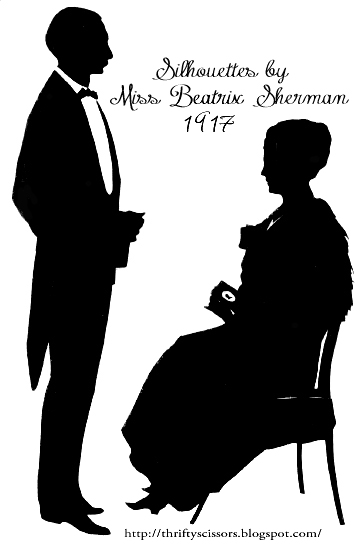
The Civic Ball In Silhouette, 1917


      Merrymakers at the Greater New York Civic Ball, held at the Biltmore in aid of after care for infantile paralysis cripples, took keen delight in the society revival of the fad of a generation ago--cut out silhouettes. Miss Beatrix Sherman, whose skill in catching a likeness with the scissors has been turned to pleasure and profit, made these. Above, at the left, is Dr. Haven Emerson, New York's Health Commissioner. Beside him is Miss Elsie Irving Tappin. Below, at the left, is Mrs. Edward E. McCall, and at the right is Major Cornelius Vanderbilt.


Monday, December 24, 2012

"The Lion and the Mouse Fable" in Silhouettes

The Lion and the Mouse

      "A hungry mouse notices a tree full of fruit and attempts to reach the fruit by climbing up a big rock, but to his surprise, the rock is actually a sleeping lion. The angry lion forgives the little mouse and helps him to reach the fruit. The lion laughs at the mouse when he promises to one day return the favor. However, when the lion gets caught in a thicket of vines and the mouse comes to his rescue, the lion realizes that even the small can be a big help."

Friday, December 21, 2012

The Pied Piper Silhouettes by Kathy Grimm


       I have redrawn my variations of silhouette's originally designed by Lotte Reiniger and Paul Wegener for their film "The Pied Piper of Hamelin," in 1918. You can download these here, read the Terms of Use.

Noyeokgae


"The process of cording and weaving hanji (Korean handmade paper) by a master weaver, Na Seo Hwan. He is a 3rd-generation master who learned from his father, who learned from his grandfather. He has also developed a more effective and efficient way of cording paper, which is different from the way most paper weavers work. This ancient paper craft, known formally as noyeokgae, still exists in Korea today but the intense labor, time, and strength required for it means that very few masters remain, and even fewer serious disciples."

Special thanks to my teacher, Na Seo Hwan.
Thanks to the U.S. Fulbright program for the time and funding to make this research possible.
Camera and editing by Aimee Lee
© 2009

Traditional Paper Angels

illustrated paper angel
       Small and simple pieces of full-round paper sculpture may be no more than tubes or cones, standing by themselves, with a few details to give them identity. More elaborate pieces, built around a framework and tacked or stapled to it, are like low-relief figures carried around on both sides of a base, save that their paper shell is not flattened; it flares out as roundly as the design of the piece requires. Fitting tubes together where they join at difficult angles is something of a tinsmith's job, but it can be managed more easily through trial and error than in a material less tractable. 
       If the piece is to be big, it is advisable to make a miniature scale model of it until a perfect grasp of the technique is acquired. It is easier to handle and wrap small pieces of paper than big ones. The miniature model may be taken apart, its pieces spread flat, and used for patterns to enlarge to the proper size.
       A knowledge of sculpture is very helpful, even to designers who can draw what they want. To maintain proportion, anatomical correctness, and easy transition from one part to the next, is not so easy as in the making of low-relief paper sculpture. The worker must move around his composition, viewing it from all sides as it progresses, to assure a satisfactory result. 
       Those without too great a sculptural knowledge can take refuge in humorous or naive simplification. A child's or a primitive cartoonist's drawing is often very spirited. So can be the paper sculptor's work. But a sufficient background makes for even more telling effects in humor or simplification when they are wanted. 

Folded ''half'' pattern for small
paper angel.
TRY THIS:  On a circle of paper 4 or 5 inches in diameter, roughly sketch a little angel, its head and neck above the center of the circle. Bend the wings up and curl the rest into a cone, fastening it together with a pasted tab. Add a wand of a paper star on a toothpick. That is a piece of full round paper sculpture. (for older students) 
       Younger students may download the pattern I've included just right and cut away all black areas. Fold a white sheet of paper in half and trace around the "half paper pattern." Cut out the angel, fold sides of skirts together under the wings and tape these together. Fold the wings forward at the dotted lines. Color the angel if you wish. Give her a gold crown and sparkly wings.
Links to Paper Angel Patterns and Ideas:  The customary tradition of cutting paper angels has been around since I was a tot in Sunday school. I will keep an up-to-date listing of links to a variety of paper angels for those of my students who may wish to add a few new versions of these Christmas visitors to their mantle or tree.
  1. A paper plate paper angel craft 
  2. Paper Rosette Angels
  3. A basic paper angel from Instructables
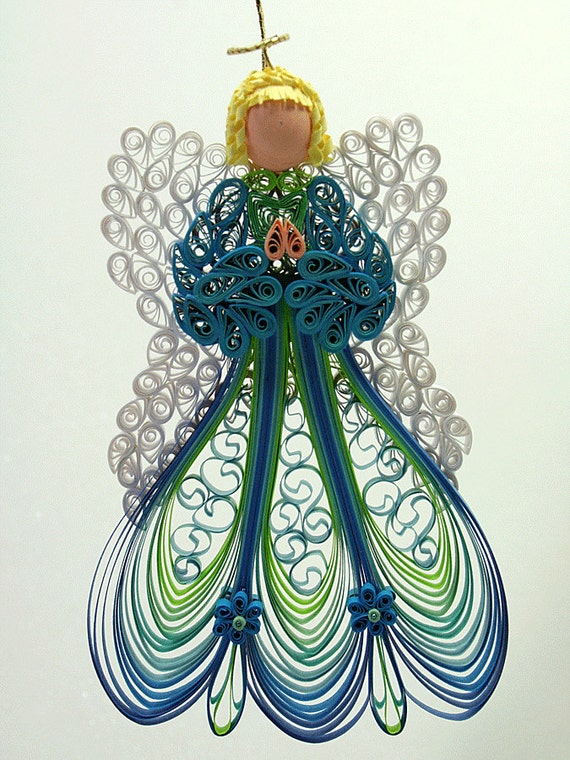
  4. A paper quilled angel
  5. An angel made from books pages
  6. New Year Angel Paper Doll - by Helen Page
  7. Very sophisticated paper angels from Carol - multi-media

The Pleated Christmas Heart

      Pleated Christmas hearts (Danish: Julehjerte) are a Danish and north German Christmas tree ornament.
      The exact age and origin of the tradition of making paper hearts is unknown, but the oldest known pleated Christmas hearts were made by the Danish author Hans Christian Andersen in 1860. However, as Andersen's heart has no handle, it seems unlikely it could have been used as a Christmas tree ornament. That pleated heart is today located in the Hans Christian Andersen House in the city of Odense in Denmark. We know, however, that Andersen did make decorations for Christmas trees, and that the predecessors of the pleated Christmas hearts were made from wicker baskets.
      The oldest known guide to making pleated Christmas hearts is found in the Official Nordic handicraft Journal from 1871, and the oldest pleated Christmas heart (from 1873) is preserved at the National Museum in Copenhagen. But it was still some 40 years before the pleated Christmas hearts became more widespread.
      It is believed that kindergartens from around 1910 started spreading the use of the pleated Christmas hearts which were made from glossy paper in order to enhance the children's creative abilities, patience and fine motor skills.
      The first pleated Christmas book, called Julehjerter, was released by the Lottrup Knudsen brothers in 1975.
      A more recent book, which includes a big variety of pleated Christmas heart templates, is Francis Jordt's Flettede julehjerter.

Woven Christmas Hearts:

Friday, December 14, 2012

Paper Silhouettes by Mrs. Collins

"Mrs. Collins" worked as a paper silhouette cutter in the city of Bath, England in the 1800s.

This silhouette portrait is presumed to of the famous author, Jane Austen.

Where does the word "silhouette" come from?

      Étienne de Silhouette (July 8, 1709 – 1767) was a French Controller-General of Finances under Louis XV.
      Sometimes said to be the next Niccolò Machiavelli, he was born in Limoges where his father Arnaud de Silhouette (from Biarritz, the modern Standard Basque form of the name would be Zuloeta) was sent. He studied finances and economics and spent a year in London learning from the economy of Britain.
Children learning to draw silhouettes in the 1800s
      He translated into French several works by Alexander Pope, Henry Bolingbroke, William Warburton's The Alliance between Church and State, (1736) as Dissertations sur l'Union de la Religion, de la Morale, et de la Politique (1742) and Baltasar Gracián's El político. The party of the Prince of Condé used his translations from English authors to criticize him but the protection of Madame Pompadour awarded him the position of Controller-General in 4 March 1759, the most extensive of all the administrative positions and a very unstable one. His task was to curb the running deficit and strengthen the finances for the Seven Years' War against Britain (1754–1763). Public opinion preferred his 72-million-livres public loan to the ferme générale, an outsourced tax collection system. He also reduced spending by the royal house and revised pensions. To favour free trade, he eliminated some taxes and established new ones operating on a unified French market.
      De Silhouette forecasted a bleak budget for 1760: income of 286 million livres compared to expenses of 503 million livres, including at least 94 million in debt service. In an attempt to restore the kingdom's finances by the English method of taxing the rich and privileged (nobility and church were exempt from taxes in the Ancien Régime). de Silhouette devised the "general subvention," i.e., taxes on external signs of wealth (doors and windows, farms, luxury goods, servants, profits). On 26 October, he took the war measure of ordering the melting down of goldware and silverware. He was criticized by the nobility including Voltaire, who thought his measures, though theoretically beneficial, were not suitable for war time and the French political situation.
      On 20 November 1759, after eight months in the position, he left the court and retired to a chateau at Bry-sur-Marne, where he set about improving it. After his death in 1767, his nephew and heir Clément de Laage completed that work.
      Étienne de Silhouette's short tenure as finance chief caused him to become an object of ridicule and his penny-pinching manner led the term à la Silhouette to be applied to things perceived as cheap.
      During this period an art form of growing popularity was a shadow profile cut from black paper. It provided a simple and inexpensive alternative for those who could not afford more decorative and expensive forms of portraiture, such as painting or sculpture. Those who considered it cheap attached the word "silhouette" to it. The name stuck and so today we know it as a silhouette.