Tuesday, April 2, 2013

The Old Testament Alphabet

      The following illustrated alphabet ( u is missing) is from "The Child's Colored Scripture Book," 1866. The plates have been restored by Kathy Grimm for teachers and parents to reprint freely.

Aaron, the High Priest of the
Jews, within the Temple pray'd,
And offer'd sacrifices, which were on the
altar laid.
Balaam the Prophet, on an ass,
a visit went to pay
To Balak; but an Angel stood to meet
him on the way.
Cain, the first son of Adam, full of
jealousy and pride,
Fiercely kill'd his brother Abel, and was
wretched till he died.
Daniel, faithful, brave, and pious,
was shut in the lion's den,
By the heathen King Darius, but came
safely out again;
For God, who made the lions, watches
over righteous men.
Elijah, when he hid himself, had
nothing left to eat,
But the Lord's ravens daily brought the
Prophet bread and meat.
Finding the infant Moses; who,
left at the river's side,
Was lying in a little ark, with fresh
bulrushed tied;
Great Pharoah's daughter pitied as the
child looked up and cried.
Goliath, of the Philistines the
leader and the pride,
Came forth and laugh'd while all the
host of Israel he defied;
But David, with a sling and stone, so
smote him that he died.
Hagar and Ishmael, her son,
out to the desert fled,
With water in a bottle, and a little loaf
of bread:
But, when they both had called to God,
in safety they were led.
Job suffer'd many sorrows, but was
patient to the end;
Knowing, in all his troubles, that the
Lord was still his friend.
King David, once a shepherd boy,
to Israel's throne was raised,
And, singing to his harp, in sweetest
Psalms he pray'd and praised.
Lot, with his wife and daughters,
left the Cities of the Plain,
Which, for their wickedness, God smote
with storms of fiery rain;
But Lot's wife was destroy'd, because
she would look back again.
Miriam, the Prophetess, was
Aaron's sister: she
Led forth the Jewish women, who
escaped from the Red Sea,
And danced and sang for joy that all her
nation was set free.
Noah alone, of all the people,
hated evil and loved good,
And when the earth was drown'd, by rain
from heaven, in a flood,
God taught him how to build a ship, or
ark, of gopher-wood.
Obadiah sought, from wicked
men, Elijah's life to save;
It was he who fed, and hid, a hundred
prophets in a cave.
Pharaoah, the King of Egypt,
Queen of Sheba. You have heard
how she from her own country came,
And brought rich gifts to Solomon, whose
wisdom, skill and fame,
Caused Kings and Princes to bow down
in homage to his name.
Ruth was the youthful widow, of
the tender, loving heart,
Who refused, in spite of poverty, from
Naomi to part.
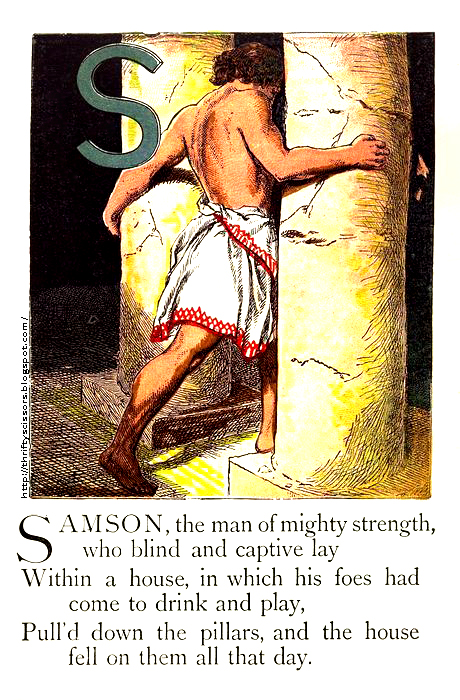
Samson, the man of mighty strength,
who blind and captive lay
Within a house, in which his foes had
come to drink and play,
Pull'd down the pillars, and the house
fell on them all that day.
Tubal-Cain was first of workmen,
who for useful metals sought,
And brass and iron into shape, at the
smith's anvil wrought.
Vashti, the Queen, refused to go
at her proud King's command,
And so was sent away, while Esther sat
at his right hand.
Widowed, and poor, and hungry,
the woman was who fed
Elijah, Prophet of the Lord, with a small
cake of bread;
But God returned a hundred-fold, and
kept her table spread.
Xis the letter which is used, to show
is the number ten,
And Ten Commandments Moses gave,
from God to sinful men.
Young Joash, when a little child,
was hidden from the sight
Of those who sought to slay him, and
was kept, both day and night,
Till priests and captains claimed for him
his own true kingly right.
Zedekiah, King of Judah, lived
to see his sons both slain,
Then blind and captive went away,
never to see again:
For he led an evil life, which brings
both misery and pain

Sunday, March 31, 2013

Cold Water

Here's water! cold water!
'Tis better than wine.
I drink to your health,
You drink to mine.

See how it glitters
And sparkles so clear.
How men can be drunkards
Seems to me very queer.


Clear water, cold water,
Is good for us all,
The soldiers and sailors,
The great and the small.

Brave lads and fair lasses,
Be you ever so fine,
There is nothing like water
For your health and mine.

Saturday, March 30, 2013

Valentine Mailbox Links

      In the United States, crafting Valentine mailboxes to collect letters and candy from classmates is an old, popular tradition. Although, most classroom teachers now ask their students to craft their mailboxes at home instead of making these at school. When I was young it was one of my favorite holidays to participate in at school. 
      I have also discovered that children from many different heritages and cultures love to exchange Valentines on February 14 during a classroom party; it makes little difference to them who first thought of the idea. A clever teacher can integrate both the study of history and literacy into a lesson about Valentines Day.  It is also a perfect opportunity to teach students of all ages about the lost art of letter writing.

The traditional Valentine mailbox is crafted from a shoe box or any other discarded box that you
may have on hand. Cereal boxes are often recycled for this mail box craft by school children.
These students have made folders and pasted hearts on top of them.
Folded Valentine mail carriers come in handy when boxes and bags are not readily available.

Teachers often help their students craft Valentine bags for collecting their mail at parties.
These are inexpensive and quick to decorate.
Students can transform their home made Valentine mailboxes into all sorts of unique critters!

Collect Your Valentines in A Traditional Valentine Mailbox: I will continue to collect all of the wonderful ideas that teachers, parents and students have come up with concerning the construction of Valentine mailboxes and link to them below.

Friday, March 29, 2013

Cute Little Paper Village Listings

      I've included a listing here of those paper houses, cities or village ideas experimented with and created by a wide variety of artists. Get inspired here. There are endless possibilities when designing your own paper village.

More Links To Little Paper Villages Everywhere:
  1. Crystal Cities by Rob Dunlavey
  2. Moldy Miniature Homes Left to Decay
  3. Little Paper Houses by Dianne Faw
  4. Round house village by even cleveland
  5. A Paper Craft Castle On the Ocean
  6. Little Church from Cut-Out Town
  7. Bird house treat box
  8. Tutorial: Glitter House
  9. The Toy Maker's Habitat for Humanity House
  10. Bath Paper Houses
  11. Wonderful paper city by joel! 
  12. Little house from Cut-Out Town
  13. DLTK 3D house templates
  14. How to decorate glitter houses
  15. Fall cottage house by Maya Road 
  16. Little houses for you and me
  17. Paper Lantern Houses
  18. Tiny Paper Village by Karin Corbin
  19. Persian Palace accordion cut from Mini-eco
  20. A Christmas House from Holly Hanks
  21. Haunted House Window card
  22. building a putz house
  23. Pop-up house card by Becca 
  24. City Lights
  25. The White House Paper Model
  26. Building The Little Charmer
  27. Shoe box apartment house
  28. Pop-Up paper village
  29. Make a recycled cardboard tube Christmas village
  30. Paper Village - Inn
  31. Paper Mache' Christmas Cottages
  32. Mel Stampz simply charming winter village diorama
  33. Wintertime paper village
  34. crowns and castles
  35. A little house box
  36. See our family's micca dusted cardboard houses from Japan...

Little Church from Cut-Out Town

First cut out the main body of the church along the heavy black outline. Then fold on all dotted lines and paste together. Next cut out the tower and paste together after folding. Then paste XX to X.
Paper dolls on Sunday go
To this little church, just so!
Two by two, just as they should.
Paper dollies are quite good!

Cut the little church out, dear.
On the outside black lines here.
Fold on all the dotted spaces,
Paste the flaps in proper places.

Little Cut-Out Town you see,
Is as good as good can be;
Little girls and little boys,
Learn this text of cut-out toys.

Design and Poem by E. Patten Beard.

Wednesday, March 27, 2013

Bessie's Knitting

Little Bessie busy knitting.
Tell me why?
On and on the ever-flitting
Hours go by;
Fleeter still her hands are flying
All so spry;
The soft twilight now is dying;
Night is nigh.

Can you tell me why she lingers
Here so long
'Tis love that prompts her nimble fingers
And her song;
Sweet thoughts of baby sister flocking 
Through her mind,
In the morning a new stocking
Baby'll find.

Thursday, March 21, 2013

The Little House From Cut-Out Town

      Cut out on black lines around the edges; fold on all dotted lines and paste X to XX. You will then have the house where Jan lived.

The Little House From Cut-Out Town was designed by E. Patten Beard.


Cut-Out Town is made of paper:
Paper houses, paper trees,
Paper flowers grown in boxes
In the windows--where you please

Cut-Out Town is very pleasant;
Paper dolls the whole long day
Play together in the houses
Paper games and paper play

Hurry! Hurry with the scissors!
Bring the gluepot or the paste
And we'll make the house of paper-
Tommy, here, is quite in haste!

Cut along the black lines folding 
Where the dotted lines all run,
Stick the side flaps--Ah! you have it!
There, the Cut-Out House is done!

By E. Patten Beard

Paper Patterns by Paul Konewka

      Paul Konewka was an artist remarkable for his skill and expression in silhouette designs. He was a Pole by birth and studied both sculpture and painting. His chief works are the illustrations of "Faust," and of the "Midsummer's Night Dream." I will eventually include these collections under his name. He died at the young age of 31 in Berlin, 1871.

A self portrait of Paul Konewka.


Related Content:

Paper Cutting Patterns by Auguste Edouart

Ad from New York Tribune, 1913.
      Auguste Amant Constant Fidèle Edouart (1789–1861) was a French-born portrait artist who worked in England, Scotland and the United States in the 19th-century. He specialized in silhouette portraits.
      "Born in Dunkerque, he left France in 1814, and established himself in London, where he began his career making portraits from hair. In 1825, he began work as a silhouette portraitist, taking full-length likenesses in profile by cutting out black paper with scissors. Edouart spent fifteen years touring England and in 1829 arrived in Edinburgh. He remained there for three years, during which time he produced some five thousand likenesses." Edouart travelled in the United States ca.1839-1849, visiting New York, Boston, and other locales. He later returned to France where he worked on smaller silhouettes. They included one of the most notable writer of this period, Victor Hugo.
Old Silhouette Present To Taft
Paper Likeness of President Tyler Made by Artist Edouart in 1841.
      Washington, June 28. --Mrs. E. Nowell Jackson, related to President Tyler, has presented to President Taft the original silhouette portrait of President Tyler, made by the artist, Auguste Edouart, in Washington, in 1841. It will be placed in the White House collection of presidential portraits.
      Mrs. Jackson has always been interested in silhouettes, the old black profile portraits of the eighteenth century.
      Six years ago she picked up a rare treatise on the art written by Auguste Edouart, a Frenchman, who toured in Great Britain and the United States, and cut the picture in black paper of every king, queen, princess, president and senator in any town he visited.

I've restored the silhouette to a facsimile from the very tiny version you see in a photo scan of the original newspaper.
Related Content:

Patterns by Silhouette Artist, Joseph Martin Klaus

A silhouette portrait of paper cutter, Joseph Martin Klaus.

Charlotte "Lotte" Reiniger

       Charlotte "Lotte" Reiniger (June 2, 1899 – June 19, 1981) was a German silhouette animator and film director. She was born in Berlin-Charlottenburg, German Empire, on June 2, 1899. As a child, she was fascinated with the Chinese art of silhouette puppetry, even building her own puppet theater so that she could put on shows for her family and friends.
      As a teenager, Reiniger fell in love with cinema, first with the films of Georges Méliès for their special effects, then the films of actor and director Paul Wegener, known today for The Golem (1920). In 1915, the young woman attended a lecture by Wegener that focused on the fantastic possibilities of animation.
      After a bit of persuasion, she convinced her parents to enroll her in the acting group Wegener belonged to, the Theater of Max Reinhardt. In an attempt to attract the attention of her distant and very-busy hero, she started making silhouette portraits of the various actors around her. This had its desired effect, and soon she was making elaborate title cards for Wegener's films, many of which featured silhouettes. 
      In 1918, Reiniger animated wooden rats and created the animated intertitles for Wegener's Der Rattenfänger von Hameln (The Pied Piper of Hamelin). The success of this work got her admitted into the Institut für Kulturforschung (Institute for Cultural Research), an experimental animation and shortfilm studio. It was here that she met her future creative partner and husband (from 1921), Carl Koch, as well as other avant-garde artists such as Hans Cürlis, Bertolt Brecht, Berthold Bartosch, and others.
      The first film Reiniger directed was Das Ornament des verliebten Herzens (The Ornament of the Enamoured Heart, 1919), a short piece involving two lovers and an ornament that reflected their moods. The film was very well received. She made six short films during the following few years, all produced and photographed by her husband. These were interspersed with advertising films (the Julius Pinschewer advertising agency invented ad films and sponsored a large number of abstract animators during the Weimar period) and special effects for various feature films – most famously a silhouette falcon for a dream sequence in Part One of Fritz Lang's Die Nibelungen). During this period she became the centre of a large group of ambitious German animators, such as Bartosch, Hans Richter, Walter Ruttmann, and Oskar Fischinger.
      In 1923, a unique opportunity came her way. She was approaced by Louis Hagen, who had bought a large quantity of raw film stock as an investment to fight the spiraling inflation of the period, who asked her to do a feature length animated film. The result was The Adventures of Prince Achmed, completed in 1926, the first animated feature film, with a plot that is a pastiche of stories from One Thousand and One Nights. Although it failed to a find a distributor for almost a year, once premiered in Paris (thanks to the support of Jean Renoir), it then became a critical and popular success.
      Reiniger anticipated Walt Disney and Ub Iwerks by a decade by devising the first multi-plane camera for certain effects. In addition to Reiniger's silhouette actors, Prince Achmed boasted dream-like backgrounds by Walter Ruttmann (her partner in the Die Nibelungen sequence) and a symphonic score by Wolfgang Zeller. Additional effects were added by Carl Koch and Berthold Bartosch.
      The success of Prince Achmed meant that Lotte Reiniger would not need a stroke of luck to make a second feature. Doktor Dolittle und seine Tiere (Doctor Dolittle and his Animals, 1928) was based on the first of the English children's books by Hugh Lofting. The score of this three-part film this time was composed by Kurt Weill, Paul Hindemith and Paul Dessau.
      A year later, Reiniger co-directed her first live-action film with Rochus Gliese, Die Jagd nach dem Glück (The Pursuit of Happiness, 1929), a tale about a shadow-puppet troupe. The film starred Jean Renoir and Bertold Bartosch and included a 20-minute silhouette performance by Reiniger.  Unfortunately, the film was completed just as sound came to Germany, and release of the film was delayed until 1930 to dub in voices by different actors – the result being so unsuccessful as to ruin any enjoyment of the film.
      Reiniger also attempted to make a third animated feature, based on Maurice Ravel's opera L'enfant et les sortilèges (The Child and the Bewitched Things, 1925), but found herself unable to clear the rights for the music with an unexpected number of copyright holders. She worked with British poet, critic, and musician Eric Walter White on several films, and he wrote the early book-length essay on her work – Walking Shadows: An Essay on Lotte Reiniger's Silhouette Films, (London: Leonard and Virginia Woolf, 1931).
      With the rise of the Nazi Party, Reiniger and Koch decided to emigrate (both were involved in left-wing politics), but found that no other country would give them permanent visas. As a result, the couple spent the years 1933–1944 moving from country to country, staying as long as travel visas would allow. They cooperated with Jean Renoir in Paris and Luchino Visconti in Rome. Somehow, they still managed to make 12 films during this period, the best-known being Carmen (1933) and Papageno (1935), both based on popular operas (Bizet's Carmen and Mozart's Die Zauberflöte). When World War II commenced they stayed with Visconti in Rome until 1944, then moved back to Berlin.
       In 1949, Reiniger and Koch moved to London, where she made a few short advertising films for the Ground Film Unit and John Grierson's General Post Office Film Unit. While she was living in London in the early 1950s she became friends with "Freddie" Bloom, who was the first director of the National Deaf Children's Society, and asked her to design a logo for the new charity. Reiniger responded by cutting out 4 children running up a hill. Bloom was amazed at her skill with the scissors – in a few moments she created about four different silhouettes of the children from black paper. The logo was used until the 1990s, when a design company was invited to revamp the design. The result was a very minor modification but the new design was also dropped a few years later.
      With Louis Hagen Jr. (the son of Reiniger's financier of Prince Achmed in Potsdam) they founded Primrose Productions in 1953 and, over the next two years, produced more than a dozen short silhouette films based on Grimms' Fairy Tales for BBC and Telecasting America. Reiniger also provided illustrations for the 1953 book King Arthur and His Knights of the Round Table by Roger Lancelyn Green.
      Reiniger was awarded the Filmband in Gold of the Deutscher Filmpreis in 1972; in 1979 she received the Great Cross of the Order of Merit of the Federal Republic of Germany. Reiniger died in Dettenhausen, Germany, on June 19, 1981, at the age of 82.

The Adventures of Prince Achmed

Title card from the 1926 animated film  
The Adventures of Prince Achmed
      The Adventures of Prince Achmed is a 1926 German animated fairytale film by Lotte Reiniger. It is the oldest surviving animated feature film; two earlier ones were made in Argentina by Quirino Cristiani, but they are considered lost. The Adventures of Prince Achmed features a silhouette animation technique Reiniger had invented which involved manipulated cutouts made from cardboard and thin sheets of lead under a camera. The technique she used for the camera is similar to Wayang shadow puppets, though hers were animated frame by frame, not manipulated in live action. The original prints featured color tinting.
      Several famous avant-garde animators worked on this film with Lotte Reiniger. These included Walter Ruttmann, Berthold Bartosch, and Carl Koch.
      The story is based on elements taken from the collection 1001 Arabian Nights, specifically The Story of Prince Ahmed and the Fairy Paribanou featured in Andrew Lang's The Blue Fairy Book. With the assistance of Aladdin, the Witch of the Fiery Mountain, and a magic horse, the title character reclaims the magic lamp and conquers the African sorcerer. The culminating scene in the film is the battle between "die Hexe" (the witch) and "der afrikanische Zauberer" (the African sorcerer), in which those characters undergo fabulous transformations. All is well in the end: Aladdin marries Dinarsade (Achmed's sister and daughter of the Caliph); Achmed marries Pari Banu; the African sorcerer is defeated; and the foursome return to the Caliph's kingdom.
       No original German nitrate prints of the film are known to still exist. While the original film featured color tinting, prints available just prior to the restoration had all been in black and white. Working from surviving nitrate prints, German and British archivists restored the film during 1998 and 1999 including reinstating the original tinted image by using the Desmet method.