Thursday, September 5, 2013

All 'descendants' of Johnny Appleseed

      This is Miss Isabel Million of Knoxville, Tenn., April 15, 1917, who invented the dolls with the dried apple faces. She carves the face in an apple which is then dried and preserved by a secret process, so that all the lines of the human face become as real as they are on her models.
      Left, Harve Hawkins and his old woman, Sairy Ann. He's the county's best known 'tater and melon fancier, and his income is pieced by Sairy Ann's quilting efficiency. Middle, Tobe Lemmons, of Smoky Cove, is "just po' white trash, with a misery in his chist which prevents him from making an honest living--just strong enough to peddle licker. Right, Old Poke Crouch of Greasy Cove, and his woman Cordie. They spend their time raising hawgs and orphans. Poke's official calling is that of a shoemaker, while Cordie is rated the *demon matchmaker of the the township.
      Left, Rhody Guinn, who makes rag carpets, lye soap and gathers *"yarbs" for a living. She is saving up to buy *"store teeth." Middle, Laviney Rupe of Turkey Egg Cove. Note, please, her crafty expression--acquired from being ceaselessly on the lookout for revenue officers. Viney's old man is a * moonshiner. Right, Miss Susie Adams, the village seamstress, caught on her way to the First Presbyterian Church. She hasn't missed a Sunday, nor a funeral, in forty years.
      Where the apple-doll models live. These cabin quarters on the right form the domicile of the real Harve Hawkins, whose daughter and granddaughter are seen in the midst of their week's wash. Photos and comments New York Tribune

* A "yarb" apparently was some variety of plant collected to make "home remedy" for cures. (medicinal purposes)
* A demon matchmaker forcasted love by witchcraft?
* Store teeth is a reference to dentures.  
*  A Moonshiner is a reference to one who makes Moonshine, white lightning, mountain dew, hooch, and Tennessee white whiskey are terms used to describe high-proof distilled spirits, generally produced illicitly. The word "moonshine" is believed to derive from the term "moonrakers" used for early English smugglers and the clandestine (i.e., by the light of the moon) nature of the operations of illegal Appalachian distillers who produced and distributed whiskey. Read more...

Wednesday, September 4, 2013

Links to More Than 100 Apple Crafts!

A worm, crafted from a paper chain, wiggles his way down the face of a vividly colored paper
 apple. With the combination of several ordinary tools plus materials found at any grocery or
drug store, your child can craft fun and easy apple projects for fall displays and school
assignments.

      Above is one of many paper apple crafts posted at Thrifty Scissors. Here I have combined several craft methods used by early learning teachers to develop the small motor skills of their young students. You will need the following supplies to make the apple craft shown above.
  • a large white paper plate
  • green, red, black and pink markers
  • a pale or lime green paper
  • goggle eyes
  • pinking shears 
  • regular scissors also
  • brown and green construction paper
  • white glue
Directions for the paper chain worm:
  1. Students may cut strips of paper using the pinking shears. This will give their worms a ruffled look. The number of strips will determine the length of their worms. Of course, the more links they add to the worm, the more practice students get at manipulating paper. I made the above worm from small half inch wide strips and looped these together into a very tight chain fold because I liked the look. If your classroom glue is not very tacky, teachers may wish to ofter students transparent tape to hold the loops together.
  2. Students must loop and paste each link into the previous link in order to craft a continuous linked chain. 
  3. When they have completed their worms to the desired length, instruct them to cut out a small round head for each worm and glue on the goggle eyes. 
  4. Draw smiles on the worm faces and then paste the paper heads to the last link on each chain. 
Directions for crafting the paper apple: 
  1. I suggest cutting apple shapes from a large white paper plates for this particular paper project. I could have used a red paper plates but this would have eliminated the coloring practice that my students needed. Some of you who are working with very young children may opt for this strategy. 
  2. Suggest the coloring of the white paper plate either red, green or yellow. Depending upon the personal preferences of each student.
  3. Then give each student brown and green scraps of construction paper to cut leaves and a stem for their paper apples. Attach these with school glue.
  4. Attach the paper chain worm with glue as well.
      Cutting, pasting, folding, coloring, and even twisting paper are the most popular and inexpensive practices included in this helpful listing for educators. Apple crafts and activities in during the Autumn months are quite common in classrooms all across the United States. 

Crafting paper apples:
  1. Back to school apple trees
  2. Apple Print Wreath
  3. Apple Tree Sewing Cards
  4. Apple life cycle paper plate project
  5. Woven paper apples
  6. An apple newsprint banner
  7. A paper apple book (bottom of page)
  8. Candy apple craft with scripture
  9. Phonics apple craft
  10. Fall Apples and Johnny Appleseed (Math, Craft, and Literacy Fun by Robin Sellers)
  11. Coffee Filter Apples
  12. Paint an apple tree on a paper plate
  13. Little Apple Yarn Favors
  14. Apple tree craft with buttons, tissue paper and a paper towel roll
  15. Paper bag apple tree
  16. Handprint, footprint apple tree
  17. Easy construction paper apple tree craft
  18. Craft an Apple Lacing Card from A Paper Plate
  19. Baby shower with apple theme, cute craft ideas!
  20. String a wormy apple craft
Crafting ceramic, clay and plastic apples:
  1. A bushel of apples to play with
  2. Plastic Bottle Apples
  3. Recycle clear, plastic lids into apples
  4. A clay and wire apple tree
  5. Salt dough apple wreath
  6. Attempting to throw an apple shaped pot on a wheel
Sewing/Knitting apple crafts:
  1. Apple Knitting Pattern Tutorial
  2. Apple Hats!
  3. Apple Tea Cozy & Coasters
  4. Felt wool apple with removable slices
  5. Sample photos of felt apples from "Big Little Felt Universe"
  6. Japanese peal away felt apple
  7. Apple + Watermelon Gift Pouches
  8. Felt apple themed tea set for kiddos (pictures only)
  9. Pattern for felt apple bean bags
  10. Little Apple Yarn Favors
  11. How to make an apple pin cushion
  12. Apple embroidery hoop picture tutorial
  13. Apple Print Tee Shirts
  14. Quilted apple picture collage for school children (picture only)
  15. Sew the perfect apple pincushion
  16. The very complicated apple tree knit scarf
  17. Stamping with paint onto knit shirts
  18. Bushel of Apples Felt Garland
  1. Apple Unit (educational games)
  2. Apple games for early learners
  3. Free Apple Activities Pack
  4. Homeschool Share – Johnny Appleseed
  5. Homeschool Creations Apple Read Write Build
  6. Confessions of a Homeschooler – A is for Apple
  7. All Our Days Apple Packs
  8. Spell Out Loud – Apple Pattern Cards
  9. 1+1+1=1 – Apple Printables
  10. Four Seasons of an Apple Tree 
  11. Apple Scented Cloud Dough
  12. Apple pie scented play dough
  13. Apple roll and pick game
Sweet Apple Deserts and Treats: 
  1. Warm Apples and Ice Cream
  2. Apple Tree Snack
  3. Apple Cupcakes with Caramel Buttercream
  4. Individual Apple Tarts
  5. How to make hot pink candy apples
  6. Apple cookies for the teacher and classmates on first day of school
  7. How to make perfect candy apples
  8. Tasty Apple Smiles by Pirate Lifestyle
  9. Spiced Apple Waffles
  10. Homemade Applesauce
An Apple for The Teacher:
  1. Surprise your teacher with an edible chalkboard
  2. Teacher Appreciation - printable apple tags by Paula Biggs
  3. thank you teacher card by Juliette Hirons
  4. Printable Teacher Thank You Notes - from tip junkie
  5. Apple Tree Magnet Board - for cute little framed photos for her students...
  6. Draw a back to school stack of books and apple - for your teacher by Art for Kids Hub
  7. Give your teacher a wooden basket craft  - with chalk work apples and strawberries!
  8. Apple Gift Basket - idea by 30DAYS
  9. How to make a book page apple for your favorite teacher's desk...
The Apple in Literature:
  1. "The Giving Tree'' - read aloud by Keith Carradine
  2. "Ten Red Apples," by Pat Hutchins
  3. ''Apple Trouble'' - read aloud by Ms. Michelle's Story time
  4. "Oats and Wild Apples," by Frank Asch
  5. "Bad Apple'' a tale of friendship read aloud by KidTimeStoryTime and puppet friends 
  6. Who as Johnny Appleseed?
Apple Facts:
  1. Apples: History & Nutrition
  2. The history of apples by Homeschool Arcade who, when, what, how...

Monday, September 2, 2013

Craft an Apple Lacing Card from A Paper Plate

Lacing cards needn't be expensive; just make your own from durable paper plates!

      This apple themed lacing card is so easy to craft. The only supplies you will need: a durable paper plate, makers, some twine and a hole punch. Draw your apple outline onto the front side of your paper plate. Then punch holes around the apple and number each hole so that your child may use the activity as a counting exercise as well. Then color the apple bright red and the stem brown and the leaves a vivid green. Add a piece of twine that is long enough to string all of the way around the paper plate's circumference. I knotted a small plastic bead to one end of my twine and strung it through the first hole (1.)  Then I taped the twine firmly in place with a transparent tape so that it would be held in the proper position for stringing.

Craft more lacing cards:

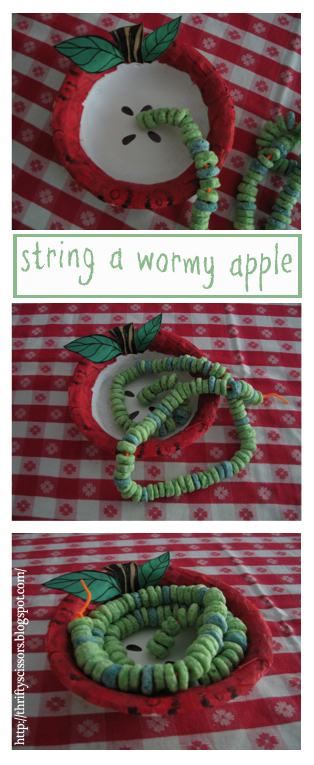
String a Wormy Apple Craft

String a wormy apple.
      This little wormy apple is made with just a few simple materials you can purchase from a local grocery store. Here is a supply list:
  • small, durable paper bowls
  • red tissue paper
  • green and brown construction paper
  • a black marker
  • a shoe string (preferably white)
  • white glue
  • tape
  • scissors
  • one box of Kellogg's Froot Loops
Step-by-Step Directions:
  1. With the pointed end of your scissors, punch a whole in the bottom of the paper bowl that is just big enough to push the end of your shoe string through to the backside of the bowl. Tape this end firmly to the back side so that your shoe string is permanently attached to the bowl. 
  2. Draw and color in a few tiny apple seeds on the inside bottom of your bowl. This will represent the core of your apple. 
  3. Now the bowl is ready for a small student to decorate with tissue and construction paper. At this point you could have your student(s) paint the bowl instead. I have chosen to use a layered torn paper method for the project in order to avoid the accidental consumption of paint. However there are many non-toxic and even edible paints on the market today that teachers could use alternatively for the craft project here without worry. The bowl is not intended for liquids to be poured into it; but the cereal worm might get a little paint on it before your student(s) ingest that part of their craft.
  4. Layer red tissue with white school glue just around the edge of the bowl approximately one inch down the sides in order to suggest a bright red apple. 
  5. Then cut and paste a simple stem and two leaves to the top half of your apple bowl to further suggest the apple's realistic appearance. 
  6. Now empty the Kellogg's Froot Loops into a large bowl and place it in the center of your cleaned work table. Make sure the bowls have dried over night and that your students have very clean hands while they string their cereal worms.
  7. Be prepared for much of the cereal to disappear into little hungry mouths! Knot the end of their worms and send the craft home. 
On the far left, you can see how the shoe string looks when it has been poked through the backside of the paper bowl.
Center is a picture of the paper apple bowl before a student has strung their cereal worm. On the far right, is a picture
of the shoe string as it looks unraveled and ready for stringing.
Stringing small objects like Froot Loops or Cherrios can help
develop your child's small motor skills.
Because this craft activity is edible, teachers may wish to string
 cereal worms during snack time at their preschool or kindergarten.

Sunday, September 1, 2013

B is For Button and Also CORE

      As you can see, early learners do practice following instructions and manipulating materials by large degrees of difference. On the far left, this student is just beginning to learn how to hold a small tool; dipping a Q-tip into glue and pasting down the tiny buttons presented a real challenge to him. The middle student filled his entire paper with the tiny buttons with both the confidence and delight of child with advanced motor skills. The student on the far right, however, is completing the project by the most advanced literacy means. 
      It is clear that she understood her teacher's vocabulary and directions because the students were asked to glue the buttons inside the shape of the letter only. This direction was not given in order to establish an aesthetic interpretation of art, but to determine if the young students understood the concept of "inside" a letter shape versus the "outside" of a letter's shape. Establishing the visual boundaries of the alphabet is one of the primary literacy skills taught to early learners. 
      Often parents and some teachers mistake the agenda of art activities in preschool.  They believe that their child is being judged by standards of personal taste, when in fact they are not being assessed by cultural aesthetic preferences at all. Art serves a wide variety of purpose in schools and should never be interpreted by agenda that is superimposed by outside observation. Parents can learn so much about "how" their child is learning concepts just by asking the teacher a few key questions:
  • Is it important that my child colors in the lines? If so, why? 
  • Is this exercise teaching more than motor skill?
  • How is art used to teach my child literacy?
      It is also important for parents to know that at the early stages of development, there are no absolute wrongs in the manipulation of art activities. The students are just beginning to explore and learn with the materials. They are also spending much of their time learning how to listen to language and how to follow directions and what words mean. This takes time and patience on the part of adults. Do not openly judge your child's work with phrases like, "Oh look her work is so much better than his" or "I guess little Johnny just isn't as good as Alex in art." Your child can hear you make these kinds of judgements and develop an idea about his own competency far too early in his own life experiences. Try to involve yourself in his explorations with an open mind to possible discovery. Wait to verbalize any opinions. Sometimes just describing the activity is enough with phrases like: "Wow, you smeared a lot of blue paint!" or "It must be fun to glue pasta onto paper, I thought is was only for eating!"
       Our students range from ages 3 to 5 in the early learning center. At this stage of their development, they are learning preliteracy skills. There are literally hundreds of methods and means to use when teaching preliteracy skills to very young students. I will share as many of these in my ABC Daily journal as I am able to note during my teaching experiences at the school. A few of these activities are precursors to CORE standards adopted by my home state of Missouri. The CORE standards begin at Kindergarten, not preschool. However, preschool curriculum can be designed to compliment CORE initiatives. I have listed below the few kindergarten standards addressed by the activity we completed with the letter B last week.

Reading: Foundational Skills - Print Concepts:
CCSS.ELA-Literacy.RF.K.1d Recognize and name all upper- and lowercase letters of the alphabet.

Speaking & Listening - Presentation of Knowledge and Ideas:
CCSS.ELA-Literacy.SL.K.4 Describe familiar people, places, things, and events and, with prompting and support, provide additional detail.
CCSS.ELA-Literacy.SL.K.5 Add drawings or other visual displays to descriptions as desired to provide additional detail.

Below are the agenda covered by the lead teacher during this simple preliteracy lesson:
  • The teacher introduced the letter B to her students.
  • Students repeated the sound of the letter after hearing their teacher make the sound herself.
  • The teacher discussed the shape of B with the students.
  • The teacher then asked the students what familiar things started with the letter B.
  • The word button was introduced as beginning with the sound and the literal letter B.
  • The teacher then showed her students a printed sheet with a capital letter B
  • Students were instructed to glue buttons inside the letter B using a Q-tip, white school glue and a wide variety of colored plastic buttons.
Common Core State Standards listed above © Copyright 2010. National Governors Association Center for Best Practices and Council of Chief State School Officers. All rights reserved.”

Saturday, August 31, 2013

Four Easy Ways to Develop Small Motor Skills in Early Learners


      These jumbo sized plastic tweezers are perfect for developing hand muscles in tiny pupils. They have large easy to grip handles and require the child to apply a considerable degree of pressure to ensure firm control of the object he or she is moving. These two factors are important because the tool needs to be safe but also effective in gradually increasing strength of a small child over a period of it's use. 
      Early learning centers often supply activities that require the use of tweezers such as these. The tasks appear to be almost too simple on the surface until you pick up the tool and squeeze it between your pointing finger and thumb. This is not such an easy task for a two or three year old. In order for the tool to work, however, one must supply ample opportunities for it to be used on a daily basis.

    
    Tracing both around a heavy cardstock stencil as well as inside of one is an excellent way to build up a child's eye-hand motor coordination. Very simple shapes should be used to begin the exercise with. Then the instructor should gradually complicate the stencils in order to build dexterity and patience in the student. 
      As the child ages, teachers may then ask him or her to cut out the shapes they have traced with the stencil. The progression of this technique will cause students to constantly focus and adapt their abilities to task. 
      Above are examples that I would expect a fourth grader to successfully cut out. However, a third grader should have no trouble with tracing around or inside these shapes. Younger children should be given geometric stencils and also be taught the names of their shapes in preschool.


      Lacing cards come in every shape, size and theme. These are also easy to make with clipart, a whole punch and heavy cardboard. The lacing cards pictured above are coated with a durable plastic so that they will endure heavy use; some lacing cards are actually made of wood. Students may use yarn, ribbon or shoe laces to string in and out of the holes around the pictures. 
      The literal act of pushing a lace through a small hole forces a child to manipulate tiny objects in a restricted way. These movements are early preparation exercises for writing. Hand control skill learned with this toy will help to insure that similar control over a pencil. Like many small motor exercises, lacing cards must be repeated daily in order for it their benefit to be substantial. Parents, teachers and child care providers should encourage their young students to lace cards, pinch with tweezers and draw around stencils for at least ten minutes every day up until they have mastered handwriting.


      Above is a zipper purse designed in the colors of a rainbow. This zipper purse is very easy to manipulate and is probably better suited to an infant. Dolls and quite books made with zippers, buttons, shoe strings, snaps etc... are also very popular toys designed to develop eye-hand coordination in young children.

More Related Links:

Create A Manuscript to Cursive Chart

      During my student teaching program, I developed several art lessons integrating cursive writing. Many of my second grade elementary students did not know how to read or write cursive because it was no longer being taught in that particular district. It was necessary for me to create a chart that students could refer to as they created picture designs with cursive letters. This chart was very large and could be easily seen from any table in my classroom. 
      The students loved learning the old form of writing and the second grade teachers were very pleased with the inclusion of the lesson in our art classroom as well. Unlike some homeroom teachers, art teachers in Missouri are free to integrate penmanship projects into their lesson plans without constraint. 
      I am of the opinion that no English speaking country should neglect teaching students to read their own language, if they can possibly help it. It is entirely irresponsible on the part of any state to exclude cursive reading and writing, even though it is not used nearly so much in our time.  For if we neglect to pass down obvious knowledge, our children will become easy to control and be easily manipulated by those who may not have their best interests at heart.
      You cannot imagine the grief that I felt, when I discovered that so many of the high school students that I taught during my student teaching program could not read any kind of text. Then after being placed into a wealthier district for elementary training, I discovered that well over half of those young students could not read or writer a cursive letter. How easy it will be to control the minds of these American students. The parents, politicians and teachers have endangered the futures of these children in my opinion. (My heart is very sad over this.)

      Illiteracy: The Downfall of American Society It is a chronic crisis of huge proportions, one that keeps millions of Americans living in the shadows.

Develop Small Motor Muscles with Clothespins and Paper Plates

Our students have been working with clothespins in order to better develop their small motor skills.
      Young children have untrained fingers as well as underdeveloped muscles in their hands. The simple act of pinching down on a clothespin with one hand and attaching this to a paper plate can be very difficult for them. In the photo above, our lead teacher has drawn a funny face on a paper plate and printed number cards for a game using clothing pins. The pins represent the hair. Every child draws a number from the center stack which tells him or her how many clothespins to attach to the paper plate. The students were fascinated with attaching the clothespins over and over, even though it proved difficult, none of them wanted to give up with the exercise!

Restored Antique Alphabet Prints

      These restored antique alphabet prints would look charming in a child's nursery/bedroom or a homeschool classroom. I've cleaned and restored them for your next alphabet craft. Enjoy and read the Terms of Use before printing them out.

The above image for pinning please.
A was and Apple, an Archer, an Arrow. B was a Bird, Bear and a Barrow.
C for Cat and D for Dish, E for an Elephant, F for a Fish.
G for Goose and Ha for Ham, I for an Inn and J for Jam.
K for Kite and L for Light. M for the Moon and N for Night. O for Owl and P for Prattle,
Q for the Queen and R for Rattle.
S for Ship and T for Tap, U for an Urn and V for Vat. W for Windmill, for Watch & Wren,
 X stands in English for no word but ten.
Y is for Yew, for Youth and for Yeast, Z is for Zebra a beautiful beast.
More Restored Alphabet Print by Kathy Grimm:

Tuesday, August 27, 2013

"Oats and Wild Apples," by Frank Asch

"Oats and Wild Apples," by Frank Asch
      "Oats and Wild Apples," by Frank Asch is a charming little book about the afternoon adventures of a young calf and fawn. These two wander deep into the woods to eat wild apples and then calf introduces fawn to his barn and oats. Fawn and mother deer, calf and mother cow are finally reunited at the end of the day with great relief and affection.
      Frank Asch (born August 6, 1946 in Somerville, New Jersey) is an American children's writer, best known for his Moonbear picture books. In 1968, Asch published his first picture book, George's Store. The following year he graduated from Cooper Union with a BFA. Since then he has taught at a public school in India, as well as at a Montessori school in the United States, conducted numerous creative workshops for children. He has written over 60 books, including Turtle Tale, Mooncake, I Can Blink and Happy Birthday Moon. In 1989 he wrote Here Comes the Cat! in collaboration with Vladimir Vagin. The book was awarded the Russian National Book Award and was considered the first Russian-American collaboration on a children's book.

"Ten Red Apples," by Pat Hutchins

"Ten Red Apples," by Pat Hutchins
      "Ten Red Apples," by Pat Hutchins is a delightful little counting book. Every time one of the farmers animal friends visits the apple orchard, there are fewer apples to eat! Young students will love the playful little illustrations that Hutchins uses to illustrate the basic concept of subtraction. She also uses classic onomatopoeia that little folks are always entertained by.
      Pat Hutchins (born 18 June 1942) is an English illustrator and writer of children's books. She won the 1974 Kate Greenaway Medal from the Library Association, recognizing the year's best children's book illustration by a British subject. The work was The Wind Blew, a picture book in rhyme which she also wrote. It shows how "a crowd of people anxiously chase their belongings" in the wind.
      Hutchins is married to illustrator Laurence Hutchins, with two children. She has written books for early readers that he has illustrated.She was born 18 June 1942 in Yorkshire, the sixth of seven children.She won a scholarship to Darlington School of Art in 1958 and continued studying illustration at Leeds College of Art in 1960, graduating 1962. She worked for advertising agency in London to 1966 when she married Laurence Hutchins and moved to New York City for two years. There she worked on writing and illustrating her first picture book, Rosie's Walk, published in 1968 by The Bodley Head and Macmillan US. In the U.S. it was a runner up for the Boston Globe–Horn Book Award and the librarians named it a 1968 ALA Notable Book. It remains her work most widely catalogued by WorldCat participating libraries. Pat Hutchins has written novels for early readers, some illustrated by husband Laurence, and more than two dozen picture books. Beside winning the 1974 Greenaway Medal, she was a commended runner up for One-Eyed Jack (1979), another book she wrote and illustrated.She also played the role of an artistic narrowboat owner in the British children's television series, Rosie and Jim. She was a presenter on the series and subsequently illustrated books for the franchise.


Johnny Appleseed Praise and Worship

"Learn it. Live it. At least when you're walkin' the orchard!"

This song, sung by Dennis Day, was part of the short 1948 Disney classic,"Johnny Appleseed"; A retelling of the story of John Chapman, who spent his life roaming America and planting apple trees, thus earning his nickname. Then entire movie can be found on Youtube under "Johnny Appleseed Song".

Lyrics:
The Lord is good to me
and so I thank the Lord,
for givin' me the things I need,
the sun and rain and an appleseed,
Yes, He's been good to me.

I owe the Lord so much,
for everything I see,
I'm certain if it weren't for Him
there'd be no apples on this limb.
He's been good to me.

Oh, here am I 'neath the blue, blue sky,
A-doin' as I please!
Singin' with my feathered friends,
Hummin' with the bees.

I wake up every day,
As happy as can be
Because I know that with His care
My apple trees, they will still be there.
Oh the Lord is been good to me.

(Another verse I found online, but not in the Disney movie)

Every seed I sow will grow into a tree
and soon there'll be apples there
for everyone in the world to share.
The Lord is good to me.