Monday, November 18, 2013

Coloring Page of "The Woodcutter's Song"

      The above coloring sheet is from "Walter Crane's Painting Book" for children.  I have also included the small color image below by Crane for coloring reference. These were also included in the original coloring book when it was first published in 1880. I have posted the Mother Goose Rhyme that I believe Crane to have made the illustration for. These rhymes were well known in the late 1800s but are no longer chanted by the school children of today.

The Woodcutter’s Song
Oak logs will warm you well  
That are old and dry  
Logs of pine will sweetly smell   
But the sparks will fly 
Birchs long will burn too fast  
Chestnut scarce at all sir  
Hawthorn logs are good to last  
That are cut well in the fall sir 
Surely you will find  
There´s no compare 
with the hard wood logs  
That´s cut in the winter time 
Holly logs will burn like wax
 
You could burn them green  
Elm logs burn like smouldering flax  
With no flame to be seen  
Beech logs for winter time  
Yew logs as well sir  
Green elder logs it is a crime  
For any man to sell sir 
Surely you will find  
There´s no compare 
with the hard wood logs  
That´s cut in the winter time 
Pear logs and apple logs 
 
They will scent your room  
and cherry logs across the dogs  
They smell like flowers of broom  
But ash logs smooth and grey  
Buy them green or old, sir  
and buy up all that come your way 
They´re worth their weight in gold sir 

Coloring Page of "Here We Go Round the Mulberry Bush"

      The above coloring sheet is from "Walter Crane's Painting Book" for children.  I have also included the small color image below by Crane for coloring reference. These were also included in the original coloring book when it was first published in 1880. I have posted the Mother Goose Rhyme that I believe Crane to have made the illustration for. These rhymes were well known in the late 1800s but are no longer chanted by the school children of today.
 
The most common modern version of the rhyme is:
Here we go round the mulberry bush,
The mulberry bush,
The mulberry bush.
Here we go round the mulberry bush
So early in the morning.

Sunday, November 17, 2013

"Little Red Riding Hood" at Thrifty Scissors

Visit the Thrifty Scissors Today! Pin this image
only please.
      Little Red Riding Hood, or Little Red Ridinghood, also known as Little Red Cap or simply Red Riding Hood, is a French and later European fairy tale about a young girl and a Big Bad Wolf. The story has been changed considerably in its history and subject to numerous modern adaptations and readings. The story was first published by Charles Perrault. Little Red Riding Hood is number 333 in the Aarne-Thompson classification system for folktales. Read more . . .
      The coloring pages below are based upon a very old European fairy tale version of "Little Red Riding Hood." I have redrawn and resized them for printing and coloring. Teachers and homeschoolers may print unlimited copies of these particular images for their classroom activities.
Little Red Riding Hood gives her mother hugs and kisses before starting her
 long journey through the woods to visit her elderly grandmother. See, her mother has
made up a basket of food for her to take.
Color this picture of Little Red Riding Hood walking through the woods.
Above is a coloring page of Little Red Riding Hood knocking at her
grandmother's cottage door.
Color this picture of Little Red Riding Hood asking the wolf, who is in
disguise, "Grandmother, what big eyes you have?"
More Excellent Links to Little Red Riding Hood:
       "Ms. Booksy puts her spin on the classic Little Red Riding Hood fairy tale story, complete with a big bad wolf, a little old grandma, Twinkies, hot sauce, ketchup, mayonnaise, and more! What story do you want to hear next? Let us know in the comments below! And subscribe so you'll never miss a Cool School class every Friday!" from coolschool
Teachers may print out this picture puzzle of Little Red Riding Hood.
Spin it around and try to find the Big Bad Wolf hiding somewhere in the woods.

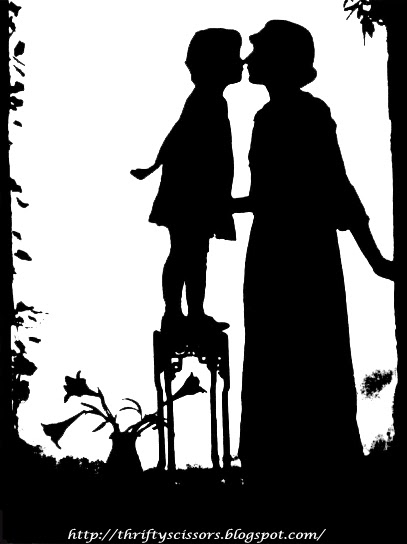
Silhouette of Mother and Child In A Garden

A silhouette of a mother and child touching noses;
 they are pictured with a vase of lilies.

"Cinderella" at Thrifty Scissors

Visit the Thrifty Scissors Today! Pin this image
only please.
       Cinderella, or The Little Glass Slipper, (French: Cendrillon, ou La petite Pantoufle de Verre, Italian: Cenerentola, German: Aschenputtel) is a folk tale embodying a myth-element of unjust oppression/triumphant reward. Thousands of variants are known throughout the world. The title character is a young woman living in unfortunate circumstances that are suddenly changed to remarkable fortune. The oldest documented version comes from China, and the oldest European version from Italy. The most popular version was first published by Charles Perrault in Histoires ou contes du temps passé in 1697, and later by the Brothers Grimm in their folk tale collection Grimms' Fairy Tales.
       Although both the story's title and the character's name change in different languages, in English-language folklore "Cinderella" is the archetypal name. The word "cinderella" has, by analogy, come to mean one whose attributes were unrecognized, or one who unexpectedly achieves recognition or success after a period of obscurity and neglect. The still-popular story of "Cinderella" continues to influence popular culture internationally, lending plot elements, allusions, and tropes to a wide variety of media. Read more . . .
       The coloring pages below are based upon a very old European fairy tale version of Cinderella called, "The Little Glass Slipper." I have redrawn and resized them for printing and coloring. Teachers and homeschoolers may print unlimited copies of these particular images for their classroom activities.

In this coloring page Cinderella's step-mother made her do all the hard work
of the house; scrub the floor, polish the grates, wait at the table,
and wash up the plates and dishes.
You can color the picture of the day, Cinderella's two step-sisters received an invitation
 to a ball that was to be given at the palace of the King, in honor of his son
 the Prince, who had just come of age. An invitation to this ball being a great honor,
the sisters were in high glee, and at once began making ready to appear there in
 grand style.
This coloring page shows that Cinderella soon dried her tears; and when her godmother said,
"Fetch me a pumpkin," she ran and got the largest she could find.
This coloring page shows that there was a great stir at the palace when the splendid carriage
was driven up, and Cinderella alighted. The Lord High Chamberlain himself escorted
 her to the ball-room, and introduced her to the Prince, who at once
claimed her hand for the next dance. Cinderella was in a whirl of delight,
and the hours flew all too fast.
Color Cinderella as she jumps up from her seat by the side of the Prince, rushes across
the room, and flies down stairs, at the stroke of midnight.
In this coloring page, the King's son decides he will marry the lady who is able to wear the glass slipper which was dropped
at the late ball at the royal palace.
This coloring page illustrates Cinderella consenting to become the prince's wife. Their wedding soon took place, the festivities attending it being the most splendid that had ever been seen in the kingdom.

More Cinderella Coloring Pages:
More "Cinderella Stories" Online:
Cinderella in Ads:
Modern Versions of "Cinderella" movie trailers:
Cinderella Web Pages:

Print and cut-out the mystery jigsaw to find out who is pictured.

Sunday, November 10, 2013

Color and Shade Vintage Racing Cars

      Above and below are "digital tracings," of vintage race cars. Students may practice shading techniques on top of the printed digital tracing. After a student learns shading techniques with a number 2 pencil, he or she may choose to try working with colored pencils or even watercolors in order to enhance the digital tracing above. 
      Advanced students may be challenged to color and shade the digital tracing in colored pencils.


      I have included below a video of vintage race cars by Chris Ashworth. These Indy Cars are from the 1950s and were shown at the Michigan International Speedway. You can click on the lower right hand part of the video to visit youtube and read more about it.
      Also watch more video that I've linked to below in order to see the equipment of the cars and how these were typically finished before drawing on top of your own digital tracings.


More Related Content:

Coloring Pages of Antique Automobiles

I will upload many more cars here eventually. I have dozens on file but they need to be redrawn and resized for the internet.
Old-fashioned Chevrolet.
   
Old Studebakers are from 1906. Have fun coloring pictures of the cars driven by your great grandparents!
Find More Cars to Color:

Working With Melted Crayons


"This little video shows you how to use the melted crayon technique on a die cut and then etch into it to bring out details. The etched lines may then be covered in crayon again to darken them or left as light lines.

The die cut is available from www.paperthreads.com; just laury
For a limited time I will be giving away the die cut files for this little fish on my blog justlaury.paperthreads.com
( by downloading the little fish you are agreeing to abide by my terms of use as listed on my blog)"

Music is from superfan2010.com
Carly Comando's Cordelias Lullaby
find more of Carly's music at www.deepelm.com or on itunes
video by Laury Vaden

Color This Bird in A Meadow by Kate Greenway

This bird in a meadow was illustrated by Kate Greenway in 1880 for a young student's paint book.

More About Kate Greenaway:

Color Two Billy Goat Friends


      I've included the video below so that teachers and parents can show the video and then talk with their student or child about the colors and characteristics they see in the real Nubian goats before making selections of materials to color their own picture.

Additional coloring pages of goats:

Color This Barnyard Scene by Kate Greenway


      This coloring page is from the one from one of the earliest coloring books published in the United States. The author was George Weatherly and the illustrator Kate Greenaway, "The little folks nature paint book" was published in 1880.
      In the 1800s coloring books included poems and stories as well as coloring pages. Students were expected to use watercolors to fill in the illustrations instead of crayons.
      You can paint this coloring page with watercolors if you print it out on water color paper. This is a sturdier paper with a slight texture that "grips" the watery paints so that these will not run or pool all over the paper's surface.

"A video about one of the first famous Children's Literature authors, Kate Greenaway. The video reveals how colored children's books were made, using wood blocks that had the pictures and text etched out in them."

Color An Elephant

 
       Elephants are ubiquitous in Western popular culture as emblems of the exotic because their unique appearance and size sets them apart from other animals and because, like other African animals such as the giraffe, rhinoceros, and hippopotamus, they are unfamiliar to Western audiences. Popular culture's stock references to elephants rely on this exotic uniqueness. For instance, a "white elephant" is a byword for something expensive, useless and bizarre.
       As characters, elephants are relegated largely to children's literature, in which they are generally cast as models of exemplary behavior, but account for some of this branch of literature's most iconic characters.

Many stories tell of isolated young elephants returning to a close-knit community, such as:
Other elephant heroes given human qualities include:
More than other exotic animals, elephants in fiction are surrogates for humans, with their concern for the community and each other depicted as something to aspire to in stories like:
      Print and color my elephant below after watching the video of the elephant in this post. Look carefully at the color of his skin and how you might shade in different areas of his body and the rocks that surround him in order to make him look three dimensional.  I have shaded parts of him already to help you get started.