Wednesday, November 16, 2022

Halloween Silhouettes for The Classroom

        These silhouettes (cut from black paper for decorating windows or cut from white paper for decorative borders) are made by folding a sheet of paper into three sections as show below. The folded sections are then folded once more to make three sections of equal size. Sketches for the silhouettes should be made twice the width and exactly the height of the paper in its final fold. When satisfactory sketches are completed and after care has been taken to have them symmetrical and with no cutting to be done through the lefthand folds of the paper, one half of the sketch (vertically) should be sketched or traced on the folded paper and cut out.

Students will need either black, white, or orange construction paper and a pair of scissors to assemble this paper Halloween craft.

Halloween Lantern Designs for The Classroom

       Illustrated below are two simple methods for cutting and assembling paper Halloween lanterns for the classroom. Included also are a few simple silhouettes that students may copy to emphasize the theme: a black cat, a black bat, a witch with a cane and Jack-o-lantern.

Students will need black construction paper, scissors, a ruler and glue to complete these projects.

Monday, November 14, 2022

Craft a moving squirrel cut-out...

Directions for Making the Squirrel:

  1. Trace the pattern onto a sheet of cardboard or thick drawing paper.
  2. Color the parts of the squirrel. Squirrels may be grey, brown, reddish brown or black.
  3. Cut out the pieces care fully.
  4. Fasten the front paws to the squirrel's body with brads.
  5. Fasten his tail to the body next with a brad.
  6. Fasten his front leg next using a brad. The wholes are marked on the printable cut-out.
  7. When you are done, your squirrel will look like the small sketch in the corner.

Remorse

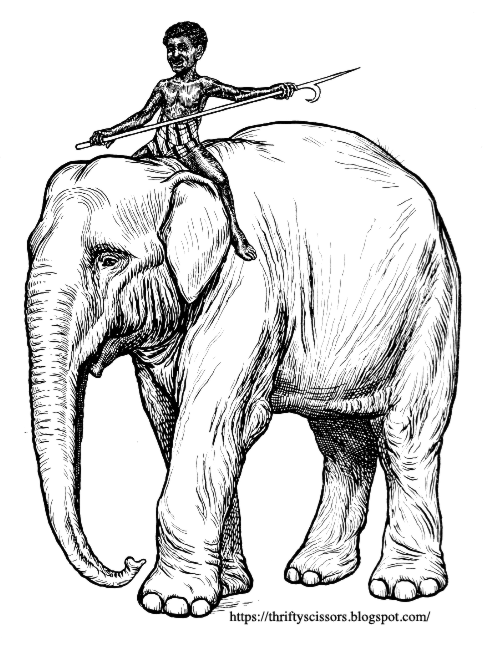
The elephant's cornack.

        An elephant, from some motive of revenge, killed his cornack or conductor. The man's wife, who beheld the dreadful scene, took her two children, and threw them at the feet of the enraged animal, saying, "Since you have slain my husband, take my life also, as well as that of my children." The elephant instantly stopped, relented, and as if stung with remorse, took up the eldest boy with his trunk, placed him on its neck, adopted him for his cornack, and would never afterwards allow any other person to mount it.

The Newfoundland Dog

The Newfoundland with his lantern.
        One of the magistrates in Harbor Grace, in Newfoundland, had an old dog of the regular web-footed species peculiar to that island, who was in the habit of carrying a lantern before his master at night, as steadily as the most attentive servant could do, stopping short when his master made a stop, and proceeding when he saw him disposed to follow. If his master was absent from home, on the lantern being fixed to his mouth, and the command given, "Go fetch thy master," he would immediately set off and proceed directly to the town, which lay at the distance of more than a mile from the place of his master's residence: he would then stop at the door of every house which he knew his master was in the habit of frequenting, and laying down his lantern, growl and strike the door, making all the noise in his power until it was opened; if his master was not there, he would proceed farther in the same manner, until he had found him. If he had accompanied him only once into a house, this was sufficient to induce him to take that house in his round.


Studying

The singing magpie.

        A magpie, belonging to a barber at Rome, could imitate to a nicety almost every word it heard. Some trumpets happened one day to be sounded before the shop, and for a day or two afterwards the magpie was quite mute, and seemed pensive and melancholy. All who knew it were greatly surprised at its silence; and it was supposed that the sound of the trumpets had so stunned it, as to deprive it at once of both voice and hearing. It soon appeared, however, that this was far from being the case; for the bird had been all the time occupied in profound meditation, studying how to imitate the sound of the trumpets; and when at last master of it, the magpie, to the astonishment of all its friends, suddenly broke its long silence, by a perfect imitation of the flourish of trumpets it had heard ; observing with the greatest exactness all the repetitions, stops, and changes. The acquisition of this lesson had, however, exhausted the whole of the magpie's stock of intellect; for it made it forget everything it had learned before.

A Faithful Companion

        A gardener, in removing some rubbish, discovered two ground toads of an uncommon size, weighing no less than seven pounds. On finding them, he was surprised to see that one of them got upon the back of the other, and both proceeded to move slowly on the ground towards a place of retreat; upon further examination he found that the one on the back of the other had received a severe contusion from his spade, and was rendered unable to get away, without the assistance of its companion!

The toad carries his wounded friend.

A False Alarm

The bell ringing baboon.

       Some years ago, a soldier doing duty at the castle of Cape Town, kept a tame baboon for his amusement. One evening it broke its chains unknown to him. In the night, climbing up into the belfry, it began to play with, and ring the bell. Immediately the whole place was in an uproar; some great danger was apprehended. Many thought that the castle was on fire; others, that an enemy had entered the bay, and the soldiers began actually to turn out, when it was discovered that the baboon had occasioned the disturbance. On the following morning a court-martial was held, when Cape justice dictated, that whereas the baboon had unnecessarily put the castle into alarm, the master should receive fifty lashes; the soldier, however, found means to evade the punishment.

Sagacious Bruin

The clever, hungry bear.
        The captain of a Greenland whaler being anxious to procure a bear, without wounding the skin, made trial of the stratagem of laying the noose of a rope in the snow, and placing a piece of meat within it. A bear ranging the neighboring ice was soon enticed to the spot by the smell of the dainty morsel. He perceived the bait, approached, and seized it in his mouth; but his foot at the same time, by a jerk of the rope, being entangled in the noose, he pushed it off with his paw, and deliberately retired. After having eaten the piece he had carried away with him, he returned. The noose, with another piece of meat, being replaced, he pushed the rope aside, and again walked triumphantly off with his capture. A third time the noose was laid; but excited to caution by the evident observations of the bear, the sailors buried the rope beneath the snow, and laid the bait in a deep hole dug in the center. The bear once more approached, and the sailors were assured of their success. But bruin, more sagacious than they expected, after snuffing about the place for a few moments, scraped the snow away with his paw, threw the rope aside, and again escaped unhurt with his prize.

A Strange Mouser

The chicken was a strange mouser.

        A gentleman once had in his possession a hen, which answered the purpose of a cat in destroying mice. She was constantly seen watching close to a corn rick, and the moment a mouse appeared, she seized it in her beak, and carried it to a meadow adjoining, where she would play with it like a young cat for some time, and then kill it. She has been known to catch four or five mice a day in this manner.

Making Sure

Teaching the crows to speak.

       During the war between Augustus Caesar and Marc Antony, when all the world stood wondering and uncertain which way Fortune would incline herself, a poor man at Rome, in order to be prepared for making, in either event, a bold hit for his own advancement, had recourse to the following ingenious expedient. He applied himself to the training of two crows with such diligence, that he brought them the length of pronouncing with great distinctness, the one a salutation to Caesar, and the other a salutation to Antony. When Augustus returned conqueror, the man went out to meet him with the crow suited to the occasion perched on his fist, and every now and then it kept exclaiming, "Salve, Caesar, Victor Imperator!' "Hail, Caesar, Conqueror and Emperor! Augustus, greatly struck and delighted with so novel a circumstance, purchased the bird of the man for a sum which immediately raised him into opulence.

The Power of Music

Music can be powerful magic.

        One Sunday evening, five choristers were walking on the banks of a river; after some time, being tired with walking, they sat down on the grass, and began to sing an anthem. The field on which they sat was terminated at one extremity by a wood, out of which, as they were singing, they observed a hare to pass with great swiftness towards the place where they were sitting, and to stop at about twenty yards' distance from them. She appeared highly delighted with the harmony of the music, often turning up the side of her head to listen with more facility. As soon as the harmonious sound was over, the hare returned slowly towards the wood; when she had nearly reached the end of the field, the choristers began the same piece again; at which the hare stopped, turned round, and came swiftly back to about the same distance as before, where she seemed to listen with rapture and delight, till they had finished the anthem, when she returned again by a slow pace up the field, and entered the wood.