Tuesday, April 2, 2013

Craft Little Houses from Milk Cartons

I'm setting up the craft supply table. I collected the cartons from the children during their snack time and washed these thoroughly in hot soapy water a week in advance. Then I stapled them shut so that students wouldn't be preoccupied with dismantling them themselves. I have some little boys who are easily distracted during art projects and so I've learned what not to give them in order to avoid their tendencies.
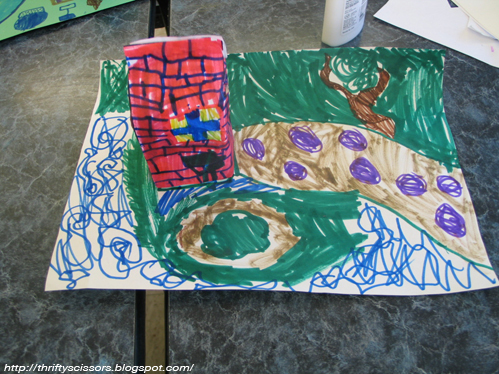
Above is my teacher's sample of this popular craft project.
      As some of you know, I teach art, whenever I can, to a large group of sixty-five students, grades k-5th during an after school program. It is difficult to choose projects that appeal to children ranging from five years to eleven. Usually I resort to including multiple projects during this time so that all of the students will enjoy their indoor activity time. This project, however, was very popular with all of the children.
      First, I made a template for a paper template using an original dismantled milk carton. Then I printed out enough of these for my students to cut out and trace around onto construction paper. The students then decorated these templates before gluing them onto their clean, dry milk carton. I also showed them how to draw a landscape for their house on a separate sheet of construction paper. We discussed what the terms architecture and landscape mean during the course of our project.




St. Patrick's Day Mobile Crafts

A simple pot of gold, a few shamrocks and a rainbow made from a paper plate are all you need to
craft this playful little St. Patrick's Day Mobile.

Craft and Hang a Mobile of a Rainbow, Shamrocks and a Lucky Pot of Gold!
      Students can craft this lucky pot of gold from just a few simple paper supplies: gold foil cupcake liners, scissors, white glue, magic markers and black and green construction paper.
  • Cut a simple pot from black construction paper and glue inside the gold foil cup cake liner to illustrate your pot of gold.
  • Cut out bunches of shamrocks to string along the side the pot of gold from bright green paper.
  •  Then each student will need a paper plate to cut in half so that they may color in the shape of a rainbow twice. 
  • After threading the shamrocks and pot of gold, glue these threads on the inside half of one paper plate so that the threads will hang between the rainbow shapes. 
  • Glue the decorated paper plates back to back so that the mobiles may be viewed from both sides.
Weave a Giant Shamrock to Hang From The Ceiling!
      I cut giant green shamrocks from painted green papers for the woven mobile pictured below. I then chose plain stripes of pale green construction paper for the paper streamers. Although, teachers or students may wish to weave their shamrocks alternatively with crepe paper streamers. Glue together the unpainted sides of your green shamrocks so that these mobiles may be viewed from either side if you should chose to hang them in the center of the classroom. I have linked to a video here that demonstrates this basic weaving procedure. 

Above are four photos showing a woven paper shamrock banner.
 

St. Patrick, Ireland's Patron Saint

      The personage whose natal day is celebrated with such enthusiasm by our Irish citizens was unquestionably the brightest luminary that adorned the Emerald Isle, for by his almost herculean labors he rescued that land from paganism. Some uncertainty exists as to the date and place of Patrick's birth. The most reliable historians, however, concur in the belief that he was born about the year 396 in the British-Roman province of Valentia, at a place near the Clyde, not far from the modern Dumbarton, called from him Kilpatrick.
Click directly on the portrait of St. Patrick to
download a coloring page.
      About the year 432 he began his missionary work of converting the pagans of Ireland to Christianity. It is said that during his stay in the island he founded 365 churches, baptized with his own hands more then 1,200 persons and ordained a great number of priests. He died about the year 469 at a place called Saul, near Downpatrick, and his relics were preserved till the time of the Reformation.
      It is but natural that the land which produced a Fingal and an Ossian should abound in legends of the great missionary who taught the Christian religion to the Irish pagans -- stories, some of which are surrounded with an atmosphere of beauty, others that are wild and ridiculous. His explanation of the Trinity to his hearers, whose simple minds could not conceive of the existence of three in one, was timely and satisfactory. Plucking a stem of the shamrock from the earth at his feet, he pointed out to his congregation the three leaves growing from the one stalk, by that simple illustration bringing the members of his flock to a realization of a Triune God. Since then that trefoil plant has been sacred, and together with the harp has been the emblem of the Emerald Isle. 
      As long as the shamrock continues to spring from the soil of Erin the true Celt will observe the yearly recurring holiday that is supposed to mark the anniversary of the birth of Ireland's patron saint. It is true that many well-informed Irishmen will tell us that the 17th of March is not celebrated as the birthday of Patrick, because it is by no means certain that it is the correct date: but that the day is merely set apart as a time upon which to honor the old saint's memory. But, be that as it may, the majority of people, and perhaps a majority of the Irish, consider it the birthday anniversary of Ireland's great evangelist. What the Fourth of July is to the true-born American St. Patrick's day is to both the native Irishman and the Irish-American. It is true that the latter is loyal to his adopted country, and has many times proved his patriotism, but when the 17th of March appears the citizen of Hibernian blood is ready to celebrate a day this is exclusively his own--a day commemorating, an event that occurred 15 centuries ago, yet which remains undimmed by the mists of time.
      It must be confessed that the celebration of St. Patrick's day is not upon the whole invested with any marked degree of sanity by its participants--that is apparent at least to American eyes. Of course, upon that occasion appropriate ceremonies are conducted in the churches with becoming reverence, but to Irishmen as a whole the anniversary of the old saint's nativity is looked forward to as a day for participating in all the pomp and pageantry of the street parade, in which the green flag with the harp  and shamrock shares the honors of the day with the Star and Stripes of the Milesian's adopted country. 
      Looked at from a meteorological point of view the festival of the canonized Patrick's birth enjoys a distinction that is by no means mythical. Those who have long made a study of the weather and its vagaries can testify that the 17th of March as it appears each year is as a rule, characterized by storms of either rain or snow, or gales of wind. The few exceptions to this phenomenon only prove the rule. The boisterous deportment of the elements on that day, however, are easily accounted for by the fact that the Vernal equinox is then near at hand, when elemental and atmospheric, disturbances are liable to occur.

More Related Content:

The Old Testament Alphabet

      The following illustrated alphabet ( u is missing) is from "The Child's Colored Scripture Book," 1866. The plates have been restored by Kathy Grimm for teachers and parents to reprint freely.

Aaron, the High Priest of the
Jews, within the Temple pray'd,
And offer'd sacrifices, which were on the
altar laid.
Balaam the Prophet, on an ass,
a visit went to pay
To Balak; but an Angel stood to meet
him on the way.
Cain, the first son of Adam, full of
jealousy and pride,
Fiercely kill'd his brother Abel, and was
wretched till he died.
Daniel, faithful, brave, and pious,
was shut in the lion's den,
By the heathen King Darius, but came
safely out again;
For God, who made the lions, watches
over righteous men.
Elijah, when he hid himself, had
nothing left to eat,
But the Lord's ravens daily brought the
Prophet bread and meat.
Finding the infant Moses; who,
left at the river's side,
Was lying in a little ark, with fresh
bulrushed tied;
Great Pharoah's daughter pitied as the
child looked up and cried.
Goliath, of the Philistines the
leader and the pride,
Came forth and laugh'd while all the
host of Israel he defied;
But David, with a sling and stone, so
smote him that he died.
Hagar and Ishmael, her son,
out to the desert fled,
With water in a bottle, and a little loaf
of bread:
But, when they both had called to God,
in safety they were led.
Job suffer'd many sorrows, but was
patient to the end;
Knowing, in all his troubles, that the
Lord was still his friend.
King David, once a shepherd boy,
to Israel's throne was raised,
And, singing to his harp, in sweetest
Psalms he pray'd and praised.
Lot, with his wife and daughters,
left the Cities of the Plain,
Which, for their wickedness, God smote
with storms of fiery rain;
But Lot's wife was destroy'd, because
she would look back again.
Miriam, the Prophetess, was
Aaron's sister: she
Led forth the Jewish women, who
escaped from the Red Sea,
And danced and sang for joy that all her
nation was set free.
Noah alone, of all the people,
hated evil and loved good,
And when the earth was drown'd, by rain
from heaven, in a flood,
God taught him how to build a ship, or
ark, of gopher-wood.
Obadiah sought, from wicked
men, Elijah's life to save;
It was he who fed, and hid, a hundred
prophets in a cave.
Pharaoah, the King of Egypt,
Queen of Sheba. You have heard
how she from her own country came,
And brought rich gifts to Solomon, whose
wisdom, skill and fame,
Caused Kings and Princes to bow down
in homage to his name.
Ruth was the youthful widow, of
the tender, loving heart,
Who refused, in spite of poverty, from
Naomi to part.
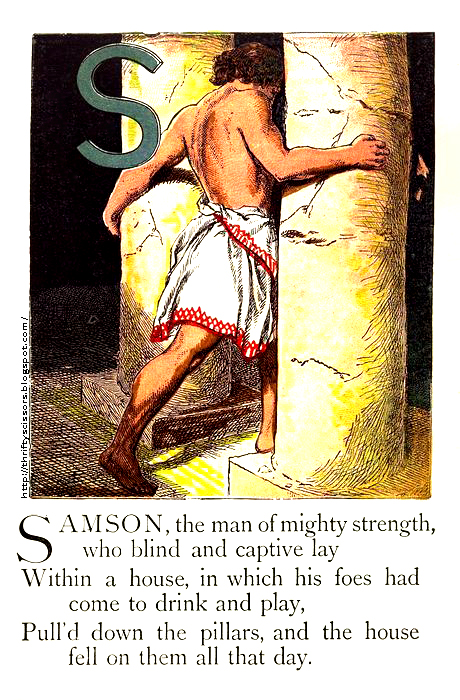
Samson, the man of mighty strength,
who blind and captive lay
Within a house, in which his foes had
come to drink and play,
Pull'd down the pillars, and the house
fell on them all that day.
Tubal-Cain was first of workmen,
who for useful metals sought,
And brass and iron into shape, at the
smith's anvil wrought.
Vashti, the Queen, refused to go
at her proud King's command,
And so was sent away, while Esther sat
at his right hand.
Widowed, and poor, and hungry,
the woman was who fed
Elijah, Prophet of the Lord, with a small
cake of bread;
But God returned a hundred-fold, and
kept her table spread.
Xis the letter which is used, to show
is the number ten,
And Ten Commandments Moses gave,
from God to sinful men.
Young Joash, when a little child,
was hidden from the sight
Of those who sought to slay him, and
was kept, both day and night,
Till priests and captains claimed for him
his own true kingly right.
Zedekiah, King of Judah, lived
to see his sons both slain,
Then blind and captive went away,
never to see again:
For he led an evil life, which brings
both misery and pain