Thursday, August 18, 2022

20 Facts About The Caterpillar/Butterfly

       Caterpillar. Mrs. Sigourney has written a child's poem about a butterfly, in which the beautiful insect sings as it flies through the sunny air, "I was a worm till I won my wings." Truly the ancients never conceived a myth more beautiful and wonderful than this familiar story of nature - the life history of the butterfly. 
Stages of the caterpillar and butterfly.
  1. The lovely, winged creature is the fourth and last step in the development of the insect, and the caterpillar is the second, for it is the larva, or worm, that hatches from the egg. 
  2. A study of the origin of the word caterpillar shows that it means, literally, hairy cat. 
  3. Everyone is familiar with the woolly kinds, and the name, so far as they are concerned, is not inappropriate. 
  4. There are, however, hairless kinds, the skin of which is often beautifully marked lengthwise or crosswise, or covered with rings and eye-spots.
  5. When the tiny caterpillar first emerges from the egg it proceeds to eat, for this is to be its chief duty during the larva stage. 
  6. The eggs are always deposited where plant food can easily be reached. 
  7. Before very long the skin of the worm becomes too tight, for it does not increase as the body grows larger.
  8. Accordingly the caterpillar soon crawls out through a split which occurs near the front end; that is, it molts (see Molting). 
  9. This process is repeated four or five times, and in each case a new skin has formed under the old one.
  10. The body of a full-grown worm is usually divided into twelve rings or segments, and each of the first three rings bears a pair of five-jointed legs. 
  11. There are also short leg- stumps on the abdomen, which disappear when the last molting takes place.
  12. On each side of the head there are six eye-spots; the head also bears a pair of short, three-jointed feelers, besides jaws and other mouth organs. 
  13. Glands, some with unpleasantly odorous or stinging secretions, frequently occur on the skin.
  14. There comes a time when the caterpillar ceases to eat and begins to prepare for the so-called pupal, or resting, stage. 
  15. The caterpillar stage lasts two or three months in temperate regions, but it may be of two or three years' duration in Arctic lands. 
  16. The quantity of food eaten is used to nourish the pupa. 
  17. Moth caterpillars spin a casing of silk about them, and form cocoons, while the pupal stage of butterflies is passed in a hard skin covering. 
  18. Butterfly pupae are called chrysalids. 
  19. When the pupa reaches maturity the outside casing splits open, and the butterfly comes out, rather crumpled and weak at first, but soon ready to spread its wings for a happy life in the sunshine. 
  20. The same processes of development occur in the life history of moths.

Monday, August 15, 2022

Little Danny Donkey

Little Danny Donkey
by Helen Cowles LeCron


I hate to talk about it, 'cause
it's sad enough for tears,

But --little Danny Donkey didn't
like to wash his ears!

At breakfast every morning
Danny's mother sent him back

To do his washing over 'cause
his ears were simply black!

They say he's doing better now--
and oh, I hope it's true!

I'd hate to be so lazy and so
careless! Shouldn't you?

The Lady-Bug Rebus

Lady-Bug
by Gertrude A. Strickler

       Long long ago a lady-bug washed out her children's clothes. "But where to hang them up to dry," said she "O goodness knows!" It happened that a spider's home was in the grass close by, and on the spider's silken line, she hung them up to dry. Then Granny spider laughed "Ho! ho! those lady-bug's clothes are mine because they're in my web" and then she took them off the line. A measuring worm was looking 'round as on a leaf he stood. He saw it all and called for help, as loudly as he could. Then to the rescue cam a wasp, and tho he had to tug, he took the clothes from Granny's grasp and back to Mrs. bug. The clothes were torn but Lady-bug patched up the holes with black. And since that day each lady-bug wears holes upon her back...

Sunday, August 14, 2022

The Interrupting Owlet

The Interrupting Owlet
by Helen Cowles LeCron


When Mother Owl and Father
Owl are talking busily
About old Uncle Blinker in the gnarled
old maple tree,
Or Cousin Drowsy Hoot-Owl in the
oak across the way,
Or stylish Old Miss Snowy Owl, I
much regret to say
That naughty little Downy often inter-
rupts the two
To ask them, "Who'd you say it was?
Say! WHO, Pa? WHO, Ma?
WHO?"

Though Mother Owl has told him that
the question's impolite,
And little owls should never interrupt
on any night
When parents talk, it doesn't seem to
do a bit of good!
For Downy still continues, as no
thoughtful owlet would,
With "WHO, Pa? Who Ma?
Who'd you say?" and "Tell me,
folks! Aw! Do!"
And "WHO'D you say it was? Aw,
Ma! Say! WHO, Pa WHO,
Ma! WEHO--OO?"

Sunday, July 3, 2022

Paper Cuts of Farm Animals

        Below, I have restored a few paper farm animals: horse, cow, goat, duck, rooster, sheep, dog, bunny, pig and cat. These may be freely used by students and teachers for the classroom. Silhouettes on my blog are not to be redistributed by alternative websites and are not meant to be sold or purchased.

These paper cuts of animals found on the farm would make great design
elements in a classroom or any other art project a young
student might need them for.

Find The Fish Puzzle

Puzzle - Find The Fish

Find The Fish
by Helen Hudson


A Joyful day it is for us,
Tommy and Richard and me,
For our friend Bill Jones is taking us
Where the biggest fish may be.

If it should be our luck to catch
The fish Bill tells about,
I really do not see quite how
We'd ever haul him out!

The Feathered Patriot

 The Feathered Patriot
by Daisy M. Moore


"Tcheer! Tcheer! Tcheer!"
I heard a warble clear;
How came a bird to know
That July Fourth is here?

"Tcheer! Tcheer! Tcheer!"
The warbler nearer drew,
And peering through the leaves
I saw his coat of blue.

I caught full sight of him
Before he flew away,
And knew just why he cheered
On Independence Day!

Of course, each one of you
Is wondering how I knew-
His lovely feather clothes
Were red and white and blue!

Find Columbia Puzzle

Puzzle - Find Columbia

Columbia
by Helen Hudson


We're very patriotic
As you can plainly see.
This birthday of our country
We celebrate with glee.

Columbia guides our footsteps
And, where her path may go,
We'll march along right valiantly
Though mighty be the foe!

Saturday, April 16, 2022

Harry Hippopotamus

Harry Hippopotamus
by Helen Cowles LeCron


Now Harry Hippopotamus had
such a heavy tread
That when he ran about the house his
mother often said,
"Good gracious, Harry, softly, please!
Your stamping hurts my head!
Besides, you'll wake the baby, who is
fast asleep in bed!
Why, Harry, one would really think
your feet were made of lead!"

I like to think that long ago a change
was seen in Harry,
And he became as graceful and as
lightsome and as airy
As any meadow butterfly or any
woodland fairy!
Who knows? Perhaps the change has
made his parents glad and merry.
(And yet, an agile hippo would be far
from ordinary!)

Friday, March 18, 2022

Steps to draw a woodchuck, a weasel, and an opossum...

It takes only five steps to draw this woodchuck.

       Woodchucks have very coarse hair, a heavy body, short bushy tail, powerful legs and feet that are made perfect for digging. Farmers do not always like them because they can do great damage to a garden or crops. In February the second he wakes from his long winter sleep and appears at the mouth of his burrow, if he sees his shadow it is supposed to be a sign of six more weeks of cold weather!

You can draw a weasel in just five steps too!

       Sometimes farmers do not like weasels because they can kill chickens. But many people love to make coats from this furry little creatures coat! For in the winter time he has a snow white coat, except the tip of his tail which is black. Sometimes he is called an ermine but when spring comes his coat turns reddish brown and then he is called a weasel.

This opossum took six steps to draw.

       An opossum is about the size of a cat and is noted for being very cunning. It has a very long tail which it likes to hang by, head down from a branch. Of course you have heard of "playing possum" which means to play dead; the opossum does this when it is threatened.

Monday, March 14, 2022

Draw bees and clover for St. Patrick's Day

       The series of simple shapes shown above can help you draw a field of clover with bees happily buzzing around the blooms for a Saint Patrick's Day activity. There are three different ways to picture the tiny stripped pollinators.
       The clover blossom and leaves are blocked out first in lightly marked lines, as indicated in figure 1. Continue with your drawing, and when you have finished it, as shown in figure 3., you may sketch as many bees as you like resting lightly on top of the clover blossoms. That is the way we often see bees when they are gathering honey in the summertime. Also include some of the bees flying about your clover drawing as well.

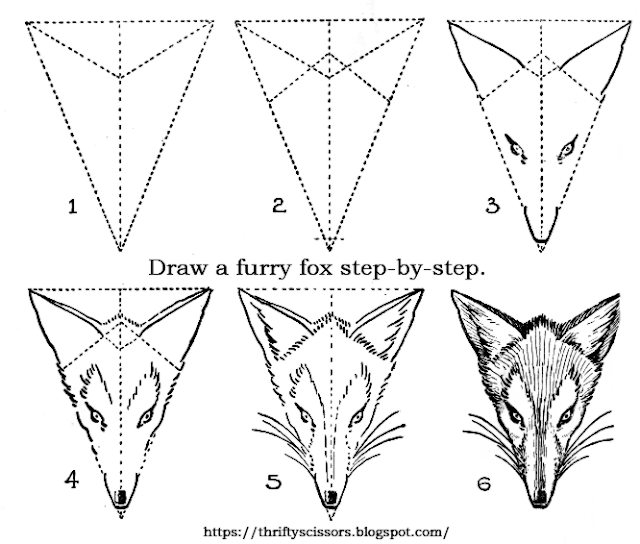
How to draw a furry fox...


      The first thing in drawing is to understand the form of the object or animal you wish to picture. Some animals are oddly shaped or so full of details that students must stop to first give a minute or two in the study of the critter. Find the general outlines of the foxes' head with his ears pricked up and alert. You can see that the ears and head included his snout form four distinct triangles. Once you have drawn these, move on to filling in the smaller details like his nose, his whiskers, and eyes. The rest of his head then may be easily filled out.