Wednesday, October 2, 2013

"In October" Poem

By Mrs L. C. Whiton.

There are lingering south-winds softly blowing
That to billowy waving the ripe grain bear;
There are dark-winged butterflies languidly going
Floating through golden air;

There are mists like vapor of incense burning,
That are rolling away under skies that are fair;
There are brown-faced sun-flowers dreamily turning,
Shaking their yellow hair.

There are noisy bees that are tired of winging
That are holding a court in some wild rose's heart;
There are sudden thrills of the late sweet singing
Of birds that are loth to depart;

There are sunsets watching their own hot blushes
On the breast of the ocean burning away;
There are wind-swept pines in the infinite hushes
Whispering as they sway.

There are changing ferns in the shadows lying,
Where the undried dews in the noontides stay;
There are gorgeous-hued leaves where, rustling and sighing,
Quivering sunbeams play;

There are tangled vines in the hollows trailing;
There are short sweet days that will not delay;
There are nights that come with a moonlight veiling
And Autumn going away.

"The Cornstalk's Lesson" Poem

This poem may be downloaded and printed
freely by teachers everywhere.
By Mrs Christine Chaplin Brush.

One single grain of corn took root
Beside the garden walk;
"Oh, let it stay," said little May,
"I want it for my stalk."

And there is grew, until the leaves 
Waved in the summer light;
All day it rocked the baby ear,
And wrapped it warm at night.

And then the yellow corn-like silk came--
A skein of silken thread:
It was as pretty as the hair
Upon the baby's head.

Alas! one time, in idle mood,
May pulled the silk away,
And then forgot her treasured stalk
For many a summer day.

At last she said, "I'm sure my corn
Is ripe enough to eat;
In even rows the kernels lie,
All white, and juicy sweet."

Ah me! they all were black and dry,
Were withered long ago;
"What was the naughty corn about,"
She said, "to cheat me so!"

She did not guess the silken threads
Were slender pipes to lead
the food the tasselled blossom shook
To each small kernel's need.

The work her foolish finger wrought
Was shorter than a breath;
Yet every milky kernel then
Began to starve to death!

So, list my little children all,
This simple lesson heed:
That many a grief and sin has come
From one small thoughtless deed.

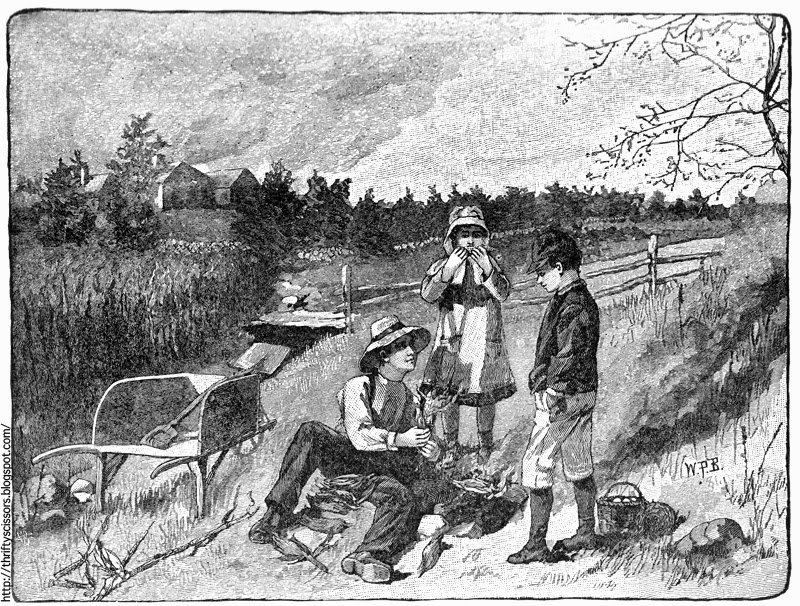
"Roasting Corn" Poem


By Mrs. Clara Doty Bates.

A faint blue cloud of smoke
Creeps up the golden air:
It must be the wandering gypsy folk
Have lighted a fire there.

No doubt they have covered vans,
And ponies shaggy and lean,
Which they will tether with dusky hands
Along the wayside green.

And the bells on their bridles hung
Will tinkle idly sweet,
With the chatter of children, rude of tongue
And bare of feet --

While, with grimy tents spread out,
Their elders lazily
Wait for the steam of the kettle-spout
To burn the time for tea.

Though surely I can get
But whiffs of the camp-fire smoke,
And though I know they are vagrants, yet
I will visit these gypsy folk.

Well, now! and is this Jack?
This Gold-locks? and this Ted?
With clothes and fingers a smutty black
And cheeks a burning red--

So hungry and forlorn,
In grandpa's ample house,
That you must pilfer an ear of corn
And nibble it like a mouse?

Will I have some? The smell
Is of itself a treat.
I'll trust the boys and girls to tell
When things are good to eat!

(All poetry on this blog is in the public domain folks.)

Paint Fall Foliage With Hugs and Kisses

This picture of Fall foliage was created
entirely with dots.

      This picture was painted with Dot paint markers. Dot paints are frequently purchased for early learning center art activities. These paint bottles have foam tips and are just the right size for little hands to squeeze and paint with. The round shapes of my tree's foliage are actually painted coffee filters that are pasted onto a large piece of blue construction paper after drying. I cut a simple tree trunk from brown construction paper to paste on top of the blue background as well. The blank circular shape is for each child to "carve" their names inside after they have completed the assignment. 
      Because dot painting is so easy to do, it is important for teachers to give young students enough of a challenge when filling in space with their paints. A picture like this will take a preschool student at least forty minutes or more to finish. Teachers may have students complete the foliage on one day and then assemble the picture with additions to the trunk, sky and ground on a second day. In any case, one large dot picture should take a week for three to five year old children to complete nicely.
      Encourage students to fill in all of the spaces. Then give them markers of similar color and demonstrate how to add Capital Xs to every circular shape. This may appear on the surface to be busy work but it serves the purpose of training small motor skills in very young students by virtue of a pleasant activity. Here are a few goals associated with the activity that teachers may wish to include within a weekly lesson plan:
  • Color matching
  • Writing the Capital letter "X"
  • Learning about color families or cool vs. warm colors
  • Defining space
  • Defining boundaries in space
  • Manipulating objects by squeezing and placement
  • Recognizing and reproducing geometric shapes
  • Teaching science concepts to children: this one would be photosynthesis.
  • Learning about additional symbolism given to letters, i.e. hugs and kisses are x's and o's

Monday, September 30, 2013

Paint, Cut and Paste a Leafy River Scene

      This fall leaf art lesson was inspired by a very popular children's book, "Leaf Man" by Lois Ehlert. View and hear the book below.
      The project may be completed over several consecutive days in an early learning center environment:
  • First day: Collect and share fall leaves from your center's playground and/or surrounding neighborhood.
  • Second day: Draw and cut many stencil patterns from the leaves that students have collected from the previous day. Let students play with the stencils, discovering how these can be layered or moved about in order to mimic the creatures depicted in the Leaf Man book.
  • Third day: Draw plastic combs through acrylic and glitter paints on construction paper to recreate the Autumn colors found in the student's leaf collection.
  • Fourth day: Trace the leaf stencils onto the decorated papers and cut them out. Now let each student paste together his or her own river scene depicting fish and turtles similar to those illustrated in the Leaf Man book.
  • Fifth day: Let the students help you display their dry art works in the hallway or classroom of their school. Serve up some warm cider or chocolate and talk about all the things they have accomplished while enjoying the fall leaves!

      Harcourt Trade Publishers also includes a fun teacher's guide for an alternative art project. Below I have linked to additional fall leaf lessons that young students may enjoy.
Students paint, cut and paste leafy fish and turtles to swim in their colorful blue river.
A detail of the paper turtle cut from papers combed with glitter paints.
Young students can achieve very professional looking results when they work
 from stencils. Collecting, tracing and cutting leaf stencils is a very complex
exercise for little students but it teaches them confidence, patience and a
set of tasks that will generate excellent results. Chunk down lofty goals into
 to smaller tasks that may be performed successfully and your little artists
will achieve great things!
This popular children's book is read by Jonah.

Craft a Paper War Bonnet

To craft a war bonnets, you will need a tape measure to determine the
circumference of each student's head. Cut strips of construction paper
approximately one additional inch longer than the measurement of
each child's head. Staple the two ends together so that these overlap by the
additional inch after the paper band has been decorated with markers
depicting native motifs. Cut and paste on to the backside of the
headband, feathers made from colorful construction paper. You may
also fringe the edges of the papers by slashing these with
scissors if you'd like.
      Feathered war bonnets (also called warbonnets or headdresses) are worn by honored Plains Indian men. In the past they were sometimes worn into battle, but most often worn for ceremonial occasions as is the case today. They are seen as items of great spiritual and magical importance. The eagle is considered by Plains tribes as the greatest and most powerful of all birds, and thus the finest bonnets are made out of its feathers.
      Its beauty was considered of secondary importance; the bonnet's real value was in its supposed power to protect the wearer. The bonnet is still only to be worn on special occasions and is highly symbolic.
      The bonnet had to be earned through brave deeds in battle because the feathers signified the deeds themselves. Some warriors might have obtained only two or three honor feathers in their whole lifetime, so difficult were they to earn. The bonnet was also a mark of highest respect because it could never be worn without the consent of the leaders of the tribe. A high honor, for example, was received by the warrior who was the first to touch an enemy fallen in battle, for this meant the warrior was at the very front of fighting. Feathers were notched and decorated to designate an event and told individual stories such as killing, capturing an enemy's weapon and shield, and whether the deed had been done on horseback or foot.
      After about ten honors had been won, the warrior went out to secure the eagle feathers with which to make his bonnet. In some tribes these had to be purchased from an individual given special permission to hunt the bird; a tail of twelve perfect feathers could bring the seller as much as a good horse. Some tribes permitted a warrior to hunt his own eagles. This was a dangerous and time-consuming mission and meant that he had to leave the tribe and travel to the high country where the bird could be found. When the destination had been reached, ceremonies were conducted to appeal to the spirits of the birds to be killed.
       A chief's war bonnet is made of feathers received for good deeds to his community and is worn in high honor. Each feather would represent a good deed. A warrior's war bonnet, such as the famous war bonnet of Roman Nose, the Cheyenne warrior, was said to protect him during battle. In several instances, Roman Nose, wearing his war bonnet, rode back and forth before soldiers of the United States Army during battles of the Indian Wars and, despite being fired upon by many soldiers, was unscathed.

Draw a Design from A Spider's Web

Start your web design by randomly selecting a point, 
on a sheet of black construction paper, somewhere in 
the center of your paper.  Then draw, with the help of
 a ruler, lines from that central point out to the edges
 of the paper. Your design should look something like 
a giant sliced pie.
Then take either a bottle of white school glue or black puff 
paint bottle, and squeeze out a thin line of liquid tracing the 
drawing thus far. Then, very carefully, squeeze out the 
intersecting spiral lines of the spider's web pattern leaving 
large spaces approximately 1/2 inch to 1 or 2 inches apart.
Next, you will need to fill in these spaces of your web design 
with chalk pastels. After completing the design, Teachers may 
spray fix the pastels with either a special fixative purchased 
for the preservation of chalk pastel drawings or with 
a inexpensive hair spray.
A close up view of my spider's web design. This art project 
is an exercise in calculation, glue application, and a 
introduction to chalk pastels. I recommend it for 2nd 
through 4th grade students.

Sunday, September 29, 2013

Craft a Ruote Pasta Web

      These little Ruote, more commonly known as wagon wheel pasta in America, make interesting design elements in a spider web craft for early learners.
      First, teachers will need to dye these Ruote pasta black:
  • Add the dryed Route pasta to a large zip-lock plastic bag. (1lb. per large freezer bag at a time)
  • Include a few teaspoons of rubbing alcohol and a few drops of black food coloring inside the bag with the dryed pasta.
  • Close the bag tight and shake. 
  • Pour this pasta out onto a napkin or paper towel to let it dry either in the sunshine or overnight in a warm place. 
 Left, a view of the Ruote pasta spider web from the side.  Right, a view of the pasta spider web from above.
      Once you have prepared the dried pasta for your young students, you will need to gather the following supplies:
  • black construction paper
  • white school glue
  • dyed black Ruote pasta
  • white tempera or acrylic paint
  • newsprint to cover the table with
  • Q-tips and cast off plastic lids for the gluing process
Step-by-step Instructions:
  1. First, have the young students play at arranging the pasta on the table top before actually gluing it down to the paper. Talk to them about the shape, texture and color of the pasta while they experiment with arranging it.
  2. Give each student a handful of pasta, a black piece of construction paper, a plastic lid full of liquid white school glue and a Q-tip for dipping into the glue.
  3. Demonstrate to them, at their table, how to dip the Q-tip into the glue and then glop it onto the construction paper. This process of applying glue to the paper will help little people add enough glue for the pasta to stick to the paper but not so much glue that they cannot control it's application all together.
  4. Now the pasta may be layered on top of the glue and arranged in a web like pattern. 
  5. These 'spider webs' will need to dry overnight in the classroom.
  6. On the following day students should each be given another plastic lid filled with non-toxic white paint. 
  7. Show your early learners how to dip their fingers into the white paint and dab it lightly onto the very tops of the Ruote in order to highlight the pasta's design. 
  8. Let the webs dry again. This takes only an hour or less.
More Fall Crafts Using Pasta:

Draw a Shaded White Spider Web

      During the Fall season, I frequently focus student's assignments on those themes that are inspired by the natural world. Drawing spider webs is a great way to include design principles, drawing techniques and science all together in one project. Students will need a few simple supplies for this drawing exercise:
  • a large piece of black construction paper
  • a white led pencil or white conte or white pastel etc... 
      Instruct the students to first draw a large X shape anywhere on their paper and divide the rest of the drawing into pie shaped pieces using their white lead pencils. Next they will need to draw a spiral design working their way out from the center of the web to the edges of the paper. Within this spiral they need to further divide the web sections into small rectangular shapes. Then they will need to shade each of these small shapes in order to create a similar web to the one I have shown in the photograph above. Students may also wish to include a large black spider somewhere within their web design as well.
      With this drawing exercise, students will learn how to shade a tiny space gradually, the differences between positive and negative space, and also about repeating patterns. I recommend the exercise for fifth or sixth graders.

Draw More Spider Webs:

Saturday, September 28, 2013

100 Spooky Crafts & Treats For Halloween

You needn't worry about using patterns for this Halloween craft
 because the even a novice artist can come up with their own charming
version of this pumpkin patch!
      Spook your own set of  paper jack-o-lanterns with a little bit of glittery morning mist; all it takes is just a few simple supplies. Gather a pair of scissors, some white school glue, a black felt tipped pin and construction paper in orange, green, black and white, plus transparent glitter to craft a similar picture to the one shown here. 
      I chose to mount the jack-o-lanterns onto a large sheet of black construction paper. Then I cut a large number of lop sided circular shapes from the orange construction paper. Paste on black shaped openings for the large toothy grins and grimaces from additional black construction paper. Then cut and paste green stems and vines from the green construction paper. I painted my white construction paper with a pearlescent white paint before cutting it out to add eyes and teeth, but you could use just plain white paper if you'd prefer. I then added the details to these frightened pumpkins with a black felt tipped marker. Squeeze a wavy line or two of white glue onto  the surrounding dark sky and add the transparent glitter to finish off this spooky pumpkin patch, just in time for Halloween!

More Jack-O-Lantern Crafts:
  1. A painted paper bag jack-o-lantern 
  2. Halloween Kids Crafts: Make a Jack-O-Lantern Pillow
  3. Make easy and inexpensive jack-o-lanterns from recycled cans
  4. I love this jack-o-lantern made from string.
  5. Personalize your own jack-o-lantern t-shirts.
  6. Magnetic Jack-O-Lantern for the refrigerator.
  7. Baby Pumpkin Dress-Up
  8. Sewing paper jack-o-lanterns
  9. Happy and Sad Finger Painting Jack-O-Lanterns
  10. Yarn Art Halloween Craft: jack-o-lantern
  11. Recycle a car wash mitt into a jack-o-lantern puppet
  12. A felt jack-o-lantern garland
  13. Jack-O-Lanterns on straws
  14. Jack-O-Lantern Sun-Catchers
  15. Halloween milk jug jack-o-lanterns
  16. Halloween jumping jacks
  17. Jack-O-Lanterns made from painted gourds
  18. Sew a jack-o-lantern bib from an orange hand towel
  19. No-sew jack-o-lantern costume
  20. Halloween wall hanging for Sunday School
  21. Mason Jar Jack-O-Lanterns
  22. Jack-O-Lantern face painting for kids
  23. Vintage Style Treat Containers
  24. A melted bead jack-o-lantern suncatcher
  25. Jack-O-Lanterns made from craft sticks
  26. Pumpkin Pinch Pots
  27. Jack-O-Lantern favor box template 
  28. Bumpy, lumpy, spooky pumpkins 
  29. Glass Halloween Votive Holders
  30. Halloween Jack-o-lantern Pinatas 
  31. Clay Jack-O-Lanterns
  32. Halloween Jack-O-Lantern with Polymer Clay
  33. Four Halloween Tutorials Using Polymer Clay
  34. Shadow Box Jack-O-Lantern
Not So Spooky, Spooky Crafts:
  1. Paint Chip Halloween Craft
  2. Pipe Cleaner Spider Craft
  3. Eyeball Topiaries 
  4. Washi Tape Patterned Pumpkins
  5. Spooky tree watercolor painting
  6. Cathe Holden's Haunted House
  7. Halloween Wood Craft Cutouts
  8. Shadow Makers
  9. Orange spider paper chain
  10. Flying Bats Halloween Craft
  11. Coffee Filter Spiderwebs
  12. Graveyard Ghouls
  13. Halloween Bat Napkin Rings
  14. Paper witch shoes (candy containers)
  15. How to cut a spider web
  16. Halloween treat pedestals (spider webs)
  17. Mini bat-o'-lanterns
  18. Felt skeleton head garland and "Smell My Feet"
  19. Monster socks
  20. Bats and spiders from pom-poms
  21. Nocturnal Story Time
  22. Insect frame or mirror
  23. Candy corn felt sachet bags
  24. Bat TP Roll Craft
  25. Who's Hooting Torn Owl Collage
  26. Potion Prop Books
  27. Haunted House Craft
  28. Styrofoam tombstones
  29. Paper bats
  30. Flying Ghost Cookie Cutter Prints 
  31. Felt Halloween Cats (picture only)
  32. Felt Skeleton (picture only)
  33. Treasure Chest Candy Wrapper
  34. Halloween Sucker Sleeves
  35. Halloween silhouettes for decorating treat bags
  36. Folk Art Halloween Totem
  37. Paper Clay Ghost Trio and Ghostly Trick-or-Treat Centerpiece
  38. Halloween Crafts from Parents Magazine
  39. Witches shoes
    Spooky Treats for Young & Old:
    1. Peek-a-Boo Treat Bags for Toddlers
    2. A jack-o-lantern cheese ball
    3. Jack-O-Lanterns made from oranges
    4. Jack-O-Lantern Treat Cups
    5. Make jack-o-lantern orange soda bottles
    6. Pumpkin Rice Krispie Treats
    7. Monster Munch
    8. Break-Open Halloween Cookies
    9. Frozen "Boo-nana" Pops
    10. Homemade Gourmet Candy Corn
    11. "No Tricks, Just Treats!" printable gift tags
    12. Mummy Cupcakes
    13. Ghost Cupcakes
    14. Marshmallow Witches Recipe
    15. No-Bake Spiderweb Cheesecake
    16. Orange monster cake
    17. How to make candy corn punch
    18. Candy corn bark
    19. Chewy Butterfinger Cookies
    20. Graveyard Cupcakes
    21. Homemade Oreos
    22. Black Velvet Halloween Trifle
    23. Edible graveyard
    24. Homemade snickers bars
    25. Milky way bites
    26. Peanut butter cups for grown ups
    27. Almond Joy Bark
    28. Homemade Kit Kat Bars
    29. Twix Bars
    30. It's Halloweek!: Spooky Cauldrons and Frankenpops
    31. Creepy Spider Cookie Tutorial
    32. Some Halloween Fun 
    33. Candy Corn on the Cob 
    34. Nutter Butter Bats 
    35. Chocolate Covered Halloween Strawberries 

    Friday, September 27, 2013

    Wad, Wrap and Tape A Fall Pumpkin Craft

           Harvest an entire "field" of pumpkins this school year without the mess and toil! Masking tape comes in many different colors and is an excellent craft material for young students to work with. Below I have included just one of the many craft ideas that I have developed for young students in my classroom using masking tape. Teachers will need to purchase this tape in orange and green for this Fall pumpkin craft. They will also need newsprint, small paper bags and green chenille stems in order to complete the the pumpkin pictured below. Also, take this opportunity to speak to your students about what it means to recycle materials while crushing and repurposing old newsprint for the stuffing used to craft their paper pumpkins.

    Directions:
    1. Crush and wad newsprint into a ball resembling a pumpkin shape. 
    2. Stuff a small paper bag with the newsprint wad.
    3. Crush the top of the bag into a stem shape and twist a piece of green masking tape around this "stem" to seal the bag. 
    4. Now twist the stem and mask it with more green tape until the stem has been completely covered.
    5. Next cover the lower half of the pumpkin with orange masking tape strips approximately two to three inches long. Cover all of the remaining brown or white parts of the bag.
    6. The bag's corners should be eventually taped down as well and the bottom completely covered.
    7. Twist a springy, soft green chenille stem around the pumpkin's stem for added texture and effect!
    An excellent alternative material to use in place of paint for crafting Fall pumpkins is colored masking tape, especially
    if you are teaching "art on a cart" and need to keep mess down to a minimum.

    "Spooky" Tree Watercolor Painting

          I first observed this simple little art project taught in an elementary school in Bellville, Illinois. The kindergarteners seemed to love it. You will need to collect the following supplies:
    • orange construction paper
    •  straws
    • watery black paint in individual paper cups
    • black permanent ink markers
    • paint shirts
    • a drying rack
    • glass eye droppers
    • tables covered with newsprint to prevent mess
    Step-by-step instructions:
    1. Each student will need to suck in the watery black paint with an eye dropper and strategically pool it near the bottom of their orange construction paper. The teacher may decide to do this part of the project for each student if he or she feels they are too young to handle the eye droppers responsibly.
    2. Then students should hold a straw approximately half an inch above the puddle and blow through it while watching the watery paint streak up their paper. This exercise will produce some very spooky looking shrubs, brush, and trees!
    3. After the Halloween "foliage" has dried (day 2), students may then draw onto their pictures with black permanent markers: Jack-O-Lanterns, a fence, bats, cats, crows, owls etc...