Wednesday, October 9, 2013

The Snowman Song


Original Poem By W. W. Ellsworth (verses of song)
Chorus lines by Kathy Grimm

One day we built a snowman.
We made him out of snow;
You'd ought to see how fine he was--
All white from top to toe!

we built a little snowman, as soon as it grew cold!
we built a little snowman, he'll melt as he grows old!

We poured some water on him,
And froze him, legs and ears;
And when we went indoors to bed
I said he'd last two years.

we built a little snowman, as soon as it grew cold!
we built a little snowman, he'll melt as he grows old!

But in the night a warmer kind
Of wind began to blow,
And winter cried and ran away,
And with it ran the snow.

we built a little snowman, as soon as it grew cold!
we built a little snowman, he'll melt as he grows old!

And in the morning when we went
to bid our friend good day,
There was n't any snowman there--
Everything had runned away!

we built a little snowman, as soon as it grew cold!
we built a little snowman, he'll melt as he grows old!

Students can sing this poem to the "The Dreidel Song." Read more about dreidels here. Listen to the original tune below and learn about the little Hannukah game.


More Little Snowman Songs on Video:

How to Draw: A Cow

Step-by-Step way to both fold paper to draw a cow's head and also how to draw
details of the cow's features.


Directions for Drawing A Cow: Fold a square sheet of paper from corner to corner in every direction before drafting the proportions of this cow's head. This simple exercise teaches young students to use basic geometry to draw a cow.

The Cow
by Robert Louis Stevenson

The friendly cow, all red and white,
I love with all my heart;
She gives me cream with all her might,
To eat with apple tart.

She wanders lowing here and there,
And yet she cannot stray,
All in the pleasant open air,
The pleasant light of day.

And blown by all the winds that pass
And wet with all the showers,
She walks among the meadow grass
And eats the meadow flowers.

How to Draw: Old-Fashioned Airplanes

Would you like to learn how to draw old-fashioned airplanes?
Above are three classic examples that teachers and parents
may print out for their young plane enthusiasts to copy step-by-step.

How to Draw: The Head of A Horse

Many young students love to practice drawing animals even though it is near to impossible to give them opportunities to do so from real life in a classroom environment. Above is a simple step-by-step, how to exercise in drawing a horse up close that educators may either print out or project on to a white board. This exercise uses triangle shapes to determine proportions of the horses head.

Saturday, October 5, 2013

A Simple Farm Maze for Little Folks

Help the farmer's cow find her way back from the pasture to the barn.

Pumpkin and Jack-O-Lantern Number Books

Crafting and gifting little number books for Fall related themes is not all that uncommon in day care programs or
early learning centers. So, I have decided to submit here a few simple ideas of my own. You can use the
same patterns for either version of this craft. One version is a spooky Jack-O-Lantern and the other is a decorative
 pumpkin. Both crafts include pumpkin seeds as the elements that young students are to count on each
 individual page.
As you can see, students may count the seeds and also associate the written number with the quantity of those
seeds on every page. Don't forget to include zero at the very beginning. Each of my number books
includes 11 pages. Above, you can see the decorative pumpkin cover using painted papers.

Here is my Jack-O-Lantern version of the same project. I have also included a little "illuminated candle on
every page as well!
Above is my page of patterns for both versions of this little Fall number book.
Below is an additional page of burning candles that I have drawn for those of
you who would prefer to turn your fall number book into a Jack-O-Lantern.

Craft a Paper Scarecrow Jumping-Jack

      For this little craft, you will need Autumn colored papers in a check, a plaid and four solid colored papers. You will also need 12 brass brads, one set of googly eyes, two buttons, a paint stick, scissors, white glue and one black felt tip marker. 
      Download and print the stencil pattern that I have drawn for the scarecrow Jumping-Jack. Trace and cut the pattern pieces, use a hole punch to clip through the papers at the x markings. Assemble the scarecrow according to the sample shown above. Mount him onto a paint stick or a wooden dowel. I did not string this particular Jumping Jack but you can string him.

A free Jumping Jack pattern by Kathy Grimm.

Thursday, October 3, 2013

Trace, Cut and Paste Developmental Learning Activities

A sampling of trace, cut and paste developmental learning activities coming soon to this blog.

       Trace, cut and paste, developmental learning activities are very popular lessons taught inside preschools, kindergartens and early learning centers. In the early learning center where I teach, students complete at least two of these kinds of exercises per week. The reason for this is obvious to those people who have ever observed the fundamental learning that takes place during any primary school’s curriculum. All young students experience some difficulty in developing the levels of obedience, observation and productivity that are required of them in order to be successful in academic environments. These qualities can be developed over a few short years by a loving, patient, and creative team of teachers (or parents) in order for children to be properly prepared for school.
      I have listed below, the preliminary objectives that educators assign to this type of activity. Very young students take at least an entire year or longer to accomplish these agenda. Ordinarily, art teachers would be expected by the State to qualify activities such as these by presuming that goals/objectives would be attainable within one lesson. This expectation is highly unrealistic for three, four and even five year old students. Most young students will not be able to fulfill all of the objectives concurrently until they have practiced them over and over for many months. The ultimate goal of the exercise is: to teach students to perform perfectly together all of the objectives within the context of the assignment, by the end of their kindergarten year, not by the end of the exercise.  
      Below are the objectives for trace, cut and paste assignments that eventually must be performed concurrently:
  • Students will learn to listen and follow directions in the order in which they are given.
  • Students will learn to recognize shapes and use their correct names.
  • Students will learn to recognize colors and to use their correct names.
  • Students will learn about spatial relationships and differences between basic shapes.
  • Students will learn how to paste elements in an organized fashion in order to create an image.
  • Students will learn how to cut simple geometric shapes accurately with scissors.
  • Students will learn how to trace around a simple geometric shape while maintaining that shape’s original proportions.
  • Students will learn to recognize and act out basic instructional vocabulary.
More Related Content:

Wednesday, October 2, 2013

"In October" Poem

By Mrs L. C. Whiton.

There are lingering south-winds softly blowing
That to billowy waving the ripe grain bear;
There are dark-winged butterflies languidly going
Floating through golden air;

There are mists like vapor of incense burning,
That are rolling away under skies that are fair;
There are brown-faced sun-flowers dreamily turning,
Shaking their yellow hair.

There are noisy bees that are tired of winging
That are holding a court in some wild rose's heart;
There are sudden thrills of the late sweet singing
Of birds that are loth to depart;

There are sunsets watching their own hot blushes
On the breast of the ocean burning away;
There are wind-swept pines in the infinite hushes
Whispering as they sway.

There are changing ferns in the shadows lying,
Where the undried dews in the noontides stay;
There are gorgeous-hued leaves where, rustling and sighing,
Quivering sunbeams play;

There are tangled vines in the hollows trailing;
There are short sweet days that will not delay;
There are nights that come with a moonlight veiling
And Autumn going away.

"The Cornstalk's Lesson" Poem

This poem may be downloaded and printed
freely by teachers everywhere.
By Mrs Christine Chaplin Brush.

One single grain of corn took root
Beside the garden walk;
"Oh, let it stay," said little May,
"I want it for my stalk."

And there is grew, until the leaves 
Waved in the summer light;
All day it rocked the baby ear,
And wrapped it warm at night.

And then the yellow corn-like silk came--
A skein of silken thread:
It was as pretty as the hair
Upon the baby's head.

Alas! one time, in idle mood,
May pulled the silk away,
And then forgot her treasured stalk
For many a summer day.

At last she said, "I'm sure my corn
Is ripe enough to eat;
In even rows the kernels lie,
All white, and juicy sweet."

Ah me! they all were black and dry,
Were withered long ago;
"What was the naughty corn about,"
She said, "to cheat me so!"

She did not guess the silken threads
Were slender pipes to lead
the food the tasselled blossom shook
To each small kernel's need.

The work her foolish finger wrought
Was shorter than a breath;
Yet every milky kernel then
Began to starve to death!

So, list my little children all,
This simple lesson heed:
That many a grief and sin has come
From one small thoughtless deed.

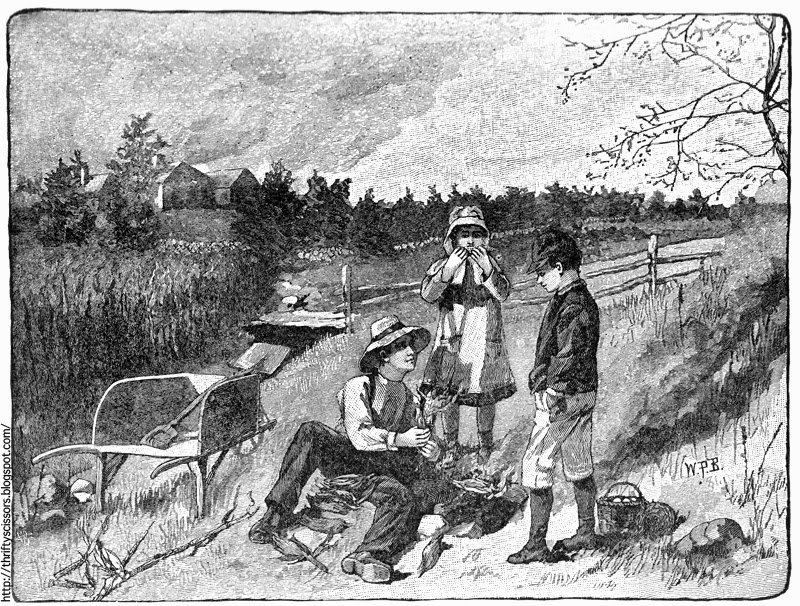
"Roasting Corn" Poem


By Mrs. Clara Doty Bates.

A faint blue cloud of smoke
Creeps up the golden air:
It must be the wandering gypsy folk
Have lighted a fire there.

No doubt they have covered vans,
And ponies shaggy and lean,
Which they will tether with dusky hands
Along the wayside green.

And the bells on their bridles hung
Will tinkle idly sweet,
With the chatter of children, rude of tongue
And bare of feet --

While, with grimy tents spread out,
Their elders lazily
Wait for the steam of the kettle-spout
To burn the time for tea.

Though surely I can get
But whiffs of the camp-fire smoke,
And though I know they are vagrants, yet
I will visit these gypsy folk.

Well, now! and is this Jack?
This Gold-locks? and this Ted?
With clothes and fingers a smutty black
And cheeks a burning red--

So hungry and forlorn,
In grandpa's ample house,
That you must pilfer an ear of corn
And nibble it like a mouse?

Will I have some? The smell
Is of itself a treat.
I'll trust the boys and girls to tell
When things are good to eat!

(All poetry on this blog is in the public domain folks.)

Paint Fall Foliage With Hugs and Kisses

This picture of Fall foliage was created
entirely with dots.

      This picture was painted with Dot paint markers. Dot paints are frequently purchased for early learning center art activities. These paint bottles have foam tips and are just the right size for little hands to squeeze and paint with. The round shapes of my tree's foliage are actually painted coffee filters that are pasted onto a large piece of blue construction paper after drying. I cut a simple tree trunk from brown construction paper to paste on top of the blue background as well. The blank circular shape is for each child to "carve" their names inside after they have completed the assignment. 
      Because dot painting is so easy to do, it is important for teachers to give young students enough of a challenge when filling in space with their paints. A picture like this will take a preschool student at least forty minutes or more to finish. Teachers may have students complete the foliage on one day and then assemble the picture with additions to the trunk, sky and ground on a second day. In any case, one large dot picture should take a week for three to five year old children to complete nicely.
      Encourage students to fill in all of the spaces. Then give them markers of similar color and demonstrate how to add Capital Xs to every circular shape. This may appear on the surface to be busy work but it serves the purpose of training small motor skills in very young students by virtue of a pleasant activity. Here are a few goals associated with the activity that teachers may wish to include within a weekly lesson plan:
  • Color matching
  • Writing the Capital letter "X"
  • Learning about color families or cool vs. warm colors
  • Defining space
  • Defining boundaries in space
  • Manipulating objects by squeezing and placement
  • Recognizing and reproducing geometric shapes
  • Teaching science concepts to children: this one would be photosynthesis.
  • Learning about additional symbolism given to letters, i.e. hugs and kisses are x's and o's