Saturday, January 20, 2018

A hot air balloon pattern block design

"a hot air balloon" Click directly on the image to enlarge it.

Questions/Activities for this figurative balloon design:
  1. How many rhombus tiles are used to make this hot are balloon?
  2. Count the number of triangles used to shape this hot air balloon.
  3. How many rhombus tiles are used to represent the star inside the balloon design only?
  4. What type of shape is used to represent the basket beneath the balloon?
  5. Now copy on your table, using the pattern blocks the exact same hot air balloon shown above.

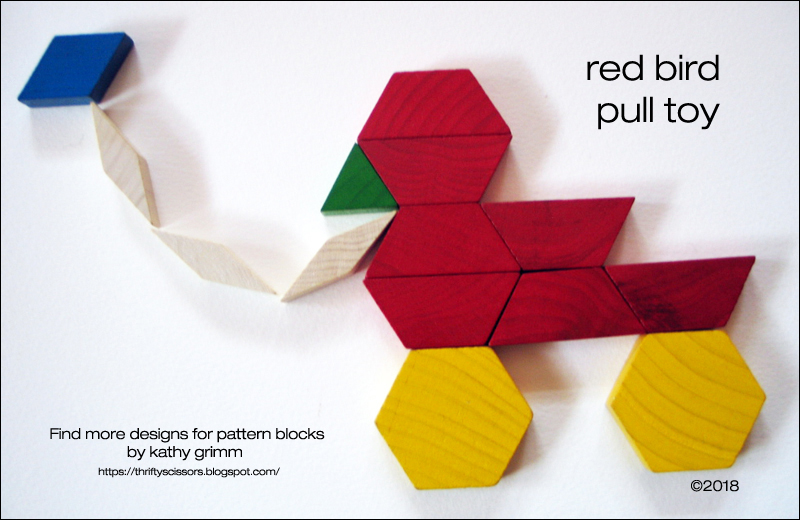
A red bird pull toy pattern block design

"a red bird, pull toy" Click directly on the image to enlarge it.

Questions/Activities for this figurative bird design:
  1. Count the number of trapezoids used to represent the body of the bird.
  2. The hexagons in this picture have six equal sides, what colors are the hexagons and where are they located?
  3. How many rhombuses have been used to symbolize the string for this pull toy?
  4. Now manipulate your own version of this pull toy on the table provided to you with the same number and colors of pattern blocks.
  5. Can you create your own pull toy with unique combinations of shapes? If so, give it a try!

A cluster of grapes pattern block design

"a cluster of green grapes" Click directly on the image to enlarge it.

Questions/Activities for this figurative fruity design:
  1. Count the number of triangles used to represent grapes in the design above.
  2. How many rhombus tiles are used to manipulate a stem for this cluster of grapes?
  3. If you add both the triangles and rhombus tiles together, how many pattern blocks will you use to make this small puzzle all together? 
  4. Can you find a six pointed star inside this cluster of grapes?
  5. How many overlapping hexagon shapes can you find?
  6. Now manipulate your own version of this cluster of grapes on the table provided to you with the same number and colors of pattern blocks.

Working With Pattern Blocks

Above are traditional wooden versions of Pattern Blocks. There are educational, toy companies that now manufacture
Pattern Blocks in plastic. If you can not afford either of these, you may cut out your own templates from paper.
        Pattern Blocks are one of the mathematical manipulatives developed in the 1960s by an Education Development Center as part of their Elementary Science Study project. They allow children to see how shapes can be decomposed into other shapes, and introduce children to ideas of tilings.

The Pattern Blocks includes multiple copies of six shapes in the following colors:
  • Equilateral triangles are green. In geometry, an equilateral triangle is a triangle in which all three sides are equal. In the familiar Euclidean geometry, equilateral triangles are also equiangular; that is, all three internal angles are also congruent to each other and are each 60°. They are regular polygons, and can therefore also be referred to as regular triangles.
  • Rhombus tiles that can be matched with two of the green triangles are blue. In Euclidean geometry, a rhombus(◊) (plural rhombi or rhombuses) is a simple (non-self-intersecting) quadrilateral whose four sides all have the same length. Another name is equilateral quadrilateral, since equilateral means that all of its sides are equal in length. The rhombus is often called a diamond, after the diamonds suit in playing cards which resembles the projection of an octahedral diamond, or a lozenge, though the former sometimes refers specifically to a rhombus with a 60° angle (see Polyiamond), and the latter sometimes refers specifically to a rhombus with a 45° angle. Every rhombus is a parallelogram and a kite. A rhombus with right angles is a square.
  • Trapezoid that can be matched with three of the green triangles are red. In Euclidean geometry, a convex quadrilateral with at least one pair of parallel sides is referred to as a trapezoid (/ˈtræpəzɔɪd/) in American and Canadian English but as a trapezium (/trəˈpziəm/) in English outside North America. The parallel sides are called the bases of the trapezoid and the other two sides are called the legs or the lateral sides (if they are not parallel; otherwise there are two pairs of bases).
  • Hexagon that can be matched with six of the green triangles are yellow. In geometry, a hexagon (from Greek ἕξ hex, "six" and γωνία, gonía, "corner, angle") is a six sided polygon or 6-gon. The total of the internal angles of any hexagon is 720°
  • Squares with the same side-length as the green triangle are orange. In geometry, a square is a regular quadrilateral, which means that it has four equal sides and four equal angles (90-degree angles, or (100-gradian angles or right angles). It can also be defined as a rectangle in which two adjacent sides have equal length.
  • Narrow rhombus with a 30° angle and the same side-length as the green triangle are white or beige.
       My patterns come with both questions and activities so that classroom teachers or homeschooling parents may use either a lap top or a desk-top computer center for creating interactive learning experiences for students reading this blog in specific:
  1. Set up a learning center using a computer, laptop or tablet with access to https://thriftyscissors.blogspot.com pages only. The content must not be transferred to an alternative web location.
  2. Provide a couple of sets of Pattern Blocks for each work space and paper with writing tools as well. 
  3. Pick and choose the questions or actions that you want your students to answer or manipulate according to their age/abilities.
  4. To enlarge the images, simple click on the image and you will be able to see a larger version on a dark background.
       If your students can not yet read, simply have them configure the same design in front of themselves with Pattern Blocks on a table or desk. Students can do this activity by themselves or in a group at a large table. This activity helps develop Pre-Math Skills: problem solving, patterning, estimation, sense of space, representation (symbolism) and number sense.
Manipulate More Shapes Using Pattern Block Games:
    Repeat Patterns Using Pattern Blocks:
    Try My Figurative Designs For Pattern Blocks: Plus questions and activities...
    1. two kissing fish
    2. flower garden
    3. a super hero shield
    4. a scarecrow
    5. the court jester 
    6. a simple Christmas tree
    7. a Christmas tree with a star
    8. a red bird pull toy
    9. hot air balloon
    10. a red stocking with a green patch
    11. a Christmas wreath
    12. St. Nickolas
    13. baby Jesus in a manger
    14. poinsettia in a planter
    15. a praying angel
    16. a soccer ball
    17. a cluster of grapes
    18. a water lily
    19. a big fish
    20. a trapped trapezoid
    21. a flowering triangle

           The photographs located here are the copyrighted property of kathy grimm. Do not upload them onto your personal blogs or webpages for this reason. Give a link to the collection only, if you are referencing the collection.
           Also, do not alter the photographs in any way. Altering photos from this web journal will get you into a heap of trouble with the law. These photos are not included here for the purpose of creating a new collection or a duplicate one on an alternative web site. Copyrighted works must be altered in such a way as to render them "unrecognizable content" in order for the material to be reproduced without censure. In other words, you must make your own unique content from the very beginning, in order to keep copyright law.
           Educators, parents, and social workers from any country may use the photographs for hard copy within the context of a classroom environment only. The photographs should never be reproduced for sale. I have not authorized any person to charge money for profits from these photographs. They are intended for children to learn from freely but not for republishing on third party websites or printing out to sell for monetary gain!
     
    More Pattern Block Templates, Mats, and Designs:
    Research more about the history of Pattern Blocks:
    Where to purchase Pattern Blocks:

    Friday, January 19, 2018

    A Memorial Day Prayer

           Almighty God, Maker of the heavens and the earth, King of kings, Lord of lords. Creator of all men, and Father of all spirits:
           We worship Thee this day as the source of all our benefits and blessings. We thank Thee for our conscious lives, for our republic, for our homes, which are the foundations of the republic; for our churches and our schools, and for all the moral forces which have shaped the nation of which we are a part.
           We thank Thee for the literature, the just laws, the sciences, the liberal benefactions, the mutual human trust, and the generous impulses which procure and preserve amity and peace among civilized  peoples.
           We thank Thee for the manliness, courage, devotion, and conscientious convictions which made possible our brave men and heroic women in the years when armies took the field against us, and dared to assail that for which our forefathers suffered and died.
           We thank Thee for our noble mothers, wives, sisters, and daughters, and for their undying patriotism and love manifested when they sadly but gladly permitted their fathers, husbands, brothers, and sons to leave their dear ones to the care of God and risk their all upon the field of battle.
           While we are assembled here today, may God make vivid, emphasize, and impress upon this great congregation a sense of the priceless value of all that for which women have suffered at home, and of that for which men were willing to yield all save their sacred honor.
           Pardon all our sins; remit the guilt of that in our national laws or habits or indulgences for which we may have become responsible through our ignorance or by our indifference to the bounden duties
    of citzinship.
           Revive within us a just appreciation of all that which by Thy blessing has preserved the nation until this day. Re-awaken us to the conditions upon which God will alone continue our national life.  We pray Thee to increase the number of our honest. God-fearing office-bearers, and to graciously rebuke and remove from power all those who have abused their sacred trusts.
           Grant Thy special blessings upon the family whose heroic husband and father is named by every voice in the nation today. May our grateful memories rival even this bronze in commemorating heroic
    and patriotic deeds. We pray Thee to stimulate our gratitude toward all those who fought for the republic, and to quicken the spirit of genuine patriotism in every American heart.
           Impress each one of us with the sense of personal responsibility for our homes, for our nation, and for the continued existence of Christian civilization upon the earth.
           Help us to serve Thee by serving our fellowmen, and in the end bring us to the better kingdom above through Him who hath loved us and gave Himself for us. Amen. Delivered at the unveiling of
    the Logan Statue, by Rev. Arthur Edwards.

    Commemoration Ode Of 1865

    Commemoration Ode Of 1865 
    by James Russell Lowell.

    Be proud! for she is saved, and all have helped to save her!
    She that lifts up the manhood of the poor,
    She of the open soul and open door.
    With room about her hearth for all mankind!

    What were our lives without thee?
    What all our lives to save thee?
    We reck not what we gave thee;
    We will not dare to doubt thee.
    But ask whatever else, and we will dare! 

    Anniversary Poem

    Anniversary Poem
    John Greenleaf Whittier

    I knew that truth would crush the lie,
    Somehow, sometime the end would be;
    Yet scarcely dared I hope to see
    The triumph with my mortal eye.
    "But now I see it! In the sun
    A free flag floats from yonder dome.
    And at the nation's hearth and home
    The justice long delayed is done.
    "Not as we hoped, in calm of prayer.
    The message of deliverance comes.
    But heralded by roll of drums
    On waves of battle-troubled air!
    "Not as we hoped - but what are we?
    Above our broken dreams and plans
    God lays, with wiser hand than man's
    The corner-stones of liberty."

    From "The Cotter's Saturday Night."

    From "the Cotter's Saturday Night."
    by Robert Burns

    O, Scotia! my dear, my native soil!
    For whom my warmest wish to Heaven is sent!
    Long may thy hardy sons of rustic toil
    Be blest with health, and peace, and sweet content!
    And, O, may Heaven their simple lives prevent
    From luxury's contagion, weak and vile;
    Then, howe'er crowns and coronets be rent,
    A virtuous populace may rise the while.
    And stand ' a wall of fire around their much-lov'd isle.

    O Thou! who pour'd the patriotic tide
    That stream'd thro' Wallace's undaunted heart;
    Who dar'd to, nobly, stem tyrannic pride.
    Or nobly die, the second glorious part,
    (The patriot's God, peculiarly thou art.
    His friend, inspirer, guardian, and reward!)
    O never, never, Scotia's realm desert.
    But still the patriot, and the patriot-bard,
    In bright succession raise, her ornament and guard!

    From Locksley Hall

    From Locksley Hall
    by Alfred Tennyson

    For I dipt into the future, far as human eye could see.
    Saw the Vision of the world, and all the wonder that would be;

    Saw the heavens fill with commerce, argosies or magic sails.
    Pilots of the purple twilight, dropping down with costly bales;

    Heard the heavens fill with shouting, and there rain'd a ghastly dew
    From the nation's airy navies grappling in the central blue;

    Far along the world-wide whisper of the south-wind rushing warm.
    With the standards of the peoples plunging thro' the thunderstorm;

    Till the war-drum throbb'd no longer, and the battle-flags were furl'd
    In the Parliament of man, the Federation of the world.

    Recessional

    Recessional
    by Rudyard Kipling

    God of our fathers, known of old -
    Lord of our far-flung battle-line -
    Beneath Whose awful Hand we hold
    Dominion over palm and pine -
    Lord God of Hosts, be with us yet,
    Lest we forget - lest we forget!

    The tumult and the shouting dies -
    The captains and the kings depart -
    Still stands Thine ancient Sacrifice,
    An humble and a contrite heart.
    Lord God of Hosts, be with us yet.
    Lest we forget - lest we forget!

    Far-called our navies melt away -
    On dune and headland sinks the fire -
    Lo, all our pomp of yesterday
    Is one with Nineveh and Tyre!
    Judge of the Nations, spare us yet.
    Lest we forget - lest we forget!

    If, drunk with sight of power, we loose
    Wild tongues that have not Thee in awe -
    Such boasting as the Gentiles use
    Or lesser breeds without the Law -
    Lord God of Hosts, be with us yet.
    Lest we forget - lest we forget!

    For heathen heart that puts her trust
    In reeking tube and iron shard -
    All valiant dust that builds on dust,
    And guarding calls not Thee to guard -
    For frantic boast and foolish word,
    Thy Mercy on Thy People, Lord! Amen.

    Planning A Child's Party or Picnic

          Though not necessarily involving much expense, a children's party or picnic calls for more careful planning and diplomacy than is demanded in the case of a similar function for the grown-ups. And of course, every child should bring their favorite doll to such an occasion as well. These kinds of social events are perfectly suited to the instruction of young children in role play.
          So what shall we do with the brave little men and dear little maids who have arrived at the appointed hour? I will include a variety of articles here in the near future intended to encourage parents and teachers whose pleasure it is to include theatrical environments and games in their child/student's parties and picnics.
    A table set for a child's party 100 years ago.
          We think nothing of systematic and elaborate preparations for our grown-up parties, and we should certainly take no less thought or time where the children are concerned, when planning a party in advance. When making out lists, keep  a carefully thought out program of games that will be interesting and appropriate to the ages and the number of children invited to your party.
          Properties, favors, and prizes should be systematically arranged beforehand, and stowed away out of sight, but easily accessible at the proper moment. The little host or hostess should be inspired to show an unselfish interest in the happiness of his or her little friends, and should receive them with the grown-up hostess.
          When the party day has arrived, and with it the children, there should be polite and cheerful greetings, and the tiny guests should settle themselves comfortably or uncomfortably, according to the nature of each. Then is the moment for the pianist to take her place and with lively airs charm away all constraint until enough children have arrived to begin playing a game. Six to eight is a good number, and if the hostess has an assistant this will be her opportunity to start the children playing. Ring games. Air Ball, or character games are suitable ones with which to begin, as the newcomers can enter into the frolic without disturbing the others. Music, wherever it can come in naturally, lends spirit and dash to the games.
          From drawing-room to library or nursery often makes an excellent change, especially where some paraphernalia is required and has to be prepared beforehand.
          There is usually a shy little girl or boy who hesitates to enter the game. By degrees the strangeness wears off ; self has been forgotten in the spirit of the play, and it is quite an easy step to draw the child into the game by tossing the ball or bean-bag temptingly near, or with an apparently careless word or question. Character parties are especially helpful in taking away self-consciousness. Playing "pretend " has in itself a fascination that few children can resist, and when a little girl finds herself actually a Queen of the Fairies by right of crown, wand, and wings, she assumes the manners and privileges of her station without an effort. A boy whose name has suddenly changed to Jack the Giant-killer will soon forget his troublesome hands and feet in his exalted position ; and he has scant notice for those who address him by the uninteresting name of Bobby. That name belongs back in the other world of kilts and curls for which he has no use at the present moment. The properties for these character parties are easily fashioned, and are sure to be a delight to the children who receive them.
          Story-telling should come after a romp. It is the prettiest moment of the party, when the children, with flushed faces, settle themselves in a group on the floor, and relax to the ever magic words of " Once upon a time‚" Interest is added if at an unexpected moment a child is called upon to tell what he supposes " happened then." Should his idea be a good one, as is almost certain to be the case, his suggestion can be taken for the cue, and the story continued, when another child may be called upon for a suggestion.
          Prizes and favors play an important part in the games, but should be made appropriate rather than elaborate. The child who wears around his neck a ribbon to which is attached a tiny bell is justly proud of his tinkling favor. It is to be won by rolling a ball so straight that the large dinner-bell, suspended from the chandelier and just above the floor, rings loud and true. And the boy or girl who pierces the center of the red-heart target, on St. Valentine's day, will appreciate the gift of the bow and arrow which helped to win the victory.
          That each may carry home some souvenir, a bon-bon favor should be found at each place on the supper-table ; and it will gladden the hearts of those who were not successful in winning prizes in the games.
          Let the menu be simple, that the joy of the occasion may not be marred later with misery and mustard plasters.
          The gift surprise is the last joy of all. A rose tree, gift ball, or one of the many new and charming devices for hiding a toy or game, which originated in the old-fashioned but ever popular Jack Horner pie, is the most suitable ending to a successful party.
          The watchful hostess need not plan for after-supper games. The pleasure in the gifts, and the comparing of trinkets and toys with one another, will fill up the time until the "good-byes" and "I've had a lovely time" are said. by Mary White.

    Picnic Party Ideas.

    How to Host A Mother Goose Party

    Design a storybook Mother Goose Party. The table is decorated with paper cups, paper plates
     and a frosted delectable cake all in soft pastel shades of every color in the rainbow.
     Buff pink carnations, satin ribbons and helium filled balloons add polish and extra interest 
    to the room. This playful party arrangement was first designed by Willie Mae Rogers and
     Dorothy B. Marsh.

    Balloons to Invite Them. Such fun for tiny misses aged four years and up! For each invitation, blow up 3 pastel-colored balloons. With India ink and paintbrush, print the party details on the balloons as shown on page 80. Let the balloons dry thoroughly; then deflate them. Tuck them in an envelope, and mail to the guest. What little girl could resist?
    Mother Goose Land. Rainbow chains: They're so pretty draped in the windows and doorway of the party room, with clusters of balloons added to complete the fairyland setting! And they're so easy to make, the young hostess may wish to do them all herself before the party. Cut pastel construction paper into 6‚Ä≥ x strips. Staple the ends of the first strip together to form a circle. Put the second strip through the first circle; staple; continue until you have a chain of 3‚Ä≤ or more. 
    Little Miss Muffet's Table. It's pink! Use a round 45″ table or a card table with folding tabletop over it to increase its size. Cover the table with a round pink cloth. At each place, arrange pastel colored paper plate, cup. and napkin—all green, all pink, all blue, all yellow, or other color—with white plastic fork and spoon.
    1.  Balloon place cards: Attach a balloon with ribbon to each child's chair back. (If balloons are filled with helium gas, they will float.) Then, with India ink and paintbrush, write on the balloon the name of the little girl who is to sit there.
    2. Rainbow surprise balls: On each plate at the table, place a Rainbow Surprise Ball to be opened after refreshments. You'll need: 15 or more tiny items dear to each little girl's heart, such as an odd-shaped balloon, powder puff, piece of doll furniture, water flowers, piece of wrapped candy, bottle of perfume, ball and jacks, magnet, tiny animal figure, etc. Also folds of crepe paper, in several colors that match your party color scheme; cut these, without unfolding, into 1 inch wide strips. To make each: Starting with a small wad of crepe-paper strips, wrap up the first favor, stretching the strips and turning the ball round and round as you wrap. When the first favor is completely covered, add another favor and continue wrapping, using strips of different colors as you work. When completed, each surprise ball will be the same size.
    3. Butterfly favors: One of these goes on each little guest's napkin; it has a bobby-pin back, so it can be worn in the hair. Lay a cardboard pattern of a butterfly on a double thickness of coarse crinoline. Trace around the pattern; then cut. With bright-colored poster paint, paint the butterfly; let it dry. Fold a colored pipe cleaner in half to resemble feelers. Insert it between the two thicknesses of crinoline. To form the body of the butterfly, with darning wool, stitch through the crinoline and over the feelers, going the full length of the butterfly. Next glue front and back pieces of crinoline together. Then paste on a few sequins, polka-dot-fashion; or dot butterfly wings with glue and top with glitter.
    4. Old-woman-in-a-shoe cake centerpiece: It's an enchanting cake! All details are given below.
    Mother Goose Party Games.
    1. China dog and calico cat: This is noisy fun for early in the party. Mother collects the candy kisses and keeps score. Props: 1 paper bag marked "Kittens"; 1 paper bag marked "Doggies"; 25 or 30 candy kisses (hidden before the party). Action: Children are divided into 2 teams: China Doggies and Calico Kittens‚ with a bag for each team. At the signal, all start hunting for kisses. When one tiny miss finds n kiss, she mews or barks until Mother gets to her, picks up the kiss (children mustn't pick up the kisses themselves), and drops it into her team's paper bag. At the end of 10 minutes, the kisses are counted. Each member of the team with the most kisses selects a prize from the table. Then the remaining children each collect a prize. They can't lose!
    2. Mother goose playhouse: Have all the children recite or sing nursery rhymes, acting them out at the same time. For instance: Jack and Jill went up the hill (point finger upwards), To fetch a pail of water (pick up imaginary pail); Jack fell down (all fall down) and broke his crown (pat top of head ) And Jill came tumbling after (with hands, make tumbling motion).
    3.  Put-the-candles-on-the-cake: (a new version of pin-the-tail-on-the-donkey)  Props: A large piece of white paper on which a birthday cake is drawn (to be tacked up before the game); a different colored crayon for each child; a blindfold. Action: Each child is blindfolded and asked to draw, with her crayon, 3 candles on the cake. The child who puts candles in the most appropriate place is the winner.
    4. Mother goose quiz: Children as well as adults love a quiz. Props: A good supply of questions. Action: The children are again divided into 2 teams: Kittens and Doggies. Teams sit. facing each other. Mother asks a question first of one side and then of the other. Sample questions might be: Where did Jack Horner sit? What did Little Miss Muffet sit on? Where did Peter, Peter, Pumpkin Eater put his wife? How many fiddlers did Old King Cole have? Who put the kettle on? What ran up the clock?
    More little folks' games: Play each of the following games for just 5 minutes; then the children won't tire so easily.
    Party Food: 
    Humpty Dumpty Sandwiches:
    1.  For each sandwich, prepare a stuffed egg; put halves together.
    2.  Using white bread with crusts removed, make a 3-decker sandwich, with peanut butter, deviled ham, and apricot jam as fillings.
    3.  Cut sandwich in half. Place halves, end to end. on paper plate; top with Humpty Dumpty (the stuffed egg), using plastic straws to skewer him in place. Use 2 thin carrot sticks for legs, letting them extend over edge of sandwich.
    4. Now mix together red. blue, and yellow food colors to achieve a brown shade. With a new paintbrush, draw features on Humpty.
    Old-Woman-in-a-Shoe Cake
    Ingredients:
    • 2 pkg. yellow cake mix.
    • Party Cream (page 185) 1 pkg. fluffy white frosting mix.
    • Licorice candy.
    • Red cinnamon candy.
    • 2 or more pkg. thin 1" candy wafers.
    Directions: The Cake Foundation: Bake cakes a day or so ahead: store, covered. Or bake them several days or weeks ahead; freezer-wrap; freeze. To make and bake cakes, proceed as follows:
    1. Start heating oven to 350" F. Grease well 10" x 5" x 3" loaf pan.
    2. Prepare 1 pkg. cake mix as label directs; turn into loaf pan. Bake about 55 min., or until cake tester inserted in center comes out clean.
    3. Cool cake in pan on rack 10 min.; remove from pan; cool on rack.
    4. Make second cake loaf same way.
    Shaping the Shoe Cake: The evening before the party, put cake together and decorate as below; then refrigerate or freeze overnight.
    1. Cut piece of heavy cardboard into 8-1/2" x 4-1/2" oblong; round off all 4 corners; cover with aluminum foil.
    2. From end of 1 loaf cake, cut 6" piece; reserve both pieces.
    3.  From other loaf cake, cut off both ends to make loaf 7" long.
    4. For toe part of shoe: With small mound of Party Cream, glue 6" cake piece, with its cut side facing in, to one end of cardboard.
    5.  For leg part of shoe: Glue 7" cake piece, standing up, with rounded side facing out, to other end of cardboard, so it's snug against cut side of first piece of cake.
    6. Now, with sharp paring knife, carefully round off and trim corners and edges of cake to resemble shoe.
    7. To prepare for peaked roof: On each side of 7" leg, 1" down from top, make upward cut to center top of cake; remove these 2 pieces of cake.
    8. For peaked roof: From reserved cake pieces, cut 2-1/2"-thick slices; trim each to 3-1/2" x 3-1/4". Glue each slice to one slant of leg so they meet in center. Hold slices in place with 2 pieces of plastic straw or with toothpicks.
    Frosting Top and Sides of Shoe Cake:
    1. Now make up fluffy white frosting mix as label directs; tint pink with red food color; spread thin over entire shoe, to set crumbs.
    2.  Then generously frost shoe with rest of pink frosting, building up shape of shoe over instep and at toe.
    3. Cut 9 strips of licorice, each 1-1/2" x 1/4"; use to make lacings. Use red cinnamon candies for holes. Cut 2 strips of licorice, each 3" x 1/4", for ends of shoelaces. Place on cake as shown.
    4. To make shingles on roof: Starting at bottom of roof on each side, overlap candy wafers in overlapping rows, alternating colors as shown.
    5.  To about cup Party Cream, add 2 tablesp. cocoa; use in cake decorator with ribbon tube to make door, shutters, and sole around shoe.
    6. Using white Party Cream in cake decorator with rosette tube, outline door and windows; then make windowpanes and doorknob.
    7. Arrange short birthday taper candles on ridge of roof.
    8. The Yard for the Shoe Cake: Set shoe cake on white round board or cardboard, with ribbon around edge as shown; then place tiny rubber children here and there in yard.
    9. To cut cake, first slice toe part into 6 to 8 slices. Then cut off rest of cake just below roof (be careful of straws); remove. Slice this part of cake into 6 to 8 slices. Makes 12 to 16 servings.

    Thursday, January 18, 2018

    The Dying Year

    The Dying Year
    by John Irving Pearce

    Ring bells! oh, ring bells!
    For the dying year-
    Dawn cometh swiftly;
    Death low-hovers near.

    Wake! O ye echoes
    Of the days long o'er!
    Harbingers mytic
    Of days now before.

    Though many flowers
    Ne'er can bloom again,
    Though many hours might
    Brighter far have been;

    Weep not; Oh! weep not!
    Other buds will come;
    New loves will blossom
    In some fairer home.

    Let no regrettings
    Mar the peaceful close;
    Wrap in oblivion
    All your weary woes.

    Dream on; Oh, dream on!
    Through the misty past,
    Mingling hope's smiles with 
    Mem'ry's tears at last

    To The New Year

    To The New Year
    by L. Smith

    My sweet New Year, I greet you!
    Memory's broken toys
    I leave with the Old Year--
    You bring new life, new joys.

    With outstretched hands I greet you!
    Your breath is like the morn;
    Your smiles cover memory--
    Again new hopes are born.

    With love I meet and greet you!
    Give me your brave strong hand,
    And lead me swiftly onward:
    'T is dangerous here to stand.

    The Old For The New

     The Old for the New
    by L. Smith

    QLD YEAR,  I've loved you well; too well;
    And yet for you I shed no tear,
    No more to you my secrets tell:
    I 'II whisper them to this New Year;
    And Oh, I know he'll do his part
    And lock them close within his heart.

    Old Year, again I say good-bye;
    We've walked together, oh, so long!
    You've caused me many and many a sigh,
    Yet oft you've filled my heart with song.
    This is the parting of the ways;
    Good-bye to you, and all your days!

    Monday, January 8, 2018

    Dr. Martin Luther King Jr. Day

    Left, monument in Birmingham Alabama and
    Right, monument in Washington D.C.
           Martin Luther King Jr. was born Michael King Jr., January 15, 1929  and died April 4, 1968. He was an American Baptist minister and activist who became the most visible spokesperson and leader in the civil rights movement. He is best known for his role in the advancement of civil rights using the tactics of nonviolence and civil disobedience based on his Christian beliefs and inspired by the nonviolent activism of Mahatma Gandhi.
           King became a civil rights activist early in his career. He led the 1955 Montgomery bus boycott and helped found the Southern Christian Leadership Conference (SCLC) in 1957, serving as its first president. With the SCLC, he led an unsuccessful 1962 struggle against segregation in Albany, Georgia, and helped organize the 1963 nonviolent protests in Birmingham, Alabama. He also helped to organize the 1963 March on Washington, where he delivered his famous "I Have a Dream" speech.
           On October 14, 1964, King received the Nobel Peace Prize for combating racial inequality through nonviolent resistance. In 1965, he helped to organize the Selma to Montgomery marches, and the following year he and SCLC took the movement north to Chicago to work on segregated housing. In the final years of his life, he expanded his focus to include opposition towards poverty and the Vietnam War, alienating many of his liberal allies with a 1967 speech titled "Beyond Vietnam".
           In 1968, King was planning a national occupation of Washington, D.C., to be called the Poor People's Campaign, when he was assassinated by James Earl Ray on April 4 in Memphis, Tennessee. King's death was followed by riots in many U.S. cities.
           King was posthumously awarded the Presidential Medal of Freedom and the Congressional Gold Medal. Martin Luther King Jr. Day was established as a holiday in numerous cities and states beginning in 1971, and as a U.S. federal holiday in 1986. Hundreds of streets in the U.S. have been renamed in his honor, and a county in Washington State was also renamed for him. The Martin Luther King Jr. Memorial on the National Mall in Washington, D.C., was dedicated in 2011.
    Civil Rights Artifacts:
    Civil Rights Links:

    Emancipation Proclamation

           The Emancipation Proclamation is a state paper issued by President Lincoln, January 1, 1863, by which all slaves in the states or parts of states actually engaged in rebellion and unrepresented in Congress, or not in possession of the Union armies, were declared free. It was justified as a "fit and necessary war measure" and had been contemplated by Lincoln for many months. When, in September, 1862, Lee was checked at the Battle of Antietam, Lincoln issued a preliminary statement announcing his intention of declaring the slaves free on January 1rst if the South in the meantime did not return to the Union. The final proclamation did not legally abolish slavery, but abolition was made effective by the Thirteenth Amendment to the Constitution.

    Emancipation Proclamation by Lincoln.

    Reproduction of the Emancipation Proclamation at the National Underground Railroad Freedom Center in Cincinnati, Ohio

    "Free At Last" Hymn

    Way down yonder in the graveyard walk,
    I thank God I'm free at last,
    Me and my Jesus goin' to meet and talk
    I thank God I'm free at last, O [Refrain]

    Refrain:
    Free at last, free at last;
    I thank God I'm free at last;
    Free at last, Free at last,
    I thank God I'm free at O
    Free at last, free at last;
    I thank God I'm free at last;
    Free at last, Free at last,
    I thank God I'm free at last.

    Ona my knees when the light passed by,
    I thank God I'm free at last.
    Thought my soul would rise and fly
    I thank God I'm free at last, O [Refrain]

    Some of these mornings, bright and fair,
    I thank God I'm free at last,
    Goin' meet King Jesus in the air,
    I thank God I'm free at last, O [Refrain]

    Folk Songs of the American Negro (No. 1), 1907

    "This is Joyful Noise, a gospel acapella group in the DC Metro area"

    "I Have a Dream..." Speech

           "I Have a Dream" is a public speech delivered by American civil rights activist Martin Luther King Jr. during the March on Washington for Jobs and Freedom on August 28, 1963, in which he calls for an end to racism in the United States and called for civil and economic rights. Delivered to over 250,000 civil rights supporters from the steps of the Lincoln Memorial in Washington, D.C., the speech was a defining moment of the civil rights movement.
           Beginning with a reference to the Emancipation Proclamation, which freed millions of slaves in 1863, King observes that: "one hundred years later, the Negro still is not free" Toward the end of the speech, King departed from his prepared text for a partly improvised peroration on the theme "I have a dream", prompted by Mahalia Jackson's cry: "Tell them about the dream, Martin!" In this part of the speech, which most excited the listeners and has now become its most famous, King described his dreams of freedom and equality arising from a land of slavery and hatred. Jon Meacham writes that, "With a single phrase, Martin Luther King Jr. joined Jefferson and Lincoln in the ranks of men who've shaped modern America". The speech was ranked the top American speech of the 20th century in a 1999 poll of scholars of public address.
    "I Have a Dream Speech" from August 28, 1963

           King delivered a 17-minute speech, later known as "I Have a Dream." In the speech's most famous passage—in which he departed from his prepared text, possibly at the prompting of Mahalia Jackson, who shouted behind him, "Tell them about the dream!"King said:
    I say to you today, my friends, so even though we face the difficulties of today and tomorrow, I still have a dream. It is a dream deeply rooted in the American dream.
    I have a dream that one day this nation will rise up and live out the true meaning of its creed: 'We hold these truths to be self-evident: that all men are created equal.'
    I have a dream that one day on the red hills of Georgia the sons of former slaves and the sons of former slave owners will be able to sit down together at the table of brotherhood.
    I have a dream that one day even the state of Mississippi, a state sweltering with the heat of injustice, sweltering with the heat of oppression, will be transformed into an oasis of freedom and justice.
    I have a dream that my four little children will one day live in a nation where they will not be judged by the color of their skin but by the content of their character.
    I have a dream today.
    I have a dream that one day, down in Alabama, with its vicious racists, with its governor having his lips dripping with the words of interposition and nullification; one day right there in Alabama, little black boys and black girls will be able to join hands with little white boys and white girls as sisters and brothers.
    I have a dream today.
           "I Have a Dream" came to be regarded as one of the finest speeches in the history of American oratory. The March, and especially King's speech, helped put civil rights at the top of the agenda of reformers in the United States and facilitated passage of the Civil Rights Act of 1964.

    Arbor Day

    Portrait if Birdsey Northop.
            Arbor Day was a day designed by legislative enactment in many states for the voluntary planting of trees by the people. It was inaugurated in 1874 by the Nebraska state board of agriculture, at the suggestion of J. Morton, afterwards Secretary of Agriculture in President Cleveland's second administration. 
           Arbor Day is observed late in April or early in May in many countries other than the United States, around the world during the warm planting months. 
    "A people without children would face a hopeless future; a country without trees is almost as hopeless; forests which are so used that they cannot renew themselves will soon vanish, and with them all their benefits. A true forest is not merely a storehouse full of wood, but, as it were, a factory  of wood, and at the same time a reservoir of water. When you help to preserve our forests or plant new ones you are acting the part of good citizens. The value of forestry deserves, therefore, to be taught in the schools, which aim to make good citizens of you. If your Arbor Day exercises help you to realize what benefits each one of you receives from the forests, and how by your assistance these benefits may continue, they will serve a good end."

    Theodore Roosevelt.
    The White House, April 15, 1907. 

    Arbor Day Artifacts:
    Tree Themed Art Projects for Arbor Day:
    History, Observance & Poems: 

    The Planting Of The Apple Tree

    The Planting Of The Apple Tree
    by William Cullen Bryant

    Come, let us plant the apple-tree!
    Cleave the tough greensward with the spade;
    Wide let its hollow bed be made;
    There gently lay the roots, and there
    Sift the dark mold with kindly care,
    And press it o'er them tenderly,
    As round the sleeping infant's feet
    We softly fold the cradle-sheet;
    So plant we the apple-tree.

    What plant we in this apple-tree?
    Buds which the breath of summer days
    Shall lengthen into leafy sprays;
    Boughs where the thrush, with crimson breast,
    Shall haunt, and sing, and hide her nest;
    We plant upon the sunny lea
    A shadow for the noontide hour,
    A shelter from the summer shower,
    When we plant the apple-tree.

    What plant we in this apple-tree ?
    Sweets for a hundred flowery springs
    To load the May-wind's restless wings,
    When from the orchard-row he pours
    Its fragrance through our open doors;
    A world of blossoms for the bee,
    Flowers for the sick girl's silent room,
    For the glad infant sprigs of bloom,
    We plant with the apple-tree.

    What plant we in this apple-tree?
    Fruits that shall swell in sunny June,
    And redden in the August noon,
    And drop when gentle airs come by.
    That fan the blue September sky;
    While children, wild with noisy glee,
    Shall scent their fragrance as they pass
    And search for them the tufted grass
    At the foot of the apple-tree.

    And when above this apple tree
    The winter stars are quivering bright.
    And winds go howling through the night,
    Girls, whose young eyes o'erflow with mirth.
    Shall peel its fruit by the cottage hearth;
    And guests in prouder homes shall see,
    Heaped with the orange and the grape.
    As fair as they in tint and shape.
    The fruit of the apple-tree.

    The fruitage of this apple-tree,
    Winds, and our flag of stripe and star,
    Shall bear to coasts that lie afar,
    Where men shall wonder at the view,
    And ask in what fair groves they grew:
    And they who roam beyond the sea
    Shall think of childhood's careless day,
    And long hours passed in summer play
    In the shade of the apple-tree.

    Each year shall give this apple-tree
    A broader flush of roseate bloom,
    A deeper maze of verdurous gloom,
    And loosen, when the frost-clouds lower.
    The crisp brown leaves in thicker shower.
    The years shall come and pass; but we
    Shall hear no longer, where we lie,
    The summer's songs, the autumn's sigh,
    In the boughs of the apple-tree.

    But time shall waste this apple-tree.
    Oh, when its aged branches throw
    Thin shadows on the ground below,
    Shall fraud and force and iron will
    Oppress the weak and helpless still ?
    What shall the task of mercy be.
    Amid the toils, the strifes, the tears
    Of those who live when length of years
    Is wasting this apple-tree?

    "Who planted this old apple-tree?"
    The children of that distant day
    Thus to some aged man shall say;
    And, gazing on its mossy stem,
    The gray-haired man shall answer them:
    "A poet of the land was he,
    Born in the rude but good old times;
    'Tis said he made some quaint old rhymes
    On planting the apple-tree."

    He Who Plants An Oak

           He who plants an oak looks forward to future ages, and plants for posterity. Nothing can be less selfish than this. He cannot expect to sit in its shade nor enjoy its shelter; but he exults in the idea that the acorn which he has buried in the earth shall grow up into a lofty pile, and shall keep on flourishing and increasing, and benefiting mankind long after he shall have ceased to tread his paternal fields. The oak, in the pride and lustihood of its growth, seems to me to take its range with the lion and the eagle, and to assimilate, in the grandeur of its attributes, to heroic and intellectual man.
           With its mighty pillar rising straight and direct toward heaven, bearing up its leafy honors from the impurities of earth, and supporting them aloft in free air and glorious sunshine, it is an emblem of what a true nobleman should be; a refuge for the weak - a shelter for the oppressed - a defense for the defenseless; warding off from them the peltings of the storm, or the scorching rays of arbitrary power. by Washington Irving.

    Arbor Day

           Our modern institution - Arbor Day - is a public acknowledgement of our dependence upon the soil of the earth for our daily, our annual, bread. In recognition of the same fact the Emperor of China annually plows a furrow with his own hand, and in the same significance are the provisions in the ancient law of Moses, to give the land its seven-year Sabbath, as well as to man his seventh day for  rest and recreation. Our observance is a better one, because it calls on all, and especially on the impressible learners in the schools to join in the duty which we owe to the earth and to all mankind,  of doing what each of us can to preserve the soil's fertility, and to prevent, as long as possible, the  earth, from which we have our being, from becoming worn out and wholly bald and bare. And we  do this by planting of any sort, if only by making two blades of grass grow where but one grew before, and by learning to preserve vegetation. We give solemnity to this observance by joining in it on an appointed day, high and low, old and young, together.

    A Hymn For Arbor Day

    By Henry Hanby Hay
    (To be sung by schools to the tune of "America")

    God save this tree we plant!
    And to all nature grant
    Sunshine and rain.
    Let not its branches fade,
    Save it from axe and spade.
    Save it for joyful shade -
    Guarding the plain.

    When it is ripe to fall,
    Neighbored by trees as tall,
    Shape it for good.
    Shape it to bench and stool,
    Shape it to square and rule,
    Shape it for home and school,
    God bless the wood.

    Lord of the earth and sea,
    Prosper our planted tree.
    Save with Thy might.
    Save us from indolence,
    Waste and improvidence.
    And in Thy excellence.
    Lead us aright.

    Arbor Day's Observance by Draper

           The primary purpose of the legislature in establishing "Arbor Day," was to develop and stimulate in the children of the Commonwealth a love and reverence for Nature as revealed in trees and shrubs and flowers. In the language of the statute, to encourage the planting, protection and preservation of trees and shrubs" was believed to be the most effectual way in which to lead our children to love Nature and reverence Nature's God, and to see the uses to which these natural objects may be put in making our school grounds more healthful and attractive.
           The object sought may well command the most thoughtful consideration and the painstaking efforts of school officers, teachers, and pupils in every school district, and in every educational institution and of all others who are interested in beautifying the schools and the homes of the state.
           It will be well not only to plant trees and shrubs and vines and flowers where they may contribute to pleasure and comfort, but also to provide for their perpetual care, and to supplement such work by exercises which will lead all to a contemplation of the subject in its varied relations and resultant influences. It is fitting that trees should be dedicated to eminent scholars, educators, statesmen, soldiers, historians or poets, or to favorite teachers or pupils in the different localities.
           The opportunity should not be lost, which is afforded by the occasion, for illustrating and enforcing the thought that the universe, its creation, its arrangement and all of its developing processes are not due to human planning or oversight, but to the infinite wisdom and power of God.
           Our school exercises, and particularly those of an unusual character, should be interspersed with selections, songs, and acts which will inspire patriotism. by A. S. Draper, 1909.

    Arbor Day In Schools

           J. Sterling Morton, once Secretary of the United States Department of Agriculture, originated Arbor Day in Nebraska in 1872. His able advocacy of this measure was a marvelous success the first year, and still more each succeeding year. So remarkable have been the results of Arbor Day in Nebraska that its originator is gratefully recognized as the great benefactor of his state. Proofs of public appreciation of his grand work I found wherever I have been in that state. It glories in the old misnomer of the geographies, "The Great American Desert," since it has become so habitable and hospitable by cultivation and tree-planting. Where, twenty years ago, the books said trees would not grow, the settler who does not plant them is the exception. The Nebraskans are justly proud of his great achievement and are determined to maintain its preeminence.
           Arbor Day for economic tree-planting and Arbor Day in schools differ in origin and scope. Both have been erroneously attributed to me, though long ago I advocated tree-planting by youth, and started the scheme of centennial tree-planting, offering a dollar prize, in 1876, to every boy or girl who should plant, or help in planting five "centennial trees"; still the happy idea of designating a given day when all should be invited to unite in this work belongs solely to ex- Governor Morton. His great problem was to meet the urgent needs of vast treeless prairies. At the meeting of the American Forestry Association, held at St. Paul in 1883, my resolution in favor of observing Arbor Day in schools in all our states was adopted, and a committee was appointed to push that work. Continued as their chairman from that day to this, I have presented the claims of Arbor Day personally, or by letter, to the governor, or state school superintendent in all our states and territories.
           My first efforts were not encouraging. The indifference of state officials who, at the outset, deemed Arbor Day an obtrusive innovation, was expected and occasioned no discouragement. My last word with more than one governor was: "This thing is sure to go. My only question is, shall it be under your administration or that of your successor?" Many state officials who at first were  apathetic, on fuller information have worked heartily for the success of Arbor Day. The logic of events has answered objections. Wherever it has been fairly tried it has stood the test of experience. Now such a day is observed in forty states and territories, in accordance with legislative acts or recommendation of state agricultural and horticultural societies, of the state grange, or by special proclamation of the governor or recommendation of the state school superintendents, and in some states by all these combined. It has already become the most interesting, widely observed and useful of school holidays. It should not be a legal holiday, though that may be a wise provision for the once treeless prairies of Nebraska.
           Popular interest in this work has been stimulated by the annual proclamations of governors and the full and admirable circulars to state and county school superintendents sent to every school in the State.
           Arbor Day has fostered love of country. It has become a patriotic observance in those Southern States which have fixed its date on Washington's Birthday. Lecturing in all these states, I have been delighted to find as true loyalty to the Stars and Stripes in them as in the North. This custom of planting memorial trees in honor of Washington, Lincoln, and other patriots, and also of celebrated authors and philanthropists, has become general. Now that the national flag with its forty-five stars floats over all the school-houses in so many states, patriotism is efifectively combined with the Arbor Day addresses, recitations and songs. Among the latter "The Star Spangled Banner" and "America" usually find a place. Who can estimate the educating influence exerted upon the millions of youth who have participated in these exercises? This good work has been greatly facilitated by the eminent authors of America who have written so many choice selections in prose and poetry on the value and beauty of trees, expressly for use on Arbor Day. What growth of mind and heart has come to myriads of youth who have learned these rich gems of our literature and applied them by planting and caring for trees, and by combining sentiments of patriotism with the study of trees, vines, shrubs, and flowers, and thus with the love of Nature in all her endless forms and marvelous beauty!
           An eminent educator says: "Any teacher who has no taste for trees, shrubs or flowers is unfit to be placed in charge of children." Arbor Day has enforced the same idea, especially in those states in which the pupils have cast their ballots on Arbor Day in favor of a state tree and state flower. Habits of observation have thus been formed which have led youth in their walks, at work or play, to recognize and admire our noble trees, and to realize that they are the grandest products of Nature and form the finest drapery that adorns the earth in all lands. How many of these children in maturer years will learn from happy experience that there is a peculiar pleasure in the parentage of trees, forest, fruit or ornamental - a pleasure that never cloys but grows with their growth.
           Arbor Day has proved as memorable for the home as the school, leading youth to share in dooryard adornments. Much as has been done on limited school grounds, far greater improvements have been made on the homesteads and the roadsides. The home is the objective point in the hundreds of village improvement societies recently organized. The United States Census of 1890 shows that there has recently been a remarkable increase of interest in horticulture, arboriculture, andfloriculture. The reports collected from 4,510 nurserymen give a grand total of 3,386,855,778 trees, vines, shrubs, roses, and plants as then growing on their grounds. Arbor Day and village improvement societies are not the least among the many happy influences that have contributed to this grand result. by B. G. Northrup, 1909.

    Arbor Day by Jarchow

           It is not long since some of our treeless Western States, desiring to promote the culture of trees, appointed a day early in spring for popular tree planting. But up to 1883 no state had advanced this movement by the institution of an Arbor Day to be celebrated and observed in schools. Ohio was the first state to move in this matter and to interest the schools in this work. Cincinnati's
           Arbor Day in the schools in the spring of 1883 will be remembered by all who took a part in the talks and lessons on trees during the morning hours, and in the practical work during the afternoon. The other states of the East, which have all suffered more or less by the wanton destruction of their primeval forests, soon followed in the wake of the Buckeye State, and our own Empire State celebrated for the first time in the spring of 1889 the Arbor Day in the public schools.
           Many considered this scheme impracticable for large cities where trees are a rare sight and where no opportunity is given for practical planting. But the logic of events has now removed any doubts and secured a general appreciation of this subject. To every patriotic American this is most satisfactory, as in the public schools should be introduced what ever shall appear in the nation's life. The foundation of the great deeds the Germans have achieved in every discipline of art, science, industries, and even in warfare, is due to the "schoolmaster." And if we train the youth into a love for trees, the next generation will see realized what we scarcely hope to initiate, the preservation of forests not only for climatic and meteorological purposes, but also for their value in the economy of the nation.
           Children may not be able to understand the importance of trees in their aggregation as forests; however, they will, if allowed to assemble in a grove or park, be inspired with the idea that trees are one of the grandest products of God when they hear that without them the earth could never have produced the necessaries of life, and that with their destruction we could not keep up the sustained growth of the plants that feed man and animals. There is no more suitable subject for practical oral lessons, now common in most of our schools, than the nature of plants, and especially that of trees and the value of tree-planting. Such lessons occupy only a little time, taking the place of a part of the "Reader." They tend to form the habits of accurate observation of common things which are of vast importance in practical life. These lessons will lead our youth to admire and cherish trees, thus rendering a substantial service to the State as well as to the pupils by making them practical arborists.
           Wherever the opportunity is given, children should be encouraged to plant or help in planting a tree, shrub or flower, actually practicing what they have learned in the study of the growth and habits of plants. They will watch with pride the slow but steady development of a young tree, and find a peculiar pleasure in its parentage. Such work has not only an educational effect upon the juvenile mind, but its aesthetic influence cannot be over- estimated. Tree planting is a good school for discipline in foresight, the regard for the future being the leading element in this work. Young people are mostly inclined to sow only where they can soon reap; they prefer the small crop in hand to a great harvest long in maturing. But when they are led to obtain a taste for trees, the grandeur of thought connected with this important line of husbandry will convince them that a speedy reward is not always the most desirable motive in the pursuits of our life, and is not worthy of aspiring men. For patiently to work year after year for the attainment of a far-off end shows a touch of the sublime, and implies moral no less than mental heroism. by Nicholas Jarchow, LL.D., 1909