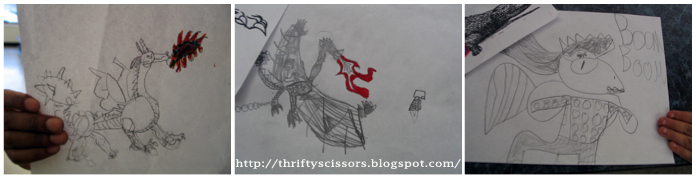
The boys at my work place love to draw mythical creatures. I've included a video here for them to watch at home if they should dare to keep pursuing these animated beasts. Below are some of their recent drawings.
I purchased this book, "Sandy's Circus" as an introductory artifact for future classroom art projects about circus life.
It is the story of Alexander Calder's early life. The book is authored by Tanya Lee Stone and is illustrated
by Boris Kulikov.
Alexander Calder (July 22, 1898 – November 11, 1976) was an American sculptor best known as the originator of the mobile, a type of kinetic sculpture
the delicately balanced or suspended components of which move in
response to motor power or air currents; by contrast, Calder’s
stationary sculptures are called stabiles. He also produced numerous
wire figures, notably for a vast miniature circus.
Alexander "Sandy" Calder was born in Lawnton, Pennsylvania on July 22, 1898. His father, Stirling Calder, was a well-known sculptor who created many public installations, a majority of them in nearby Philadelphia.
Sandy Calder's grandfather, sculptor Alexander Milne Calder, was born in Scotland, immigrated to Philadelphia in 1868, and is best known for the colossal statue of William Penn on top of Philadelphia City Hall's tower. Sandy Calder's mother, Nanette (née Lederer), was a professional portrait artist, who had studied at the Académie Julian and the Sorbonne in Paris from around 1888 until 1893. She moved to Philadelphia where she met Stirling Calder while studying at the Pennsylvania Academy of the Fine Arts.
Sandy Calder's parents married on February 22, 1895; his sister, Mrs.
Margaret Calder Hayes, is considered instrumental in the development of
the UC Berkeley Art Museum.
In 1902, Sandy Calder completed his earliest sculpture, a clay elephant. Three years later, Stirling Calder contracted tuberculosis, and Calder's parents moved to a ranch in Oracle, Arizona, leaving the children in the care of family friends for a year.
The children were reunited with their parents in late March 1906 and
stayed at the ranch in Arizona until fall of the same year.
After Arizona, the Calder family moved to Pasadena, California.
The windowed cellar of the family home became Calder's first studio and
he received his first set of tools. He used scraps of copper wire that
he found in the streets to make jewelry and beads for his sister's
dolls. On January 1, 1907, Nanette Calder took her son to the Tournament of Roses Parade
in Pasadena, where he observed a four-horse-chariot race. This style of
event later became the finale of Calder's wire circus shows.
In 1909, when Calder was in the fourth grade, he sculpted a dog and a
duck out of sheet brass as Christmas gifts for his parents. The
sculptures were three dimensional and the duck was kinetic because it
rocked when gently tapped.
In 1910, the Calder family moved back to Philadelphia, where Sandy briefly attended Germantown Academy, then moved to Croton-on-Hudson, New York. In Croton, during his early high school years, Calder was befriended by painter Everett Shinn
with whom he built a gravity powered system of mechanical trains.
Calder described it, "We ran the train on wooden rails held by spikes; a
chunk of iron racing down the incline speeded the cars. We even lit up some cars with candle lights". After Croton, the Calders moved to Spuyten Duyvil to be closer to the Tenth Street Studio Building
in New York City, where Stirling Calder rented a studio. While living
in Spuyten Duyvil, Sandy Calder attended high school in nearby Yonkers. In 1912, Stirling Calder was appointed acting chief of the Department of Sculpture of the Panama–Pacific International Exposition in San Francisco, California.
He began work on sculptures for the exposition that was held in 1915.
During Sandy Calder's high school years (1912–1915), the family moved
back and forth between New York and California. In each new location,
Calder's parents reserved cellar space as a studio for their son. Toward
the end of this period, Calder stayed with friends in California while
his parents moved back to New York, so that he could graduate from Lowell High School in San Francisco. Calder graduated with the class of 1915.
In 1926, at the suggestion of a Serbian toy merchant in Paris, Calder began to make toys. At the urging of fellow sculptor Jose de Creeft, he submitted them to the Salon des Humoristes. Later that fall, Calder began to create his Cirque Calder,
a miniature circus fashioned from wire, string, rubber, cloth, and
other found objects. Designed to fit into suitcases (it eventually grew
to fill five), the circus was portable, and allowed Calder to hold
performances on both sides of the Atlantic. He gave improvised shows,
recreating the performance of a real circus. Soon, his Cirque Calder (usually on view at the Whitney Museum of American Art at present) became popular with the Parisian avant-garde.
In 1927, Calder returned to the United States. He designed several
kinetic wooden push and pull toys for children, which were mass-produced
by the Gould Manufacturing Company, in Oshkosh, Wisconsin. His originals, as well as playable replicas, are on display in the Berkshire Museum in Pittsfield, Massachusetts. Throughout the 1930s, Calder continued to give Cirque Calder performances, but he also worked with choreographer Martha Graham, designing stage sets for her ballets and created a moving stage construction to accompany Eric Satie's Socrate in 1936.
"Kids made this incredible art after hearing author Tanya Lee Stone read
her picture book about Alexander Calder's circus made of found
materials. The artist's Cirque de Calder is on exhibit at the Whitney
Museum. Stone's picture book about Calder and his circus is called
Sandy's Circus: A Story About Alexander Calder. Illustrations in the
book by Boris Kulikov. Published by Viking Children's Books. (c) 2008" by goldendoodlerule
In drawing, all objects should be studied under the general heads of:
The Copy, or Imitation.
The Object, or Observation.
The Memory and Imagination.
In general, these three divisions should go hand in hand, each helping to explain and make clear the others. But if an order is followed in the study of birds, the best one for young pupils is as follows: (1) The copy; (2) memory and imagination; (3) the object.
This order, however, is not intended to be arbitrary. If the object is something that can be leisurely studied, like a leaf, or a flower, then an order similar to this should be followed: (1) The object; (2) the copy; (3) memory and imagination.
The principle of the construction of all birds is, in general, the same ; the difference is in the proportion and minor details. By learning the proportions and general features from pictures and drawings, much time will be saved, and the work made more effective and less discouraging than if the study is attempted from the living bird alone. This does not mean to blindly copy the drawings of others, but to study them intelligently, to study them with a view of learning their form and proportion and the general principle of bird construction. To learn such points the following: The size of the head as compared with the body; the movement of the tail, head and body; how the feet are placed under the body to give perfect balance; how the wings rest on the body, and their movements when flying. All of these can be studied from drawings coupled with observation, and then verified on the real bird, much better than from the real bird alone. It is doubtful if one untrained in drawing can make very much headway learning to draw from such a restless bit of animation as a live bird, with its multiplicity of markings and numberless details. One must have both knowledge of the bird and skill in drawing to do this.
Balance
Character
Divisions of Study
General Directions
Drill Exercises
Here is a simple sketch of how to draw a bird. Memorize how to
draw birds from these instructions and soon little birds will be dancing
across your notebook in no time.
The circus strongman is one of many acts found in a modern
circus. The strongman demonstrates great strength, power and agility to
the audience. The strongman and strongwomen were very popular
attractions in the circus in the 19th century.
Early strongmen would usually exhibit their awesome strength by lifting
or moving objects which the audience would believe impossible to move.
They would lift anvils, have anvils placed on their chest, bend metal
bars and some were even reported to hold cannons on their shoulders
while an assistant lit and fired the cannon. What do you suppose your
circus strongman or strongwoman could lift? Perhaps an elephant or two
maybe?
First, either draw a circus tent boarder for your bugs to perform inside or print out our blog's free version below.
Here is a circus tent border for you to use.
Second, select the bugs you like best. Give them names and jobs in your
doodle circus, then design the astounding acts your bugs will perform.
I've linked to some creative cartoonists on the web who doodle bugs:
Below is a film of a real flee circus! Before television people would do
almost anything for entertainment. Your circus is an imaginary one,
however, so no bug will be harmed in order to maintain the performances!
The first records of flea
performances were from watch makers who were demonstrating their metal
working skills. Mark Scaliot in 1578 produced a lock and chain which
were attached to a flea. Flea performances were first advertised as
early as 1833 in England, and were a main carnival attraction until
1930. Some flea circuses persisted in very small venues in the United
States as late as the 1960s. The flea circus at Belle Vue amusement
park, Manchester,
England, was still operating in 1970. At least one genuine flea circus
still performs (at the annual Oktoberfest in Munich, Germany) but most
flea circuses are a sideline of magicians and clowns, they use
electrical or mechanical effects instead of real fleas.
Fleas typically live only for a few months and are not trained.
They are also observed to see if they have a predisposition for jumping
or walking. Once sorted, they are harnessed by carefully wrapping a thin
gold wire around the neck of the flea.
Once in the harness the fleas usually stay in it for life. The
harnesses are attached to the props and the strong legs of the flea
allows them to move objects significantly larger than themselves.Jumping fleas are used for kicking small lightweight balls. They are
carefully given a ball; when they try to jump away (which is not
possible because of the harness) they shoot the ball instead. Running
fleas are used to pull small carts and vehicles or to rotate a Ferris
wheel. There are historical reports of fleas glued to the base of the flea
circus enclosure, instruments were then glued to the flea performers and
the enclosure was heated. The fleas fought to escape giving the
impression of fleas playing musical instruments.
Some flea circuses may appear to use real fleas, but don't. A variety
of electrical, magnetic, and mechanical devices have been used to
augment exhibits. In some cases these mechanisms are responsible for all
of the "acts," with loose fleas in the exhibit maintaining the
illusion.Other "flea circuses" do not contain any fleas at all and the
experience and skill of the performer convince the audience of their
existence. In much the same way that viewers know that a woman
won't really be cut in half, the magician's showmanship allows viewers
to suspend disbelief in order to enjoy the show.
* * * * * *
No "big top" for the Flea Circus! This is the way spectators watch the star actors of Prof. William Heckler's Trained Flea Circus in 1930.
Star Actors of the Flea Circus
by ALFRED ALBELLI
Professor William Heckler’s Trained Flea Circus at Hubert’s Museum on
West 42nd St., New York City, proves a great spectacle for the skeptical
to marvel at, and at the same time the professor shows that he has
bridged one of the gaps between science and practical mechanics.
Recently, in the throes of irresistible curiosity, I stood before the
emblazoned billboards of Hubert’s Museum, which proclaimed the
astounding feats of the flea, better known for its annoying qualities.
Flea pulls a merry-go-round.
A ballyhoo gentleman roared through a megaphone that there was a flea
hotel inside. That fleas would engage in a chariot race. That they
could be seen playing football. Prince Henry, a blueblood among fleas,
would juggle a ball. Flea Rudolph woujd operate a merry-go-round. Paddy,
carrying a flag, would jump through a hoop.
The program ended with the Dance of the Fleas, in costume. Greatest
show on earth! Well, from one observer’s point of view Prof, Heckler can
do anything with a flea he trains, and the chances are he could even
send one down to the corner for a newspaper, if he had a mind to. At any
rate, he has done almost as much.
For over eighteen years Prof. Heckler has been making capital of the
recent discoveries made by J. J. Ward, the famous English entomologist.
The British scholar announced the other day that the earwig, a Samson
among insects, is able to pull a toy railway car 530 times its own
weight or to drag a load of pins twenty-seven times its weight.
Scientists went further. They made computations and adduced that the
average man, proportionately as strong as the earwig, would be able to
haul two freight cars along the street, these weighing nearly twenty
tons apiece.
Prof. Heckler has studied all of the flea’s habits until he has been
able to recruit a troupe for a circus, as it is called. This creation of
his goes back to the days when he ran away from home, from his native
Switzerland, to follow the adventures of the sea.
“My first meeting with the fleas,” he related to me, “was while I was
traveling on the Mediterranean. Many of the boats on which I shipped
were infested with these tiny demons. To the amusement of the crew, I
captured some of these fleas and had them doing stunts for them. As I
had much leisure time in those days, I thought up various freak
performances for the fleas. In time I gave up the life of the sailor for
the flea as a career and opened my first Flea Circus at the St. Louis
World’s Fair. Since then my company of trained flea artists has toured
the globe, playing fairs and expositions everywhere.”
He explained that of the 134 or more species, only the human flea,
the so-called pulex irritans, getting its sustenance from human blood,
is intellieent enough to be trained. He takes the insect at a very
tender age and it is put through a rigid training for its life work.
Captive flea being trained.
The performing flea is found in Europe. But those which have been
imported by Prof. Heckler and bred become easily acclimated. They make
their home in chambers inlaid in mother-of-pearl, with white downy
cot-ton as their sleeping quarters. Everything quite cozy!
Training fleas is very difficult and Prof. Heckler guards his secret
conscientiously. For the first lesson the neophyte flea is put into a
bottle which is almost airtight. This is quite possible as he requires
little oxygen.
In this small vessel, the flea, true to his nature, gets rambunctious
and hits off to a jumping spree. And every time he jumps he bumps his
head. Soon he learns that by ceasing to jump he avoids the bumps, and
thereby he passes his first test.
Next in his training course the flea is attached to an instrument
which looks very much like a gibbet. Here he can hop or do any form of
motion, but he is under restraint, of course. The shackles keep him in
tow. It is in this section that the professor selects the dancers from
the strong men, and classifies them. In turn they are garbed in
miniature costumes, befitting their particular bit.
The fleas in this photo have been enlarged 700 times as
compared with
the human figure. They are shown in action
posses from several of the
stunts they perform in the circus.
The Grasshopper, singing
All summer long,
Now found winter stinging,
And ceased in his song.
Not a morsel or crumb in his cupboard--
So he shivered, and ceased in his song.
Miss Ant was his neighbor;
To her he went:
"O, you're rich from labor,
And I've not a cent.
Lend me food, and I vow I'll return it,
Though at present I have not a cent."
The Ant's not a lender,
I must confess.
Her heart's far from tender
To one in distress.
So she said: "Pray, how passed you the summer,
That in winter you come to distress?"
"I sang through the summer,"
Grasshopper said.
"But now I am glummer
Because I've no bread."
"So you sang!" sneered the Ant. "That relieves me.
Now it's winter--go dance for your bread!"
Some of my little charges are very talented. These second
graders spent nearly two hours occupying themselves with
this art project after school.
It seems as though a very unfriendly dragon had wandered
into Medieval Christendom and decided to vent his anger
on a few unsuspecting knights.
However, the knights were not totally unprepared! They had
amassed, over time, an abundance of catapults, spears and goodly
armor for occasions such as these. After all, one can't just let
dragons go wandering about burning down perfectly
good churches and castles!
Oops. Somebody dropped a house on it's side.
If you breath fire you of course eventually become the color of it.
During our discussions about their incredible piece of drawing, I spoke to the boys about another similar artwork depicting historically accurate battles (cough). This one in particular was created by women. A fact, mind you, that these small boys found difficult to swallow.
The Bayeux Tapestry (French: Tapisserie de Bayeux, IPA: [tapisʁi də bajø], Norman : La telle du conquest) is an embroidered cloth—not an actual tapestry—nearly 70 metres (230 ft) long, which depicts the events leading up to the Norman conquest of England concerning William, Duke of Normandy and Harold, Earl of Wessex, later King of England, and culminating in the Battle of Hastings.
According to Sylvette Lemagnen, conservator of the tapestry,
The Bayeux tapestry is one of the supreme achievements of the Norman
Romanesque, ... Its survival almost intact over nine centuries is little
short of miraculous, ... Its exceptional length, the harmony and
freshness of its colors, its exquisite workmanship, and the genius of
its guiding spirit combine to make it endlessly fascinating.
The tapestry consists of some fifty scenes with Latin tituli (captions), embroidered on linen with coloured woollen yarns. It is likely that it was commissioned by Bishop Odo,
William's half-brother, and made in England—not Bayeux—in the 1070s. In
1729 the hanging was rediscovered by scholars at a time when it was
being displayed annually in Bayeux Cathedral. The tapestry is now exhibited at Musée de la Tapisserie de Bayeux in Bayeux, Normandy, France. Read and see more . . .
Art teachers are always looking
for new ideas for teaching this standard paper weave project. This is
because many states require a weave technique be taught to young
students several times before they graduate from elementary school.
Paper weaving is, of course, very inexpensive for teachers to teach.
Above you can see my teacher's sample of the process.
This year, I viewed these examples of paper weaving in a local elementary art exhibit and thought them to be unique interpretations of an old paper weaving requirement. A child's perspective on life is both charming and refreshing when given just a bit of liberty. I particularly love the teddy bear version below.
St. Patrick's day in the morning,
An' I donned a sprig av green,
An' away for the day, wid laughter gay,
Wid me own dear, swate colleen;
Wid Nellie, me blue-eyed darlint;
Wid Nellie, me own colleen!
An' it's gree, I ween, on our brists Is seen
St. Patrick's day in the morning.
Ah! St. Patrick's day at midday--
It is thin the bands are seen,
An' the way they play all the bilased day
At the "Wearing ay the Green!"
Yis, chunes like "God Save Ireland"
An' "The Wearing av the Green,"
An the rhyme an' chime av that chune subline,
"St. Patrick's Day in the Morning!"
St. Patrick's day in the avening,
Whin the sun has gone to rist,
Thin I'll tell me Nell what she knows so well-
Who it is I love the bist.
An' sure it's this I'm thinkin',
Whin I say, "Jist name the day,"
She will say, so gay: "Arrah, now, the day?
St. Patrick's day in the morning!"
In this craft project, students make their own molas from paper instead of fabric. The methods of designing used in reverse applique are the same when using paper. However, the use of paper instead of fabric is much easier to do.
Both the crab and the turtle pictured here
are my teaching samples of paper molas.
Traditional molas are made with fabric and a reverse applique technique.
Several layers (usually two to seven) of different-colored cloth
(usually cotton) are sewn together; the design is then formed by cutting
away parts of each layer. The edges of the layers are then turned under
and sewn down. Often, the stitches are nearly invisible. This is
achieved by using a thread the same color as the layer being sewn,
sewing blind stitches, and sewing tiny stitches. The finest molas have
extremely fine stitching, made using tiny needles.
The largest pattern is typically cut from the top layer, and
progressively smaller patterns from each subsequent layer, thus
revealing the colors beneath in successive layers. This basic scheme
can be varied by cutting through multiple layers at once, hence varying
the sequence of colors; some molas also incorporate patches of
contrasting colors, included in the design at certain points to
introduce additional variations of color.
Molas vary greatly in quality, and the pricing to buyers varies
accordingly. A greater number of layers is generally a sign of higher
quality; two-layer molas are common, but examples with four or more
layers will demand a better price. The quality of stitching is also a
factor, with the stitching on the best molas being close to invisible.
Although some molas rely on embroidery to some degree to enhance the
design, those which are made using only the pure reverse-appliqué
technique (or nearly so) are considered better.
Molas will often be found for sale with signs of use, such as stitch
marks around the edges; such imperfections indicate that the mola was
made for use, and not simply for sale to tourists. A mola can take from two weeks to six months to make, depending on the complexity of the design.
Kuna woman selling Molas in Panama City
The mola forms part of the traditional costume of a Kuna
woman, two mola panels being incorporated as front and back panels in a
blouse. The full costume traditionally includes a patterned wrapped
skirt (saburet), a red and yellow headscarf (musue), arm and leg beads
(wini), a gold nose ring (olasu) and earrings in addition to the mola
blouse (dulemor).
In Dulegaya,
the Kuna's native language, "mola" means "shirt" or "clothing". The
mola originated with the tradition of Kuna women painting their bodies
with geometrical designs, using available natural colours; in later
years these same designs were woven in cotton, and later still, sewn
using cloth bought from the European settlers of Panamá.
More Related Content
The Art of Being Guna, from The San Diego Museum of Man. Retrieved February 19, 2006.
Folk Art: From Mexico - Mexican handcrafts and folk art is a complex collection of items made
with various materials and intended for utilitarian, decorative or other
purposes. Some of the items produced by hand in this country include
ceramics, wall hangings, vases, furniture, textiles and much more.
And Tom went crying [or "roaring", or "howling", in some versions]
Down the street.
The 'pig' mentioned in the song is almost certainly not a live animal
but rather a kind of pastry, often made with an apple filling, smaller
than a pie.
Another version of the rhyme is: Tom, Tom, the piper's son, Stole a
pig, and away he run. Tom run here, Tom run there, Tom run through the
village square.
This rhyme is often conflated with a separate and longer rhyme:
Tom, he was a piper's son,
He learnt to play when he was young,
And all the tune that he could play
Was 'over the hills and far away';
Over the hills and a great way off,
The wind shall blow my top-knot off.
Tom with his pipe made such a noise,
That he pleased both the girls and boys,
They all stopped to hear him play,
'Over the hills and far away'.
Tom with his pipe did play with such skill
That those who heard him could never keep still;
As soon as he played they began for to dance,
Even the pigs on their hind legs would after him prance.
As Dolly was milking her cow one day,
Tom took his pipe and began to play;
So Dolly and the cow danced 'The Cheshire Round',
Till the pail was broken and the milk ran on the ground.
He met old Dame Trot with a basket of eggs,
He used his pipe and she used her legs;
She danced about till the eggs were all broke,
She began for to fret, but he laughed at the joke.
Tom saw a cross fellow was beating an ass,
Heavy laden with pots, pans, dishes, and glass;
He took out his pipe and he played them a tune,
And the poor donkey's load was lightened full soon.
Both rhymes were first printed separately in a Tom the Piper's Son, a chapbook produced around 1795 in London.
The origins of the shorter and better known rhyme are unknown. The
second longer rhyme was an adaptation of an existing verse which was
current in England around the end of the seventeenth and beginning of
the eighteenth centuries. The following verse, known as "The distracted
Jockey's Lamentations" may have been written (but not included) in Thomas D'Urfey's play The Campaigners (1698):
Jockey was a Piper's Son,
And fell in love when he was young;
But all the Tunes that he could play,
Was, o'er the Hills, and far away,
And 'Tis o'er the Hills, and far away,
'Tis o'er the Hills, and far away,
'Tis o'er the Hills, and far away,
The Wind has blown my Plad away.
This verse seems to have been adapted for a recruiting song designed to gain volunteers for the Duke of Marlborough's campaigns about 1705, with the title "The Recruiting Officer; or The Merry Volunteers", better today known as "Over the Hills and Far Away", in which the hero is called Tom.
One of the most commonly used modern versions of the rhyme is:
Hey diddle diddle,
The Cat and the fiddle,
The Cow jumped over the moon,
The little Dog laughed to see such sport,
And the Dish ran away with the Spoon.
Older versions of the nursery rhyme use "craft" instead of "sport" to
maintain the rhyming scheme of AABCCB. In more recent versions the
archaic 'sport' is replaced with 'fun' or 'a sight'.
Hey diddle diddle,
The Cat and the fiddle,
The Cow jumped over the moon,
The little Dog laughed
To see such craft,
And the Dish ran away with the Spoon.
The book comments:"It must be a little dog that laugh'd, for a great dog would be ashamed to laugh at such nonsense." There is a reference in Thomas Preston's A lamentable tragedy mixed ful of pleasant mirth, conteyning the life of Cambises King of Percia, printed in 1569 that may refer to the rhyme:
They be at hand Sir with stick and fidle;
They can play a new dance called hey-didle-didle.
There are numerous theories about the origin of the rhyme, these include: James Orchard Halliwell's
suggestion that it was a corruption of ancient Greek, probably advanced
as a result of a deliberate hoax; that it was connected with Hathor worship; that it refers to various constellations (Taurus, Canis minor, the Big Dipper etc.); that it describes the Flight from Egypt; that it depicts Elizabeth, Lady Katherine Grey, and her relationships with the earls of Hertford and Leicester; that it deals with anti-clerical feeling over injunctions by Catholic priests for harder work; that it describes Katherine of Aragon (Katherine la Fidèle); Catherine, the wife of Peter the Great; Canton de Fidèle, a supposed governor of Calais and the game of cat (trap-ball). This profusion of unsupported explanations was satirised by J.R.R. Tolkien in his fictional explanations of 'The Man in the Moon Stayed Up Too Late'. Most scholarly commentators consider these unproven and that the verse is probably meant to be simply nonsense. The melody commonly associated with the rhyme was first recorded by the composer and nursery rhyme collector James William Elliott in his National Nursery Rhymes and Nursery Songs (1870).